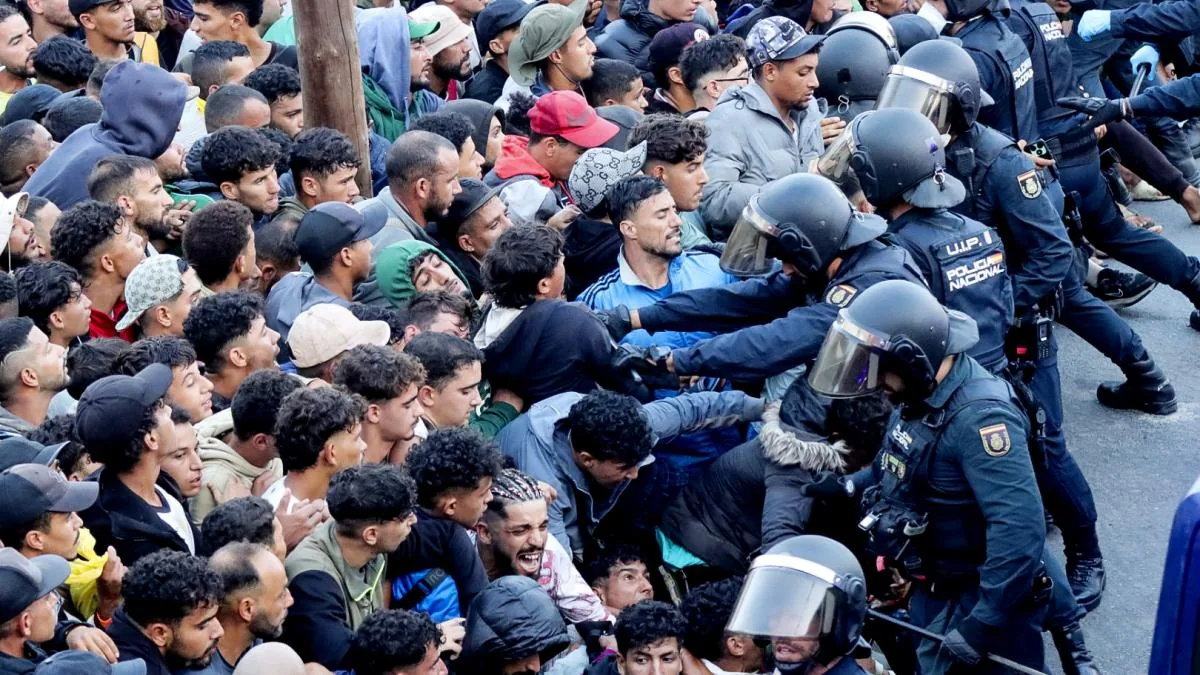
Italy is preparing to extend border controls on passengers arriving by plane and boat from Spain. The temporary suspension of Schengen between the two countries, which came into effect on August 1 due to the Ceuta migration crisis, had an initial duration of one month. According to the communication sent by the authorities in Rome to the European Commission, it expires on August 31, so everything should return to normal from Tuesday onwards.
Read more Albares sees behind the Ceuta crisis the drive of the “reactionary international” networks
However, after several days of total uncertainty, Giorgia Meloni’s government is preparing to extend it, likely for at least another month.
For now, no formal decision has been made and, if the extension is finally confirmed, Italy will have to send a new communication to Brussels. Government sources now point to a “worsening of the situation in Ceuta” and possible terrorism risks as arguments to justify it. This last element, however, was not among the reasons included in the communication sent to Brussels to introduce the controls on August 1.
By mid-August, the possibility of an extension began to circulate among members of the Italian government. And this despite the fact that the controls have not yielded significant results: very few people in irregular situations have been detected and none coming from Ceuta. The practical effectiveness of the measure has therefore been limited, but the political element remains.
The confrontation with the Spanish socialist government has not toned down throughout the month. This very Friday, during his appearance in Congress, Spanish Foreign Minister José Manuel Albares again accused Italy of “lack of solidarity” and of having acted in a partisan way to gain political advantage from the crisis. Words that have not gone unnoticed in Rome.
Read more Serbia will bury Ratko Mladić with honors, convicted of genocide in Bosnia
One of the possibilities being considered by the Italian government is to coincide the end of the Schengen suspension with September 6, the date until which Spain decided to maintain the measures adopted in response to the Italian ones. But even that solution does not guarantee the end of the standoff, as Madrid could opt for a new extension at that time.
During this month there have been practically no contacts between the Spanish and Italian authorities. The only exceptions, sporadic and isolated, have been some communications between the interior ministries, led in Rome and Madrid by Matteo Piantedosi and Fernando Grande-Marlaska, two ministers with a more technical than political profile who also maintain a good personal relationship.
The situation is very different between the foreign ministers, José Manuel Albares and Antonio Tajani, whose relationship is poor, which has contributed to further complicate diplomatic relations between the two countries. And this despite the work, highly valued in both capitals, of the respective ambassadors, Miguel Fernández-Palacios in Rome and Giuseppe Buccino Grimaldi in Madrid. Between the political battle, ultimatums, and snubs, it does not seem to be the hour of diplomacy.
Read more Retirees will be able to return to work as self-employed and keep part of their pension