Saxony opens the dance, we said last week in the first Peninsulas of this course. We were referring to a long electoral cycle that will be decisive in America and Europe. General elections in Brazil (October 4). Midterm legislative elections in the United States (November 3). Parliamentary elections in Sweden, Latvia, Italy, Spain, Greece, and Poland between 2026 and 2027. Presidential elections in France in the spring of 2027. Regional elections in Germany, which will gradually show the pulse of a country tormented by the risk of a severe industrial decline. This is the calendar. At stake are the intensity of Donald Trump’s second term, the balance of power in the United States, and the fiber of the new far-right international, increasingly influential worldwide. The main country in Latin America is on edge. And the future of the European Union spins on the roulette. It is no small matter.
Read more The UAE reportedly warned Netanyahu of a major Hamas attack days before October 7
The dance begins and Prussian marches sound. It was foreseeable, as we pointed out last week, but the punch this weekend in the federal state of Saxony-Anhalt resonates throughout Europe. Conventional German politics has been humiliated by a young far-right party that two years ago was not admitted to the Patriots for Europe platform due to its ambiguous positions regarding the Nazi period, which particularly unsettled the French National Rally of Marine Le Pen. Georgia Meloni also did not want them in her European parliamentary group (Conservatives and Reformists), shared with the Polish ultranationalists of the Law and Justice party and other smaller groups from the Czech Republic, Sweden, Denmark, and Finland. To date, Vox has formally kept its distance from the Alliance for Germany (AfD) but has closely followed its steps.
Also read
A German party that calls for ending the examination of conscience for the Nazi period puts many people on guard. Two years ago, AfD was somewhat feared by other hard-right parties. Its resounding victory in Saxony-Anhalt will change many things. They will be admitted to rooms that were previously off-limits. They will have more support from the current United States administration.
They will surely be able to govern. AfD has not reached an absolute majority but has shattered the scene by surpassing 43% of the votes, with the consequent collapse of the conservative CDU, the party of Federal Chancellor Friedrich Merz. It is likely they can obtain support from the singular BSW party, a sovereigntist formation that declares itself left-wing and opposed to immigration, which has managed to surpass the 5% threshold. The acronym BSW stands for Sahra Wagenknecht Party in German, founded after splitting from Die Linke, a group equivalent to Spain’s Podemos in its most vigorous times. Mrs. Wagenknecht was a member of the SED, the communist party of the former German Democratic Republic, and is married to Oskar Lafontaine, former leader of the SPD’s left wing, who in 2007 left the Social Democrats to found Die Linke. It is likely that AfD can govern with some kind of parliamentary agreement with BSW, which could turn the former Saxon province of the Kingdom of Prussia into a unique political laboratory: a hard far-right program, overseen by ex-communists opposed to mass immigration.
Perhaps this is the best way out for Chancellor Merz, at a very low point after the humiliation suffered by his party. The CDU has not been able to go beyond 17% of the votes. The CDU is losing East Germany. Applying the cordon sanitaire to a party that has just surpassed 40% could be counterproductive.

AfD experiment with possible critical support from BSW. Both formations are hostile to immigration and share another relevant point: they want friendship with Russia and to stop helping Ukraine. One of AfD’s program points is strengthening the teaching of the Russian language in Saxony-Anhalt, as in the times of the GDR. Vladimir Putin must be smiling in Moscow. Lieutenant Colonel Putin was head of the KGB station in the city of Dresden, which belongs to the neighboring state of Saxony, also in East Germany. One day he had to burn papers and hastily pack his belongings because Mikhail Gorbachev, General Secretary of the Communist Party of the Soviet Union, had decided to abandon the USSR’s tutelage over Eastern Europe, trusting that the West would help finance his reforms, which did not happen. Russia withdrew from Eastern Europe without firing a single shot, without even imposing conditions on Germany’s reunification. Putin and most young KGB officers considered it a grave mistake.
The war in Ukraine is largely a consequence of that moment. The electoral punch this weekend in Saxony-Anhalt could also be said to be. The German political forces that agreed on the terms of reunification in 1991 (the CDU-CSU and the SPD, Christian Democrats and Social Democrats) have barely added up to 26% of the votes in the former Prussian Saxony, a small state with 2.1 million inhabitants, aging (average age 48), with more men than women, few young people, few immigrants, and the lowest wages in Germany. Allow me a clarification in this regard. Many Spanish regions would like to have the per capita income of Saxony-Anhalt (36,517 euros), higher than the Spanish average (32,633 euros). The unease of societies is difficult to measure in absolute figures. The dialectic between past and future is usually decisive. The evolution of expectations strongly regulates the mood of people and social groups. In the most disappointed societies, a painful contrast is often perceived between the glories of the past and the uncertainties of the future.
(Currently, there are three federal states named Saxony in Germany: Lower Saxony, in the northwest, whose capital is Hanover; Saxony (capital, Dresden) and Saxony-Anhalt (Magdeburg), in the east. The Saxony that voted this weekend was a province of the Kingdom of Prussia and merged with the former Duchy of Anhalt in 1945, under Soviet supervision. Anhalt was the German territory where, in 1932, the Nazi Party won elections for the first time. I would like to thank Mari-Paz López, correspondent for La Vanguardia in Germany, for her patience and generosity in explaining to me these days some of the keys to Germany’s territorial division, a true walk through European history).
Read more The 72 hours in the new immigrant detention center in Ceuta that will test Morocco’s cooperation
A glorious past, an uncertain future. AfD has surpassed the 43% barrier by feeding two nostalgias: the greatness of Prussia and the quiet life in the German Democratic Republic. It has been written many times that the GDR inherited and assimilated much of the Prussian spirit: discipline, method, sense of duty, statism. Its soldiers wore Prussian-style uniforms and marched with the goose step. Let’s make Prussia great again. Let’s be strong and disciplined like Prussia. Let’s live peacefully like in the GDR. There is the AfD formula. They have nailed it.
Saxony-Anhalt, we recall last week, was the cradle of the Augustinian friar Martin Luther, father of the Protestant Reformation, a rigorist turn of Roman Christianity. Also born there were the painter Lucas Cranach (the Younger), austere portrayer of the Reformation, the composer Händel, the philosopher Friedrich Nietzsche, creator of the myth of the Superman (the individual who knows how to leave behind the morality of the herd to create his own scale of values); and Prince Otto von Bismarck, the Iron Chancellor, main minister of Prussia who carried out the great German unification of 1871, becoming the first chancellor of the German Empire. Bismarck devised the world’s first modern social security system in 1880. He fought socialists and at the same time promoted a protection system, paid by employers and workers, that offered health insurance, work accident insurance, and a small pension for old age.
Saxony-Anhalt: a glorious past, a gray future. AfD has galloped through that breach. A great increase in voter turnout (almost 250,000 additional voters), especially pronounced in rural communities, the areas most affected by depopulation, the decline of the female population, and income erosion. Voter turnout has increased more in those polling stations where AfD was already first in the 2021 elections and in those areas where old marginal far-right formations had some roots. AfD approaches 50% in small rural municipalities, wins comfortably in towns of between 20,000 and 50,000 inhabitants, and barely exceeds 30% in the largest cities, where Greens and Social Democrats obtain their best results, according to data collected by German researcher Julius Kölzer.
A party whose main fuel is mature men who feel frustrated in a declining rural environment, where women are lacking, has just humiliated the coalition that governs the most powerful country in Europe, a very strong country that feels insecure again in the face of the furious gale of the digitized world. AfD’s overwhelming victory in Saxony-Anhalt has acquired a strong symbolic character. “The dikes are giving way one by one, with a regularity that should alarm us,” wrote former French Foreign Minister Dominique de Villepin, tireless on social networks. It is very possible that France will decide Europe’s future in the presidential elections of spring 2027.

AfD imitators will appear. We will see greater radicalization of European far-rights. It is already happening in Italy. A new party named National Future, led by paratrooper General Roberto Vannacci, draws from Germanic sources. Vannacci tries to outflank Prime Minister Meloni on the right, with a neofascist program without camouflage, invoking an Italy anchored in “Roman-Germanic” Christian values, proposing tax and social contribution cuts, apparently without touching pensions. And promises a firm hand: more authority for the police, sealed borders, deportation of immigrants, and systematic control of radio and television broadcasts so they do not promote homosexuality. He also proposes distancing from Ukraine. This summer, Vannacci has not stopped promoting himself shirtless, emulating a famous image of Benito Mussolini in 1925, when for the first time in history a European head of government appeared shirtless from the waist up on newspaper covers and in cinemas, leading the “Battle for Grain,” a summer campaign for wheat harvesting.
Meloni, politically formed in the Italian Social Movement, a post-fascist party founded in 1946 after the postwar amnesty, has tried another path. “Non rinnegare, non restaurare.” (“Do not renounce, do not restore”) was the MSI motto. Meloni has tried to turn her current formation, Brothers of Italy, into the Party of the Nation, a new central force, rooted in fascism, seeking the large vote warehouse of Christian Democracy. She has always asked her followers not to fall into the folklore of the black shirts. She wanted to be very friendly with Trump, but also with Ursula von der Leyen and Manfred Weber, president of the European People’s Party; very conservative, a great admirer of Benedict XVI and at the same time very cordial with Leo XIV. Trump got angry with her because she did not support him in the Iran war, and after a few weeks, an invisible hand propelled General Vannacci. Meloni’s aggressiveness with the Spanish government immediately after the Ceuta crisis is related to that conjuncture. If Vannacci gets 15% of the votes, he could kidnap her.
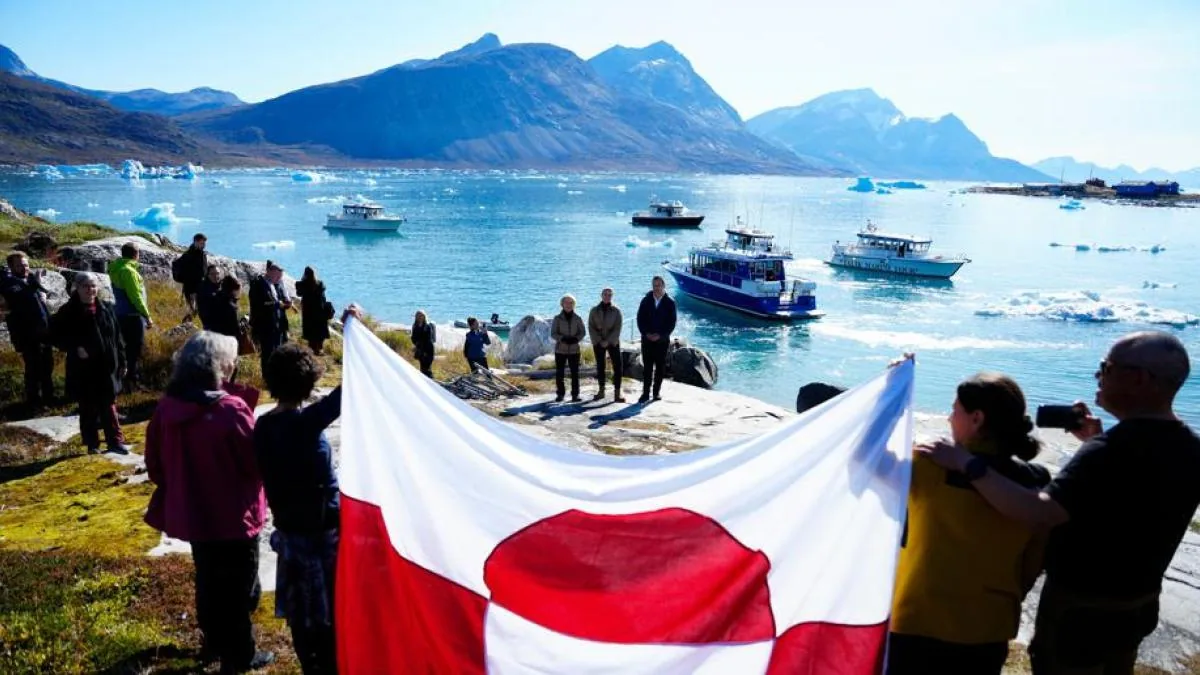
The colossal Ceuta crisis — that immediate spot of Elon Musk on July 30, in which thousands of wild zombies storm the walls of a fortified city — a badly managed crisis that keeps Spain in shock. The EU’s defeat in the recent referendum in Iceland on resuming accession negotiations. (To compensate, Von der Leyen visited the Danish island of Greenland yesterday). And the blow to democratic Europeanism in the Saxony-Anhalt elections. The course begins with a Prussian soundtrack. They smile in Washington. In Moscow, too.
Read more Vivas demands more firmness from Brussels in the European relationship with Morocco