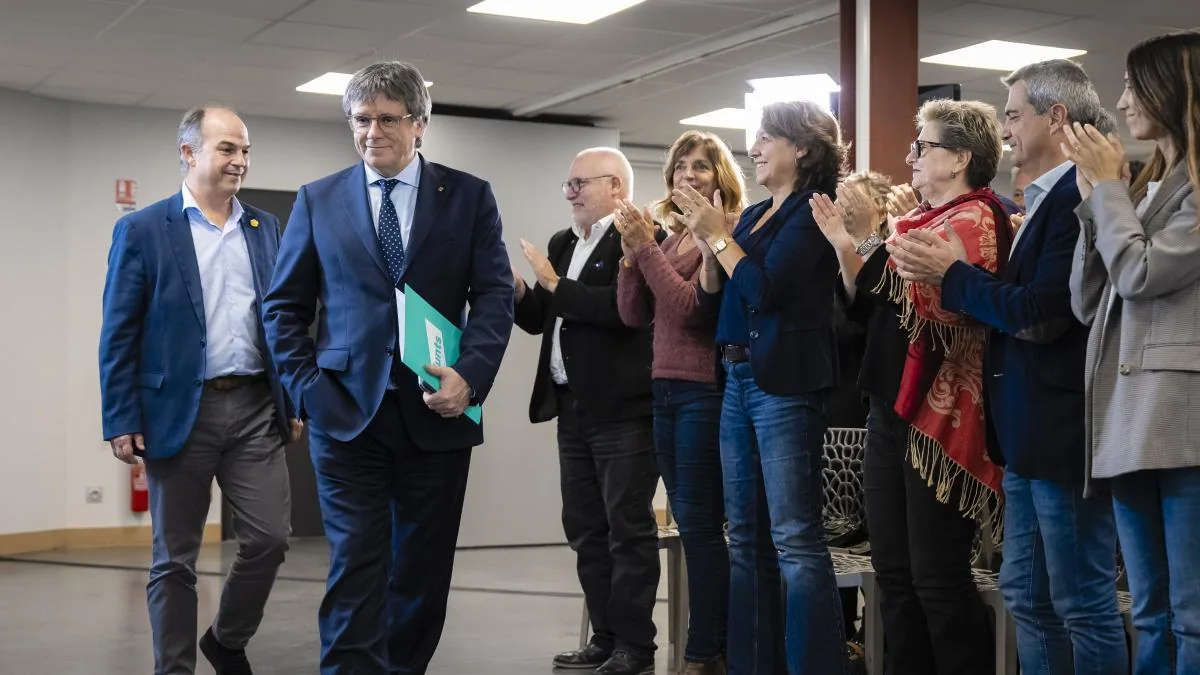
Judgment of the Court of Justice of the European Union (CJEU) did not alter the dynamics of recent months, during which former president Carles Puigdemont has stayed away from the spotlight. Jordi Turull, secretary general of Junts, pointed out that Thursday’s script – only he and lawyer Gonzalo Boye spoke – was designed not to raise expectations… Although the ruling was labeled a “resounding victory,” “it is not final,” they argue. And politically everything remains frozen awaiting clarity on the former president’s future, with a PSOE that is watching the next moves of the post-convergent party.
Read more Objective: reverse the amnesty
After the CJEU ruling, Junts is now rallying to try to reverse the rise of Aliança Catalana, supported by recent polls, aware that there is still a way to go in the courts and that there are no guarantees that their leader’s return will be immediate. The Constitutional Court and the Supreme Court hold the ball in their court, and this time caution prevails when making predictions about the timeline.
With these cards, a certain provisional situation remains within the party, and until Puigdemont sets foot in Catalonia, doubts surrounding the party in a pre-election year will not dissipate. Several debates are delayed awaiting the former president’s decision on what he will do and whether he will continue as leader – the plan is to take the political pulse when he returns to decide what is best and, above all, respect his will – which causes nerves and uncertainty among some cadres who want to know how the second half of the Catalan legislature will be approached or if the JxCat president will run again as candidate for the Generalitat. Otherwise, these sources say, a lead candidate would have to be designated and the future prepared, even if that means holding primaries, as in Barcelona.
Supporters and detractors of the JxCat leader see his return as urgent amid negative polls
That is why everyone wants Puigdemont to return as soon as possible. Both his supporters – who pin everything on his return and believe it will be a boost – and those who think a new stage must be opened and express concern about the polls, where Sílvia Orriols’s party is gaining ground. If the official message is that “the page is not turned,” within the organization some believe the political scenario has changed chapters.
In the PSOE, they are not unaware of all this and also make their calculations. They have long believed that the return – which has not yet happened – could open “a window of opportunity” to try to mend broken plates and even approve the general state budgets – the first and last of the legislature – although we are on the doorstep of municipal elections and the mystery remains about when the general elections, scheduled for a year from now, will be held.
The post-convergent party separates both issues and maintains the demand set at the start of the legislature: To talk about the next budgets, the money not spent in Catalonia in previous years must be paid with a direct transfer to the Generalitat.
Read more The legislature of amnesty (for better or worse)
Turull has made it clear these days that he has not exchanged messages with the socialists nor with the Prime Minister, Pedro Sánchez, after the CJEU ruling that both JxCat and PSOE celebrated. He adds that there is nothing to discuss beyond parliamentary courtesy and complains about the breaches of the agreement made in Switzerland, which they attribute to the PSOE. “Nothing changes,” he asserted about the ruling.
Puigdemont’s lawyer has also accused the Government this week of having lied to the Junts leadership about the deadlines for applying the amnesty and considers that if the Constitutional Court has not resolved last year’s appeals for protection, it is for political reasons. To make matters worse, the message from Minister Óscar Puente advising Puigdemont’s return, even if it means going to prison, was not well received, and JxCat attributes it to an attempt by the socialists to close a matter, the amnesty, which remains alive.
At Ferraz they defend that dialogue is possible; the post-convergents refuse to negotiate
Anyway, there are several open fronts, and if there is no contact between the leaderships – officially – there is contact at another level, as seen with the tax cuts approved by Moncloa due to the rise in energy prices following the Iran war. The same could happen in housing now that the central government is opening the door to including tax cuts in a new decree law. It remains to be seen what position Junts will take on the financing model, whose processing could be allowed despite rejecting it, or with the cancellation of the FLA, a measure they want to modify in the amendment process to benefit Catalonia more.
Junts replies that they support measures that are good for Catalonia, even if they come from Moncloa, and that contact is purely technical. And if with the PSOE they say there is nothing to talk about, they also do not want to hear the PP’s tune about a motion of no confidence, even if instrumental. It would force them to take a position.
Turull encourages “turning around” the rise of Aliança Catalana
The secretary general of Junts made a call to the municipal cadres of Junts to “turn around again” the “malicious and defeatist forecasts” drawn by polls like the recent CEO one, which supports a ‘sorpasso’ by Aliança Catalana. “We have a project. If we persist, we will succeed; and many of the flashes there are now will be blown away by the wind,” said the leader at the National Council held yesterday, where he also emphasized the “victory” represented by the CJEU ruling on the Amnesty Law. Turull appealed to perseverance and political coherence, which in practice translates into “maintaining the position” in favor of “integration and cohesion,” and not falling into “stigmatization, labeling, and hatred,” which he attributed to the ultra competition of Sílvia Orriols. The leader admitted the “demanding” and “complicated” scenario presented by the polls but defended Jordi Pujol’s postulates on the “plural reality” of Catalonia. “Our strength has never been uniformity, but the ability to integrate, to add, to make very different people feel involved,” he proclaimed.