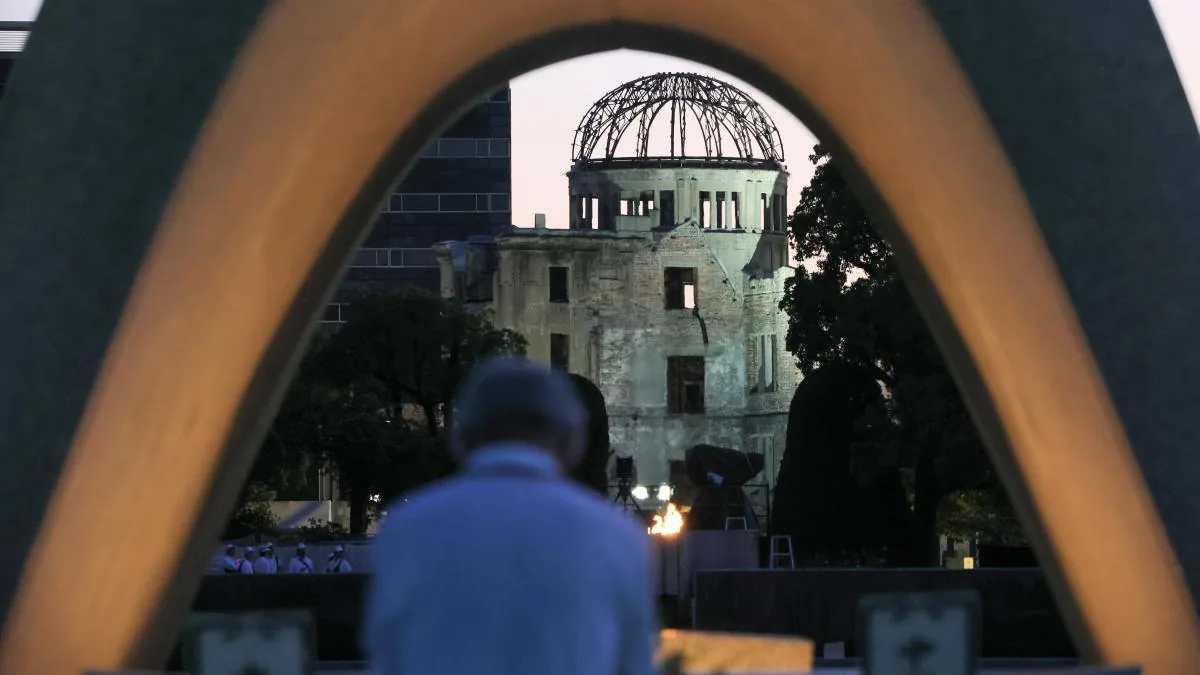
“Trust in peace.” The message printed on Keiko Ogura’s t-shirt, a survivor of the atomic bomb, summarizes the identity that Japan built after the United States’ nuclear attack on Hiroshima and Nagasaki.
Read more The Anti-Fraud Office opens a file on the hiring of Orriols’ daughter as a local police officer
Ogura has dedicated her life to telling what happened on a day like today, 81 years ago, to warn about the consequences of “pressing the button” of a weapon that killed more than half a million people in Hiroshima and, three days later, in Nagasaki. Although this 89-year-old woman is part of a generation opposed to war, Japan today faces a crossroads: maintaining its pacifist character while being aware of the growing military power of its most threatening neighbors, Russia, China, and North Korea.
The bombing of Hiroshima and Nagasaki marked a before and after in Japan. When on September 2, 1945, the country signed the official surrender that ended World War II, the U.S. took charge of dismantling Japan’s war machinery. To do this, it ordered the drafting of a new Constitution in which Japan “forever renounces war as a sovereign right,” as established in Article 9. In exchange, the U.S. would install military bases throughout the archipelago to guarantee its defense. However, Japan did not completely renounce its right to protect itself by its own means. Thus, in 1954, in a reinterpretation of Article 9, it created the so-called Self-Defense Forces.
Pacifism as a priority that has defined the country in recent decades is called heiwaboke in Japanese. This expression, which can be translated as “peace-induced stupor,” is used to describe those who live in a kind of bubble, supposedly unaware of what is happening outside.
For Ayato, a student at Hiroshima University, the Constitution should be more flexible so that Japan can better prevent a possible attack. He believes that while people of Ogura’s generation maintain a firm pacifist stance, younger people are more open to reviewing the legislation.
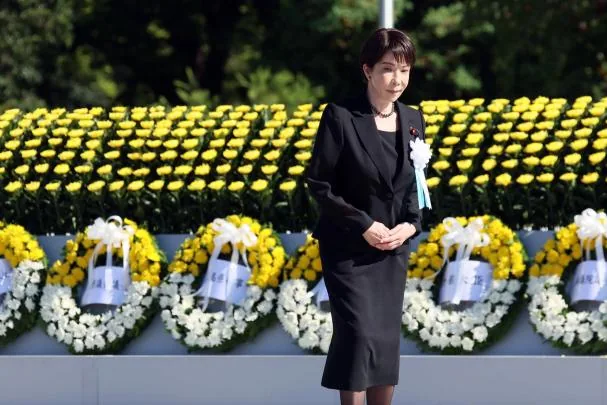
In recent years, the Liberal Democratic Party (LDP), the country’s main political force, has flirted with a possible revision of the Constitution. The current prime minister, the ultraconservative Sanae Takaichi, warned last year that a possible attack by China on Taiwan would open the door to a military response, as it would represent a “threat” to Japan’s survival. In response, Beijing imposed direct economic reprisals on Tokyo, discouraged its citizens from traveling to the neighboring country, and tightened control over the export of products that could have military use.
Hostility with neighbors with whom Japan shares an ocean is not limited to China. North Korea’s ballistic and nuclear programs and Russian expansionism, evidenced by the invasion of Ukraine, have transformed the value that Japanese pacifism held for decades.
New course
Japan’s defense budget now includes offensive weapons, marking a strategic shift
In 2022, then Japanese Prime Minister Shinzo Abe announced that defense spending would double by 2027, rising from 1% to 2% of GDP. According to data from the 2025 fiscal year, the budget now includes not only defensive missile systems but also long-range cruise missiles. In other words, there is an offensive strategy.
Although the LDP still holds power in the Diet (Parliament), a radical nationalist rise is emerging in the country. Sofia, a Uruguayan linguist living in Japan for five years, says she is surprised that she is always asked: “When will you return to Uruguay?” assuming she will not stay permanently. She believes that policies toward foreigners are becoming harsher and thinks it is a way of “shooting oneself in the foot,” since Japan, the most aged country in the world and one of the most indebted, needs labor.
Although the trauma caused by the war and the atomic bomb remains very alive in Japan, that memory seems to be gradually fading. The growing geopolitical tension and the rearmament process reflect a change in the pacifist strategy. And although since 1967 the country has been governed by the three non-nuclear principles – not possessing, not producing, and not allowing atomic weapons on its territory – international security experts consider it a “latent nuclear power”: it does not have nuclear weapons but could develop that capability in a relatively short time.
The testimony of a survivor
“I opened my eyes and the sky was black”
When the Hiroshima bomb exploded, Keiko Ogura was 2.4 kilometers from ground zero. “I had just turned eight years old,” she says. “My older brother was working in a sweet potato field when he saw something small flying in the sky. It was the bomb,” recounts this survivor. “I lost consciousness after a blinding flash of light. When I opened my eyes, the sky was black. Suddenly, the black rain began. The thatched roofs were on fire, and people threw themselves into the rivers to relieve burns. Some clung to my legs, desperate, asking me for water. I ran to my house’s well and gave them water, but two of them died in front of me. I didn’t know that because of the burns they shouldn’t drink water, and for years I thought I had killed them,” Ogura recalls, who asks to “never forget” what happened. “The only way to survive the trauma of the bomb is to tell my story,” she concludes.