








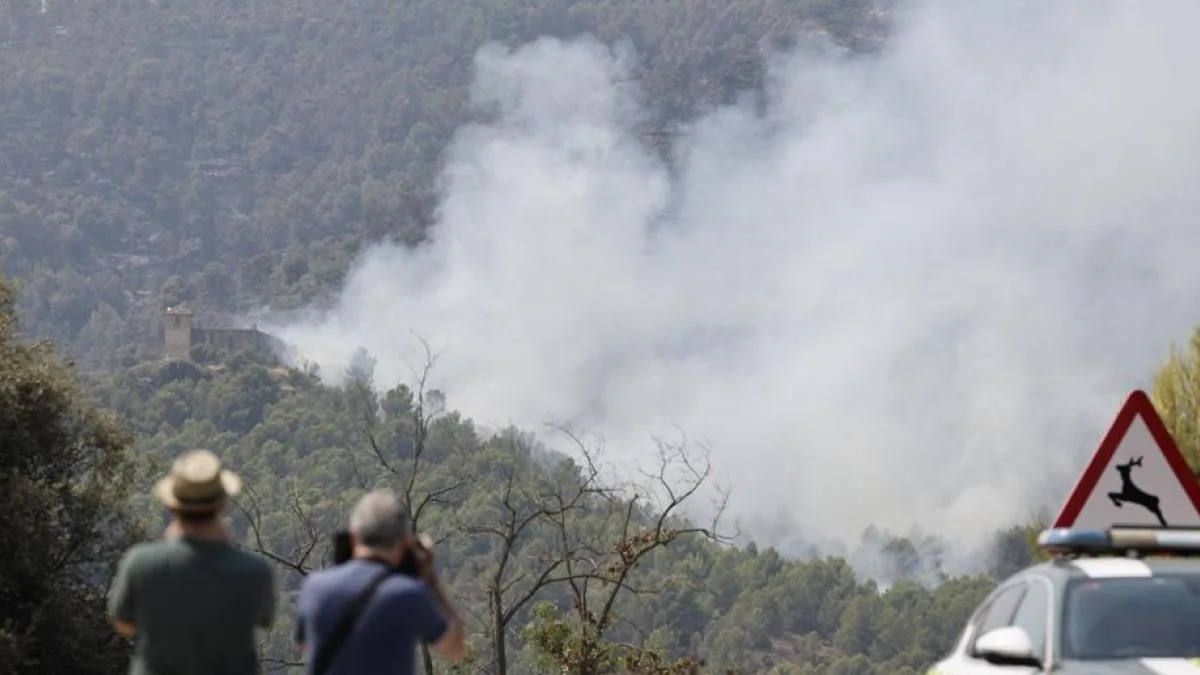
Pollution (smoke, particles…) associated with forest fires significantly increases hospital admissions in the areas affected by these disasters. In this regard, what worries experts the most is ozone pollution, a secondary, harmful pollutant with a powerful oxidizing action mainly on the respiratory system and cardiovascular diseases. This is highlighted in a study published in Science of The Total Environment, and presented by two of its authors, Cristina Linares and Julio Díaz. Both are co-directors of the Reference Unit on Climate Change, Health, and Urban Environment of ISCIII.
Read more The fire in Zamora reduces its danger but forces the evacuation of two new towns
The research team concluded that during biomass combustion episodes in fires, the main impact on hospital admissions was due to ozone. This secondary pollutant has become the “most feared enemy” for health during the disasters that occurred between 2013 and 2018 affecting nine studied provinces (A Coruña, Balearic Islands, Las Palmas, Madrid, Málaga, Seville, Valencia, Biscay, and Zaragoza).
“The greatest finding of our article is that during the days when biomass combustion occurs, ozone causes more than twice the hospital admissions than particles,” says Cristina Linares.
Smoke contains different toxic substances that are transported over long distances
During that period, almost 18,000 hospital admissions associated with fires were recorded in those provinces, of which 8,018 were due to ozone, 5,982 to nitrogen dioxide (NO2), and 3,813 to particles.
Emergency hospital admissions in the mentioned cities caused by PM 10 particles rise from 0.8% on days without fires to 13.9% of admissions on days with fires, while in the case of ozone, the incidence increases from 8.3% to 21%.
“Many toxic compounds are generated in fire smoke and can also be transported many kilometers away, causing health problems in very distant populations,” explains Cristina Linares. “And the particles they emit are much more harmful than the standard material from vehicle traffic,” Linares adds.
“The result is that the population is thus exposed to several risk factors, with special incidence on vulnerable populations, that is, on people who already have a metabolic and chronic disease, as it causes chronic inflammation and oxidative stress…”, Linares adds.
Another confirmed fact is that cities that are normally free of ozone register peaks of this pollutant when a fire occurs. High temperatures also increase this toxicity.
Not being exposed to smoke is the recommendation
The experts’ recommendation to face this pollutant is “not to expose yourself to smoke, protect yourself with masks, stay indoors, and avoid exercise or activities that require respiratory effort,” Linares added in a meeting facilitated by the SMC Spain platform.
Also read
Julio Díaz highlights that ozone, on the dates when there are fires, worsens the baseline pollution already present in cities, which is why he considers it “surprising that the population is only advised to stay in their homes when preventive measures should also be taken to tackle that baseline pollution, and that involves, among other measures, implementing traffic restrictions.” Ozone is formed from NO2 emitted by vehicles, among other precursor pollutants.
Read more Man stabbed to death in a fight at a bar in the La Mina neighborhood