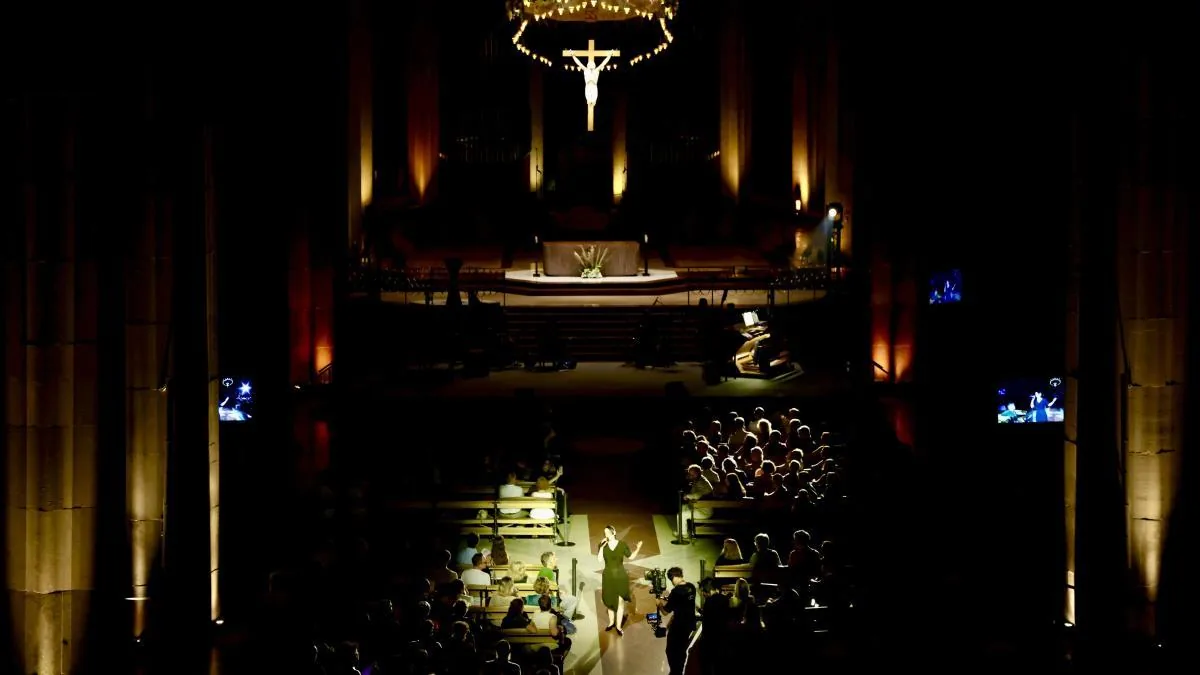
Gaudí took Montjuïc as a reference to build the Sagrada Família: it should not exceed the height of the divine work that is the mountain, so its tallest tower, that of Jesus, measures half a meter less than the place where, among other things, the Teatre Grec is located. Two perspectives, the divine and the classical humanistic past, which this Friday converged in a sacred and profane performance, between the sacred mountain of Montserrat and the spirit of the Grec festival combining the baroque music of Joan Cererols, composed in the 17th century, with the present voices of Lídia Pujol and Maria Arnal.
Read more How are you?
The centenary of Gaudí’s death and the fiftieth anniversary of the Grec converged to foster the concert that started at night, when the basilica’s stained glass windows do not turn the sunlight into a thousand colors. It was the music that showed these Arrels de llum to which the Cor Cererols joined. A song to life, nature, and death as an inevitable end, although not therefore fearful. Nor did the enormous interior of the temple scare – but it did impress – supported by stone trees in a forest of lights and shadows that did not escape the summer heat.
The show was a song to life, nature, and death, inevitable, although not fearful
The same feeling was conveyed by the musicians assembled by Josep Barcons, director of the Espurnes Barroques festival, located on the main altar in this kind of secular inauguration of a basilica that has been a proud neighbor of Barcelona for more than a century.
Also read
“ L’arbre no sap d’on li ve l’esperança ”, sang Lídia Pujol dressed in white, and its echo ran through the entire nave. Thus, she placed the story in nature, admired by Gaudí and reflected both in the green tree that crowns the Nativity facade and in the resemblance of the towers to the stone spires of Montserrat. The most sacred mountain in the country was present through the Mariam Matrem from the Llibre vermell , as well as in the Salve Montserratina by Anselm Ferrer, simultaneously reflecting the devotion Gaudí felt for the Virgin Mary. Devotional were also the a cappella performances by the choir based on pieces by Cererols, whom the composer from Martorell created in the monastery.
Read more The Orés fire burns 14,000 hectares and keeps five towns evacuated
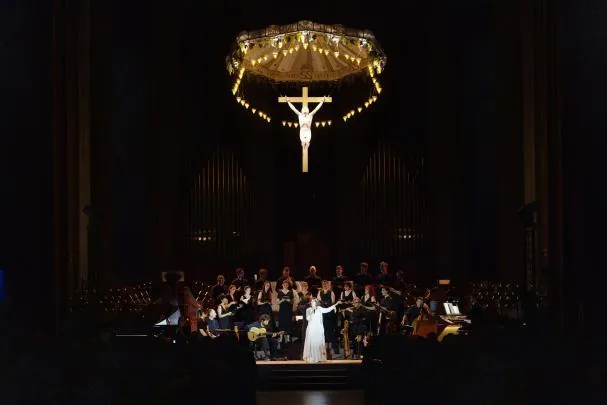
The contemporary arrived with the voice of Maria Arnal, who contributed three songs from her latest album, where she experiments with her voice in Madrigal , combining past and present with a song that continued even when the microphone could not pick it up. In Que me quiten she gave free rein to her passion, although the most sublime was the Ball del vetllatori , a traditional song sung to bid farewell to children from this world, and last night, in a duet with Pujol and to the rhythm of a gentle jota, it was imbued with the absolute silence in which the event took place from beginning to end by express request.
Lídia Pujol contributed the worldly and bucolic Cançó de suburbi , popularized by Ovidi Montllor, so that “ sota el concert de les estrelles/anem fumant tranquilament ”. From her tribute to the ephemeral Cecilia, she rescued Nada de nada , elevated by the choir and the organ. And she closed the concert with that Morir that Maria Mercè Marçal compared to returning to the womb, “ matriu de Déu ” and thus desnacer .
There was also death in the fleeting Requiem by Cererols, as well as Arbor lucis (tree of light), a piece specially made for the concert by Josep Maria Guix, premiered on the night when citizens and nature made God’s house their own with music transformed into liturgy.
Read more How to be deceived