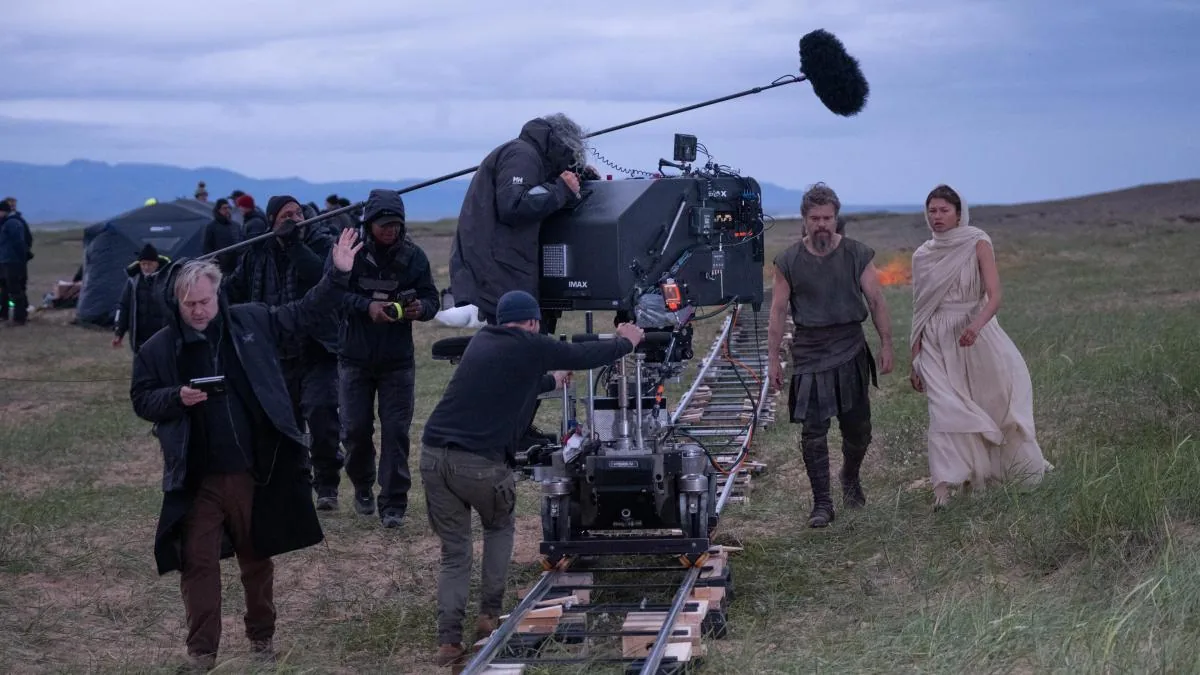
A mid-July morning on the Moray coast in Scotland, near Inverness: the sky is leaden, the sea rough, and the rain falls horizontally. Christopher Nolan makes his way to the pier in search of his maritime advisor, secretly hoping that this will be the first day of the six-month filming of The Odyssey when they tell him: “Sorry, not today, the sea is too rough.” However, the vessel they are filming on — a 35-meter wooden ship from Norway — was built with those conditions in mind. So, although it is clear the experience will be terrible, Nolan is assured it will also be perfectly safe.
In less than an hour, he, his cast, and his crew are being tossed by waves so steep that several supporting actors cling to the railing and vomit. “Excuse me,” Nolan shouts over the storm, signaling to his director of photography, Hoyte van Hoytema. “Would you mind if we filmed the vomiting?” “And credit must be given,” the director says a year later: “They said, ‘Of course, go ahead.’ And that day ended up being fabulous as well as tough; some of my favorite shots of the film came from it.”
Today, Nolan is safe from the weather at the Corinthia Hotel in his hometown, the morning after England’s victory over Mexico in the World Cup. It is the morning of the world premiere of his astonishing adaptation of Homer’s mythological epic. Nolan stayed up until 4 a.m. watching the football match and has to stay awake for the screening later, so he drinks a large cup of his favorite Earl Grey tea to keep going.
Outside, the thermometer nears 32 degrees, but inside everything is cool and calm. Nolan’s unflappable and confident demeanor is what convinces studios to grant him huge sums to carry out ideas that are not obvious hits: a three-hour biography of a theoretical physicist ( Oppenheimer ); a mystery told backwards ( Memento ); a multi-layered heist film where everyone is asleep ( Inception ).
New generations
“Some parts of ‘Backrooms’ are like the darkest of Lynch. And young people love it”
Contrary to what has been published, Nolan insists that The Odyssey is not his most expensive film: that title belongs to The Dark Knight Rises (2012), the conclusion of his Batman trilogy. But, as it is a nearly three-hour adaptation of an ancient Greek poem costing around $250 million, its risk-reward ratio is on par. However, Nolan and his lifelong wife and producer, Emma Thomas, are known for getting the most out of every penny, a skill that goes beyond film production. At the end of the conversation, Nolan takes a jar from his briefcase and methodically pours out the last drop of tea left.
Born in London in 1970 and raised between the British capital and Chicago, Nolan harbored cinematic ambitions from childhood: his first feature, Following (1998), an intricate noir shot on weekends with a tiny budget, was promising enough that when he adapted one of his brother Jonathan’s short stories in Memento , a Newmarket Films executive barely gathered $4.5 million and let him direct it. The result — intellectual, provocative, addictive, and painfully sad — made him a sensation, and his projects became increasingly ambitious: the thriller Insomnia , starring Al Pacino and Robin Williams, and then Batman and beyond.
Critics spent some time trying in vain to pigeonhole him — was he the new Spielberg, Kubrick, or even Lean? — though they have accepted he is a unique case: an explorer of big existential themes like time, regret, and identity, but who also appreciates the simple pleasure of filming a jumbo jet crashing into an airport terminal. Part of the appeal of adapting The Odyssey , he explains, lies in the fact that no one in Hollywood had dared to try it since the silent film era. “Of course, there were all those brilliant works by people like Ray Harryhausen in films like Clash of the Titans ,” says Nolan, whose Odyssey includes a sequence in Hades with a clever homage to one of the scenes from Harryhausen’s 1981 classic. “But he always worked with B-movie budgets. He didn’t have the technology to carry out the fantastic elements on the scale of Cleopatra or Spartacus . So I always saw it as a tremendous opportunity.” An opportunity that only arose after Oppenheimer grossed a billion dollars and won seven Oscars. Universal gave Nolan carte blanche, and he knew what to do.
Whatever the studio expected, it was not that the work would be dragged into a cultural war on the Internet. When it became known in May that the role of Helen of Troy would be played by Kenyan-Mexican Lupita Nyong’o, prominent classicists like Elon Musk and a group of YouTubers whose income depends on getting angry about a film twice a week accused Nolan of capitulating to the woke agenda.
No smartphone
“I can only make progress on my ideas in those moments when everyone is looking at their phone”
Others complained about alleged inaccuracies in costume and ship design, while others — Musk and the YouTubers again — disagreed with casting transgender actor Elliot Page as Sinon, a warrior taken from Virgil’s Aeneid . Despite praise from people like historian Tom Holland, enough controversy was generated for the final trailer to accumulate 600,000 “Dislikes.”
Was Nolan baffled? “It comes with the territory,” he says, smiling serenely, before raising the cup and saucer and taking a theatrical sip. “But look,” he adds, “these debates that arise before people see the film are irrelevant because no one knows what it’s like yet.” Also, he was aware that The Odyssey was exactly the kind of project likely to spark heated comments about how it should be approached. “But remember —” he continues — “I spent ten years of my life working with Batman.”
Read more Tanorexia, a tanning addiction that affects mostly young women
“When I joined Batman Begins , writers and artists had been working on this beloved character for almost 65 years, and there were many preconceived ideas. And what I learned during my time on that trilogy is that you can’t worry about any of that. What you have to do is honor the original text by interpreting it as powerfully as you can.” Readers may recall the initial skepticism around some of Nolan’s boldest decisions in that trilogy, such as casting Heath Ledger as the Joker, then a romantic comedy heartthrob. “In the end, fans of the saga, even when we did something they wouldn’t have done, enjoyed the sincerity of the attempt to bring the best possible version to the screen.” With The Odyssey , he hopes the audience reacts the same way.
What unlocked the adaptation process, he says, was that Homer’s story took place about 400 years before it was told. “Both he and his audience looked back to what they considered a superior civilization, that distant Age of Heroes, and between those moments there had been a social and cultural collapse. They found remnants of that era that seemed beyond their capabilities, like what they called cyclopean walls, made of stones so large they believed only giants could have built them.” The Odyssey , certainly, does not seem like a film by someone who believes human progress is a neat upward curve, I suggest. “Yes, well, Homer didn’t believe that either,” he adds ironically. “But that’s the key. They idealized the past and believed something significant had been lost.”
The key to the script
“Homer idealized the past, a superior civilization, the distant Age of Heroes”
That elegiac tone permeated the filming process. Matt Damon, who plays Odysseus, told GQ magazine that during filming — which took place in Morocco, Greece, Italy, Iceland, Malta, and Western Sahara, as well as Scotland — “he knew it was the last chance he would have to do something like this.” Nolan makes a slight grimace. “I think I know what he meant, because it seems like it’s been a long time since anyone made a film like this in this way, traveling the world, gathering a cast of thousands,” he says. “But there is a defeatist aspect to seeing it that way that I don’t agree with. Cinema is vital and essential, and it keeps transforming: we have new and magnificent young voices who make the medium their own and push it forward.” He highlights Curry Barker and Kane Parsons — the young YouTube talents whose directorial debuts, Obsession and Backrooms , have been among the biggest critical and commercial successes of the year — as proof that things are on the right track.
“That’s why I’ve never believed the arguments that young audiences’ attention spans are too depleted to enjoy a three-hour Greek epic,” he says. “Those films are mysterious and thoughtful. Some parts of Backrooms are like the darkest of David Lynch. But young people love them.” Nolan also says he has been encouraged by Barker and Parsons’ preference for practical effects created on set whenever possible, as well as their ambivalence toward AI. “Never in my life have I seen such a rapid and widespread rejection of what was supposed to be a fundamental technological advance,” he says. “A lot of energy has been devoted to introducing AI, but if you look at that generation’s reaction, they reject it completely.”
He cites his own four children — who are around twenty years old — as another example. “Their judgment on AI’s shoddiness has been immediate and severe. They see it for what it is quickly and find it much easier to identify because it came from an online world they know very well. And while that doesn’t mean all aspects of the technology are useless, in filmmaking it comes at the worst possible time: after years of moving toward highly virtual environments, we are witnessing renewed interest in more tangible and real storytelling forms.”
Nolan’s own distrust of certain technological trends is already almost legendary, although The Odyssey uses a good dose of visual effects, as well as all the other tricks in the cinematic arsenal. He seems especially proud of the cyclops sequence. The giant is played by Bill Irwin, although his enormous size is achieved through a mix of puppetry, animatronics, optical effects, and computer graphics. His face is also lit in the scene where the witch Circe, played by Samantha Morton, transforms Odysseus’s crew into pigs, reshaping their faces like a potter at his wheel. Nolan looked back at some of his favorite transformation scenes from the films he grew up with, like An American Werewolf in London , “where they were largely done in-camera and had a texture that was at once believable, captivating, and repulsive.”
Giving it all
“I consider every film I make as the last I will ever make, and someday I will be right”
There are some technological advances Nolan remains determined not to adopt: he doesn’t have a smartphone. “You’ve all become sheep,” he says laughing. But, although he has no intention of giving in, “I worry the world will eventually bend me. The return of the QR code since the covid pandemic has been especially difficult for me.” Why is he so against it? “Partly because I know I would become terribly addicted to them if I had one. I would spend all my time looking for things. And I can only make progress on my ideas for projects in those moments when everyone is usually glued to their phone: waiting for the train, at an airport, or sitting in a restaurant waiting for someone to arrive for dinner.”
If he had a cinema, would he ban phones? “My usual cinema is the Vista in Los Angeles, run by Quentin Tarantino, and they have a very strict policy for smartphones: go out to the lobby. It’s a wonderful rule.” He doesn’t agree so much with Tarantino’s self-imposed rule of “ten films and that’s it.” “It’s dangerous to see it so concretely. Quentin has his reasons, and I respect them enormously. But I hope he doesn’t stick to them,” he says. For him, the reasoning is a little different: “I consider every film I make as the last I will ever make, and someday I will be right. That’s why I want to give it my all in every project I have in hand. I want every film to be everything.”
Read more World Central Kitchen, from the Middle East or the earthquakes in Venezuela to Los Gallardos
(C) Telegraph Media Group Holdings Ltd