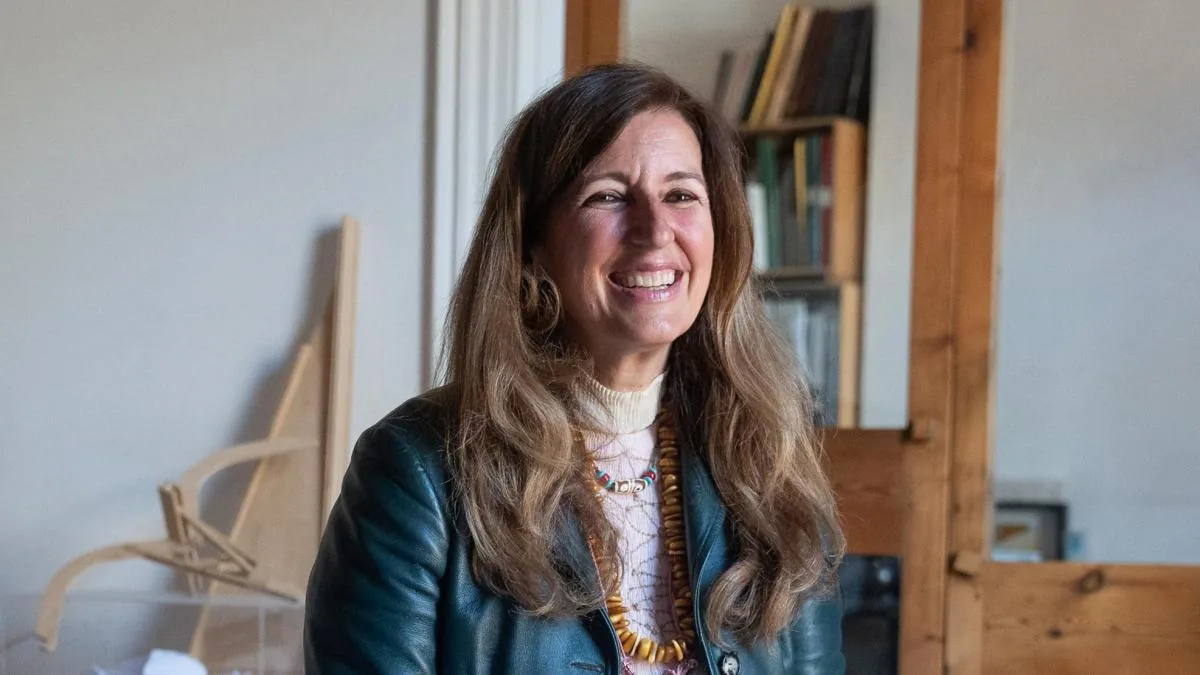
Born in Milan in 1963, Tagliabue overflows with Italian genetics everywhere: her enveloping presence and undeniable elegance perfectly combine with an indomitable character and a conviction when describing her life that many would want for themselves. But perhaps these convictions are not only given by her roots, but also by a very intense life.
Read more Lost inside a closet to assemble
She left her native Italy before even entering adolescence and it was in New York where she met the man of her life, the architect Enric Miralles. Together they moved to Barcelona, where they opened their studio Miralles Tagliabue EMBT in 1994, from where they signed the Scottish Parliament in Edinburgh, the Rectorate of the University of Vigo, the headquarters of Gas Natural Fenosa, and the Santa Caterina Market in Barcelona. But Miralles’ premature death in 2000 forced her to continue leading the studio alone, taking on ten unfinished works by Miralles and starting many others. At 63, Tagliabue now leads a studio with offices in Barcelona, Shanghai, and Paris that works worldwide.
In Longevity we focus on the passage of time, evolution, perspective, reflection, and old age. An aspect that people often try to camouflage, but in architecture it represents an added value…
I love it, perhaps because I was educated in Italy, in Venice, a city that precisely enchants you with the passage of time. It’s this thing about humidity, about nature eating away at buildings, so that the city becomes natural and takes on a certain romantic beauty. I would like the buildings we make to seem as if they have always been there.
When you design a construction, a building, does time condition you? That is, do you work thinking that the building has to be able to surpass eras and fashions?
Of course I think about it, yes! But you do what you can because obviously you are conditioned by your time, by the materials you find, by the way of thinking of the moment… When you see a building, you usually know which era it belongs to, and that is a game I often play on the historic streets of Italy: guessing the era of each building. Some buildings from certain eras are still alive, still speak, and are still relevant, and this is what I try to give each time I raise one, that strength. It’s not easy, but it’s something we keep very present.
Recently, precisely the Higher Council of the Colleges of Architects of Spain awarded you the Permanence Prize, which recognizes those works that stand out, after twenty years, for their proper aging and adaptability. Specifically, you received it for the Santa Caterina Market in Barcelona. Congratulations!
Thank you! It’s a good initiative because it’s a prize that was established recently and that precisely invites you to look twenty years back to see which of the buildings made at that time still touches the heart. Last year we won with the University of Vigo and this year we repeated with Santa Caterina.
Benedetta, why do you think people do the opposite and try to hide the years?
You’re absolutely right! In architecture there is a collective feeling, but on a personal level we don’t like the idea of dying. No one wants to disappear and that’s why there is this individual fight against time. But if we didn’t die, society wouldn’t move forward. It would be a disaster! Imagine if all of us alive were here forever. We couldn’t have more children, we wouldn’t evolve, and it would be terrible! This aesthetic of natural and romantic buildings that we mentioned can’t be applied to people, but that’s what happens when we die, we become part of the earth. We should be able to respect that, but we have a contradiction between our individuality and the collective good, which sometimes come into conflict.
In architecture there is a collective feeling, but on a personal level we don’t like the idea of dying
Benedetta Tagliabue
I don’t know if this will to permanence also tries to be sought in your personal life. Are you worried about the legacy you will leave, what will remain of you the day you are no longer here?
Of course I’m worried! Spiritual life is less in vogue now, but I’m very interested. I think it’s very important to have a way of doing and behaving, and to be an example and a model for the generations that come after.
With your feet on the ground and talking about more mundane things, an example of life is the Italian one. Good food, a good car, movie-like landscapes, the “dolce far niente”… Do you think Italians are an example when it comes to enjoying life and the small pleasures?
I think so. Italy has been a very complicated place with a very complicated history as well. In Roman times maybe we were a great empire, but then we went through wars and never quite had clear what our nation was, our leader, our king. This has made Italians a people who have always adapted and tend to live in the moment, appreciating the small things.
Also read
At what age did you leave Italy, Benedetta?
When I was fourteen and went to study in Switzerland. Then I returned to study at university in Venice, and then I went to New York. There I met Enric Miralles and then I came to Barcelona.
Read more “La analog quantum computing is very useful for emulating nature”
Do you think that Benedetta who was just starting to defend herself in the world of architecture has changed a lot from the current one?
Surely, because back then I was very young. But I think I more or less already had the same desire to do many beautiful things. Now I understand that this restlessness, this entrepreneurship, comes a lot from my genealogy, from where I come from. In northern Italy there are many small entrepreneurs and people work a lot. That same spirit, the desire to do, the desire to invent, I felt very early. It’s what we said: we think we are individuals, but deep down we are collective.
This attitude of trying, launching yourself, and innovating doesn’t always succeed. At least not on the first try. Do you consider that at certain moments in life you have been wrong?
Yes, but doing things also gives me a lot of security because, if it works out, you realize that this strength of believing in yourself and insisting is important. More than trying and failing, often you have to adapt. You were going in one direction, you find a wall and you stop. And you go to one side… And you find a way out! I strongly believe in this possibility of adaptation that we humans have.
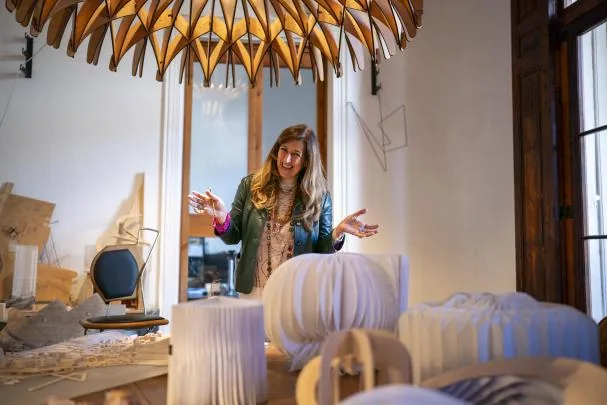
Have you had to adapt a lot at this stage of life? Do you do things very differently than before?
I would like to, but it seems to me that in this sense I am still very adolescent. I have the same impulsivity I have always had. But maybe one thing I have learned is to have respect, respect for others, to try to maintain good manners, because often we go very fast and we have a kind of disdain for each other. Life has taught me that respect for those around you is fundamental. You never know where things come from, why, and that’s why throughout my life I have tried not to crush anyone.
What is important to you, Benedetta? What can’t be missing in your life now?
I’m not a very constant person and I don’t have routines that I have to do inevitably every day, but I think there are many important things. Getting up in the morning, breathing deeply, going to the park and taking a walk with my dog every day, for example. I also do tai chi with a group of friends and sometimes I go to the sea with the dog. And seeing friends and cultivating family. There’s a lot of work because I also have the studio and the job!
You never know where things come from, why, and that’s why throughout my life I have tried not to crush anyone
Benedetta Tagliabue
Exactly! You are precisely keeping a very intense work pace, Benedetta. Have you ever thought about taking it easier?
The truth is I’m not able to consider it. This process depends a bit on genetics. When I was little, I asked my father when he would retire and he told me never. He had his small industry and when he left it, he continued with his interests, his garden… He has even started writing history books now! You change your things, but the important thing is to always have some project in your head.
What is the interest that is currently on your mind?
I’m between the studio and the Enric Miralles Foundation, which is a place where we do more culture, where we talk about architecture topics and do it publicly, because we set up exhibitions and invite international schools to come and do courses and workshops. This balance between the hard work of the studio, which is production, and the cultural work of the foundation, which is reflective, is beautiful. Maybe over time I will give more weight to the foundation.
Any future interest, any dream you still have between your eyebrows to fulfill?
When they ask me this question, I never know what to answer. But if I think… When I was young, I imagined being an architect to make a more beautiful society where we all worked together and lived in community. I think this purpose of creating community is still one of the goals I like the most. It’s not a project you do once and finish, but a philosophy that you apply to each job.
Let’s hope you can keep applying this goal for many years! We will have kinder and more human cities!
Yes! But… there’s one thing I haven’t told you, and that is that from a certain age, which I won’t tell you, I stopped celebrating birthdays. I organize collective birthdays with friends who were born close to me and, above all, I celebrate my dog’s birthday. That way I can hide my age.
Read more Tomás, the deer that traveled 50 kilometers to return to his village in Zamora
And you don’t blow out the candles anymore?
Yes… my dog’s candles!