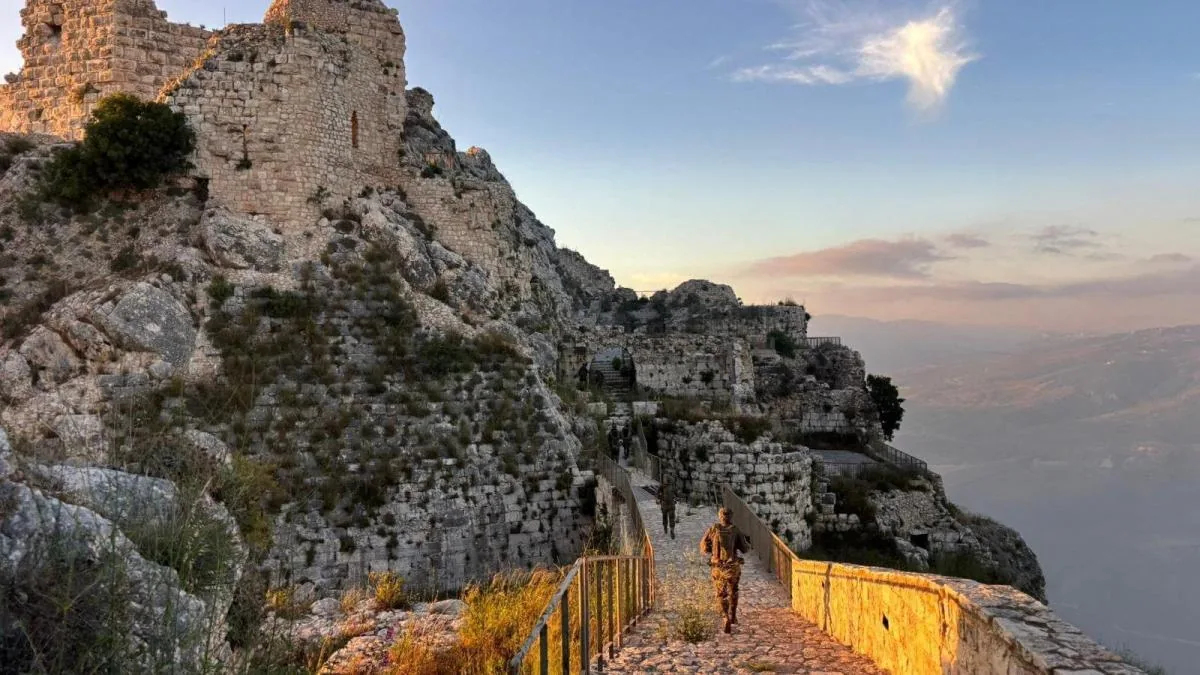
The Israeli flag now flies atop Beaufort Castle, the main lookout point in southern Lebanon. The fortress, built 900 years ago during the Crusaders’ advance towards Jerusalem, is a symbolic but also strategic conquest for the Israeli Army, which is already advancing into Lebanese territory beyond the Litani River.
Read more Carreño is a victim of his battered shoulder and Jódar, the future that is already present
Known in Arabic as Qalaat el Shaqif, the fortress is one of the most important historical and heritage monuments in southern Lebanon, and one of the most significant Crusader castles in the region’s history. It was in Christian forces’ hands until Saladin captured it in the 12th century, and it has the status of “enhanced protection” according to the Hague Convention.
The government has praised this military victory against Hizbulah, which, according to Israeli military sources, used the elevated enclave to launch attacks. “The capture of Beaufort marks a dramatic stage and a drastic change in the policy we are carrying out (in Lebanon),” Prime Minister Benjamin Netanyahu said on Sunday in a video shared on his social media. “Now my directive is to deepen and expand our control over areas that were under Hizbulah’s control.”
This is not the first time Israeli soldiers have walked through the ruins of the Crusader castle. In one of the first battles of the 1982 war, Israel took control of the fortress from Lebanese forces — at that time embroiled in a civil war — and remained in the enclave until the withdrawal in 2000.
At that time, before Hizbulah became one of the most powerful armed groups in the world, Beaufort “became a symbol of deep division within our society,” according to Benjamin Netanyahu. “Today we have returned to Beaufort in a different way. We have returned united, determined, and stronger than ever,” the prime minister said.
Its location is key: from that position, the entire south of the country can be observed and it facilitates troop deployment, who are currently heading towards Nabatiyeh, the main Shiite city in the south and one of Hizbulah’s most important command centers. “We have broken the barrier of fear. We took the initiative. We operate on all fronts: in Syria, Gaza, and Lebanon. We have established security zones beyond our borders to protect our communities.”
Read more Reading or going to the museum, as healthy as the gym?
The Israel Defense Forces (IDF) claim to have killed more than 8,000 fighters of the Shiite militia since October 7, 2023, when Hizbulah, backed by Iran, entered into an intermittent conflict with Israel. The war is now at its peak intensity despite the ceasefire agreed on April 17: more than 3,200 people have died in Lebanon and over a million remain displaced due to the advance of Israeli troops, who already control 20% of the country.
Although the country is in the worst humanitarian crisis in its history, the Party of God refuses to surrender. In recent days, Hizbulah drones have triggered air raid alarms in northern Israel every few minutes. In the town of Kiryat Shmona, located just a few kilometers from the border, a militia projectile destroyed a shopping center that was empty at the time of the attack.
On the other hand, schools in towns and cities near the border with Lebanon will remain closed from Sunday, while the IDF Home Front Command tightened restrictions following the intensification of drone and rocket attacks by Hizbulah against northern Israel over the weekend. Educational activities were not taking place in those communities, including cities like Kiryat Shmona, as well as other localities in the northern area.
In retaliation, the ultra wing of Netanyahu’s government has promised severe revenge against the Lebanese capital. “We need to go against Dahiye, raze it, raze it, and raze it again,” said Israeli National Security Minister Itamar Ben Gvir, referring to the densely populated Shiite neighborhoods in southern Beirut. The United States asked Tel Aviv to stop attacking this area as a goodwill gesture during the truce, although a new attack was reported last week in Hizbulah’s urban stronghold.
“It will take time, but we will complete the mission,” Netanyahu assured, determined to continue the offensive in Lebanon, which now fears that Israeli troops will not limit themselves only to the south.
Read more “Cuba is not Venezuela, because there was no revolution there”