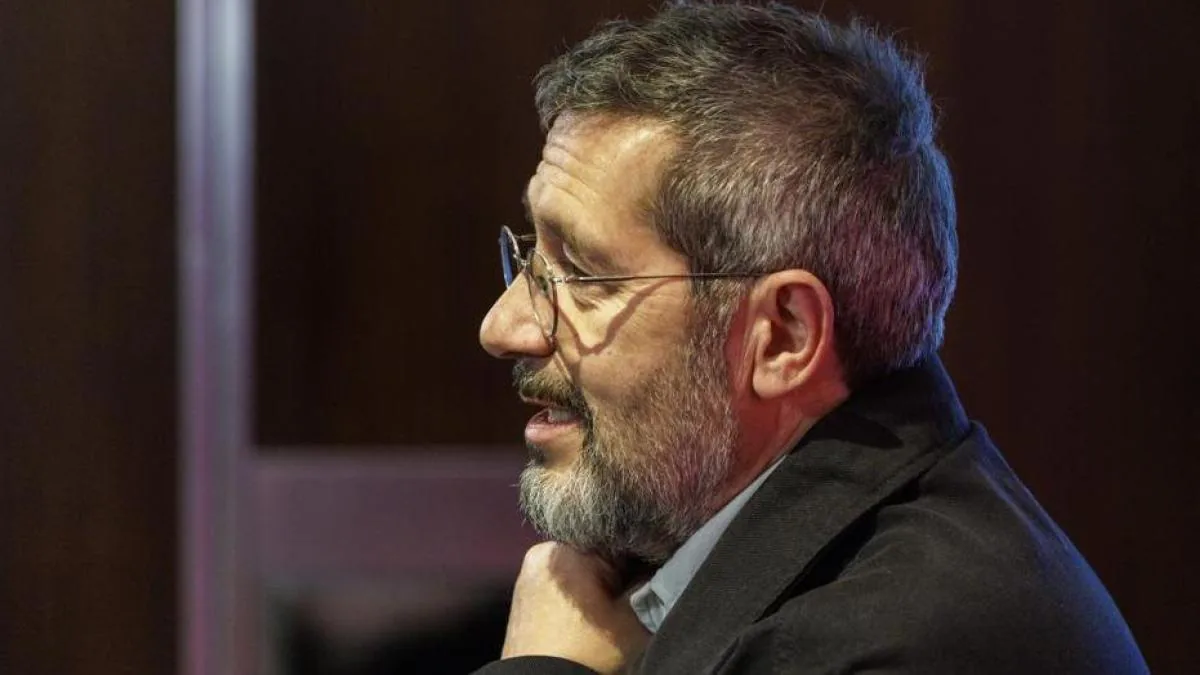
Amos Gitai manages at the Venice Film Festival to make the reflection on the unsustainable Israeli situation resonate deeply, in that space of consciousness to which only art has access. The Road to Jericho, a hybrid documentary that was rushed to be made – “my friend Alberto Barbera encouraged me to speed it up to make it in time for the Biennale” – and which unusually mixes the present, the past, archival material, and the landscapes where all this geographically takes place, resulting in a powerful audiovisual poem about the destinies of humanity.
Read more Trump’s emissaries bring Russia and Ukraine a proposal to try to revive dialogue
“We all know that this landscape witnessed the rise of the three great monotheistic religions that dominate two-thirds of the planet. Jerusalem, this small city of one square kilometer, gave rise to great ideas about how to govern the planet, about the question of ethics. So sometimes you ask yourself: what does the landscape tell us? These stones of Jericho are all that remains after all these battles, all this hatred, all this manipulation. Only a pile of stones remains. And all that led me to make a political poem, also in the context of a very hostile and toxic situation. So we have to foster dialogue, not just arguments, not just hatred towards the other.”
The filmmaker, who is precisely known for tackling complex topics, considers that both sides in the Middle East are at once angels and bastards. Hence he wants to introduce complexity and invite the viewer “to work as an interpreter, not as a consumer.” And to foster a civilized dialogue.
Accompanied by his family and friends – his daughter, a psychologist and linguist, has published a book on the birth of Hebrew as a modern language – Gitai recalls that in Hebrew, unlike European languages, there is no present tense, only past and future. “And that is also true in Arabic, the concept of time is very similar. So we have many things in common, which should nurture understanding.”
In his dry and profound documentary, the filmmaker brings ghosts, “those people I love and who share their talent with me, including the great playwright Arthur Miller, who talks about his thoughts on what he believes is happening with the colonization of Israel.” He also includes Samuel Fuller, who played the role of Flavius Josephus in Gibellina, about the danger of the Zealots taking power and destroying sovereignty, which is the story of what happened 2,000 years ago when Rome wanted to crush Jewish fanaticism.
There is also a Hebrew prayer from Yom Kippur, “fragments that floated in my mind.” Hannah Shikula with the text by Oscar Wilde Each man kills the thing he loves. And then, contemporary images: this small Bedouin school, a place with 300 boys and girls together, which was built with the help of Italian architects using only tires and earth, because they were not allowed to build a room. “Our Minister of Finance decided he wanted to demolish this school,” explains Gitai.
What can cinema do? “Although some filmmakers pretend that we have real power, we do not have real power. And we do not even want to have real power. We only have symbolic power. But symbolic power is also powerful. So I want to raise my voice for these Bedouins and also for this wonderful Israeli group of women and men human rights defenders who took to the streets and wanted to defend the school.”
Read more The PP starts the term in Madrid with the order not to trust Sánchez
“I believe in dialogue. I do not believe in boycotts. In the midst of this toxic situation, we have to talk. The alternative is war. If we do not want to have a war, we have to talk. We have to express our opinion. And the use of archives is a statement about the present. So I think that is how it was built. And we felt the urgency to finish it for a festival I like, which is Venice.”
How optimistic is he about the future? “I would not say I am optimistic, that would sound too naive. The situation is bad, very bad. My film is almost a lament for the country I love and whose politics I do not share. Those who only believe in force and, when it does not work, want to use more force, and more force, and more force, will not succeed. That is why we have to keep hope as the engine of change.”
The filmmaker recalls, in this context, his visit to the Basque Country last year, invited by the former Minister of Foreign Affairs, Miguel Ángel Moratinos. “That town, Bailika (Gernika), as you know, was bombed by the Luftwaffe in 1937. And they asked me to talk about the relationship between culture and politics. So I talked about Spain. I said: ‘Listen, the duel between Franco and Picasso was won by Franco. He remained in power for more than 40 years, or almost 40 years. But in the duel for memory, Picasso won.'”
One of the crucial moments of the film is the interview with Isaac Rabin, when he assures that sometimes peace is built with the worst enemy. And images of his assassination, which marks three decades, are also shown.
“Rabin’s assassination decapitated the possibility of dialogue. I like Rabin for many reasons, not just political. That man spoke simply. And he had the respect of the Palestinians… respect is the basis of an agreement. If you do not believe in the other side, there is no agreement. I spoke with Palestinians who negotiated with Rabin, and they told me that, because of his personality, they were willing to move forward. Not all Palestinians, because Hamas and Jihad decided to place bombs in Israeli civilian centers exactly when Rabin gave the order to the army to advance towards Palestinian cities.”