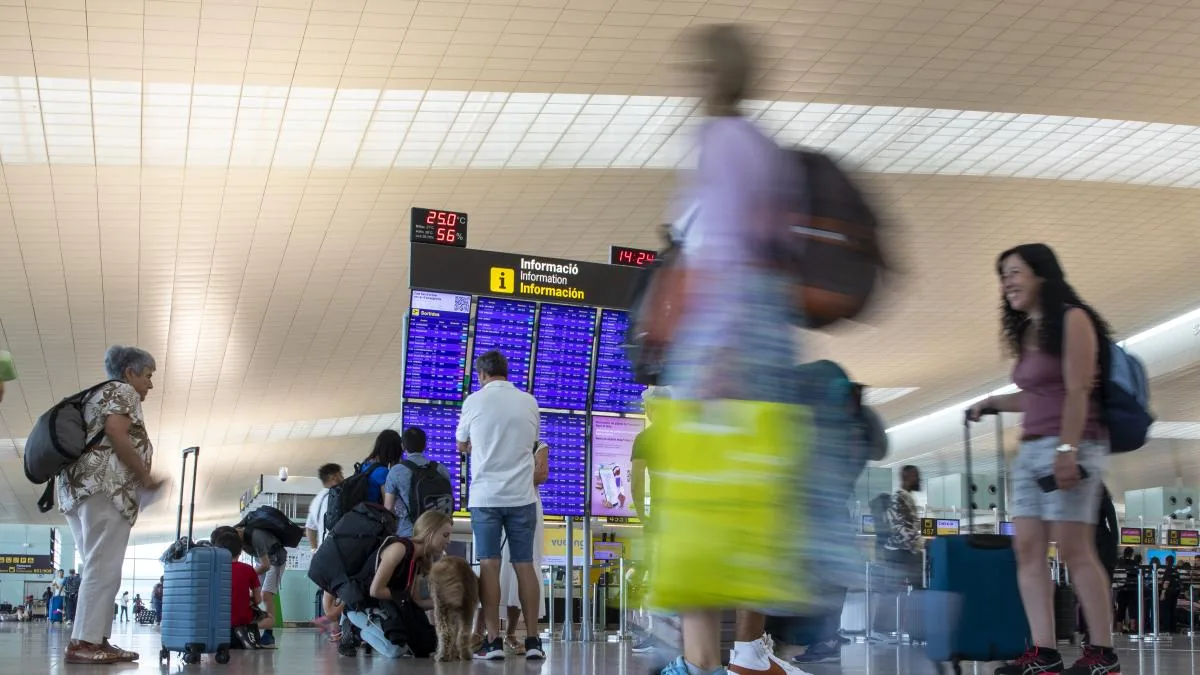
Flying has changed its logic. Checking a suitcase, which for decades was the automatic gesture of any flight, has become the last option, almost a personal failure: something only resorted to for major reasons or because the suitcase is simply too large to sneak into the cabin.
Read more Narco apartment? What is that?
In between, there is a weighty reason (or rather, a price reason) and another of habit: no one wants to lose sight of their luggage, risk it arriving at another airport, or wait twenty minutes or more on the belt when they could already be on their way out. The result is a cabin increasingly crowded with trolleys, backpacks, and bags competing for the same usual space.
This summer the ‘surprise’ comes just before boarding, when staff scrupulously inspect the size of the piece
There lies the problem: that space has not grown at the same rate as airplanes. Airlines have been tightening the configuration of their cabins: more seats, less distance between them, high-density certifications that allow more passengers per flight, although the physical space to store hand luggage remains, in practice, the same as always, except in some models with redesigned overhead bins. It is an equation that does not add up because if every passenger carried a trolley, as everyone would prefer, they would not fit on the plane. Someone has to be left without space, and companies have found a way for that “someone” to pay in advance so it is not them.
The ‘drawer’ of discord
That is why those metal frames waiting by the boarding queue have the exact measurements of what the airline admits for free: 40 x 30 x 20 centimeters, more or less, depending on the company. Those who do not pass the test pay, and not a little: between 60 and 75 euros per item if it does not fit as luggage under the seat, and between 110 and 140 euros if the affected piece is directly the cabin suitcase. Tickets that sometimes cost less than 30 euros, that “shock” at the boarding gate can multiply the real price of the trip by three or four.
The entry ticket is cheap, although what was previously included, a reasonable hand luggage, has become a separate product that can add between 10 and 60 euros if paid in advance, and much more if discovered at the airport. The effect is a sometimes confusing final price: what it costs to fly and what it costs to carry what is necessary for the trip are increasingly two separate bills.
That pressure also pushes passengers themselves to move through the system’s loopholes: carrying extra items between their legs, hanging from their body, or distributed in several pockets just to avoid paying the surcharge, a common scene in any low-cost boarding queue with passengers and ground agents sometimes playing cat and mouse. Most airlines charge a surcharge at the time of ticket purchase if the customer wants to carry a suitcase (with the regulatory measurements) that goes in the cabin compartments.
Read more Police pressure alleviates the distress of the residents of the building on Muntaner Street
Spain against the airlines, with Brussels in the middle
The battle over hand luggage has been in Spanish courts for years. In November 2024, the Ministry of Social Rights, Consumption and Agenda 2030, led by Pablo Bustinduy, fined Ryanair, Vueling, easyJet, Norwegian, and Volotea with fines totaling nearly 179 million euros for abusive practices, including charging for hand luggage in the cabin (Ryanair’s exceeded 107 million; Vueling’s, 39). The airlines appealed and the litigation remains open, although Spanish courts have already ruled more than a dozen times in favor of consumers, relying on European jurisprudence that distinguishes between checked luggage, which can be charged separately, and reasonable hand luggage, which should be included in the ticket. A court in A Coruña has gone further and referred a preliminary question to the EU Court of Justice to settle the doubt once and for all.
Brussels, however, has taken the opposite side: in October 2025 it opened an infringement procedure against Spain for considering that its sanctions violate the airlines’ freedom to set prices. The Spanish government responded that its fines comply “scrupulously” with the 2014 ruling of the CJEU itself, and Bustinduy called the European stance “regrettable.” Consumer associations, led by BEUC, also criticized the Commission’s turn.
A rule change that arrives, albeit with nuances
Meanwhile, the European Parliament has made a course correction: after more than a decade of negotiations, it closed an agreement with the Council in June 2026 and ratified it almost unanimously in July (646 votes in favor, 12 against). The new rule guarantees for free, in any case, a personal item up to 40 x 30 x 15 cm, and requires showing from the first click the real price of the cabin suitcase if the passenger decides to add it. It is, more than a universal trolley freebie, a transparency reform: the consumer will know what they pay, although they will not necessarily pay less. And it will take time to be noticed: the rule will not come into force until the second half of 2027, so until then each airline will continue playing by its own rules.
The delicate issue of weight
Every plane takes off with a maximum authorized weight and a center of gravity that must be kept within a very narrow margin. Before each flight, the crew calculates that balance by adding passengers, checked luggage, cargo, and fuel. Hand luggage also counts, and it is not a minor detail: the more that goes into the cabin instead of the hold, the more variables enter that weight and balance calculation, and the more complicated it is to distribute the load without exceeding the structural limits of the aircraft. It is not just a matter of physical space in the overhead compartments: every kilo traveling in the cabin instead of checked alters, even if minimally, that delicate adjustment that determines how much fuel the plane really needs and how the load must be distributed to fly safely and efficiently on each route.
Read more Restrictions worsen the funding conflict in the Costa Brava