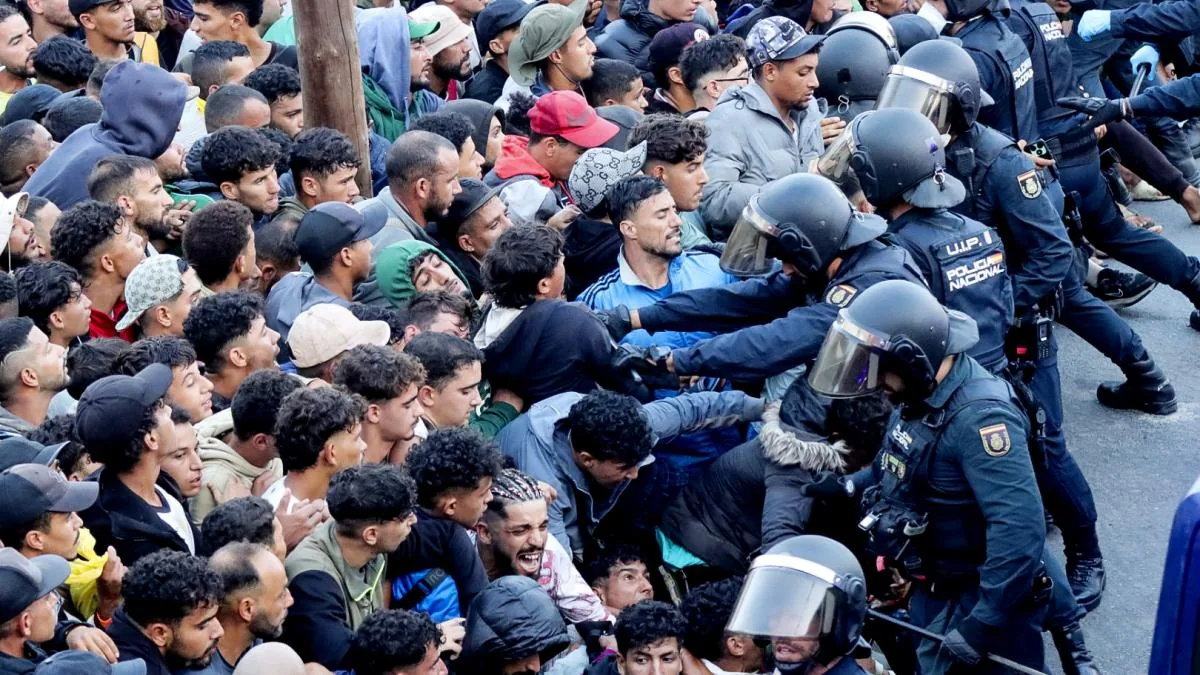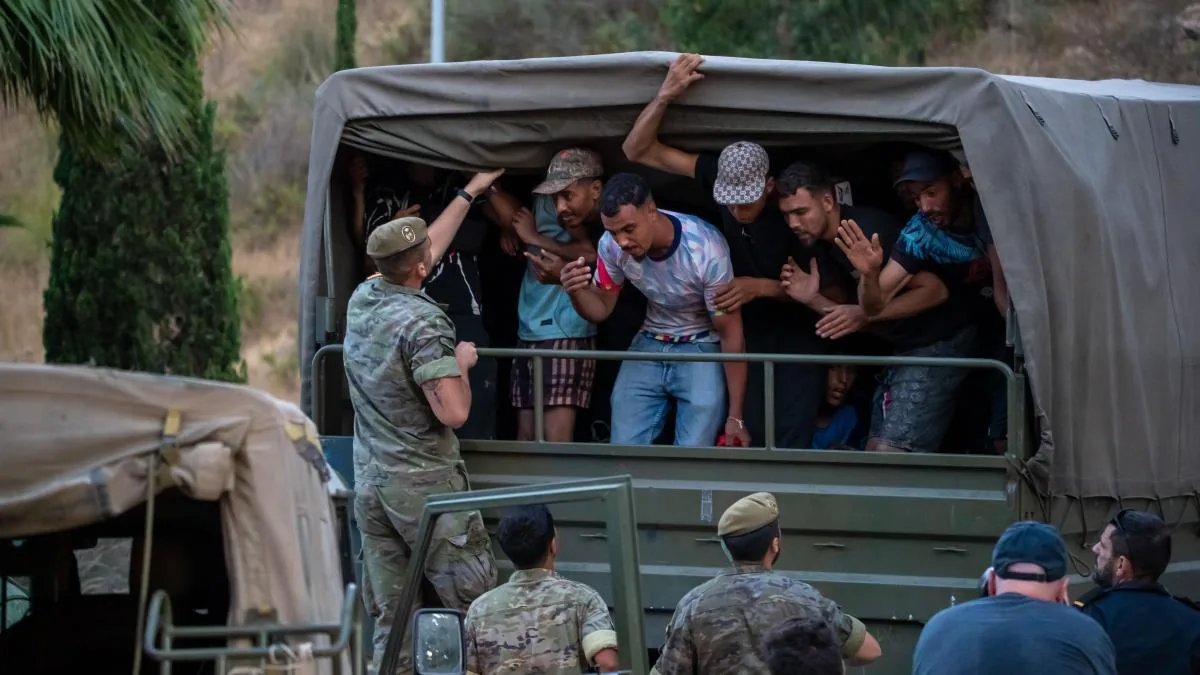
The Interior Ministers of the European Union (EU) have shown this Tuesday their “firm solidarity” with Spain following the migration crisis in Ceuta and have highlighted the need to “continue fighting tirelessly” against migrant trafficking networks, as well as to improve prevention capacity for such situations.
Read more Marlaska confirms that 70,000 of the 72,000 migrants who entered Ceuta have returned to Morocco
At the end of the videoconference, the ministers of the Twenty-Seven valued “the rapid and effective action of the Spanish authorities in response to the situation” in the autonomous city and reached a consensus on strengthening the EU’s external borders, as well as “forging strong alliances with third countries,” according to a statement issued by the Council of the Union, the representation of the Member States.
They also expressed the need to “improve shared knowledge of the situation,” for which they proposed “the development of early warning systems, such as intelligence prior to border exploration and monitoring of social networks.”
“The EU is united and ready to support Spain. We congratulate Spain on its swift response to the situation in Ceuta and express our deepest condolences for the tragic loss of lives. The EU’s external borders are a shared responsibility, and migration requires a unified European response,” said Jim O’Callaghan, Ireland’s Interior Minister, which holds the rotating presidency of the Council this semester.
Expressions of solidarity with Spain and recognition of Morocco’s role in managing the crisis in previous days have been unanimous, according to diplomatic sources, who point out that the use of disinformation in such situations, referring to criticisms from some Member States, means working for the enemies of the EU.
In this regard, the ministers emphasize that communication in times of crisis “could be further strengthened through timely coordination and should be more coherent, especially to counteract malicious external agents dedicated to manipulation and foreign information interference.”
The telematic meeting also included countries associated with the Schengen area outside the EU – Iceland, Liechtenstein, Norway, and Switzerland – which joined the expressions of solidarity with Spain, as did the European agencies Frontex (borders), Europol (police), and Asylum.
Read more The PSOE requests an Assembly meeting for Ayuso to give explanations about her penthouse
“Today’s meeting provided an important opportunity for Member States to assess the instruments we already have, identify areas where greater cooperation is needed, and advance our collective preparations ahead of the next ministerial meeting and the European Council in October,” added O’Callaghan.
For his part, Interior Minister Fernando Grande-Marlaska assured that the meeting with his counterparts from the European Union, who had requested to put limits on the Schengen area due to the migration crisis in Ceuta, was “satisfactory” for Spain once he explained at the meeting that the autonomous city has a “special regime” since 1991, which prevents anyone from leaving “without effective documentary control.”
The minister recalled that the Schengen area, which allows free movement within the community territory, has not been “at risk in any way,” as there is no possibility of “any secondary movement,” meaning that the people who entered Spain en masse last Thursday could reach the Peninsula. To cross from the autonomous city, for example, to Algeciras by ferry, it is necessary, even for European citizens, to show an identity document at police control.
Meanwhile, Migration and Interior Commissioner Magnus Brunner, who participated in the meeting of the 27 EU Interior Ministers analyzing the Ceuta crisis and Spanish migration policy, stated that Europe will provide logistical and economic support to solve the problem currently affecting the city of Ceuta, where it is estimated that between 3,000 and 5,000 people are on the streets awaiting accommodation and proper processing of either an asylum request or legal support given their status as minors.
The commissioner, when asked by journalists, did not explicitly object to the Spanish regularization policy, like other policies applied by other states, and regarding the suspension of Schengen, the commissioner said the Union will study whether this measure makes sense.
Brunner is Austrian and belongs to the European People’s Party, of which the Spanish PP is also a member.
Read more Rodríguez Zapatero accuses the Police of producing a “highly speculative” thesis