What has been said?
That the United States Congress approved transferring Ceuta and Melilla to Morocco just two weeks before the humanitarian crisis.
Read more The cursed fortune of Congo
What do we know?
That the approved law does not mention the autonomous cities, but that a non-binding parliamentary report considered Ceuta and Melilla as Moroccan territories administered by Spain.
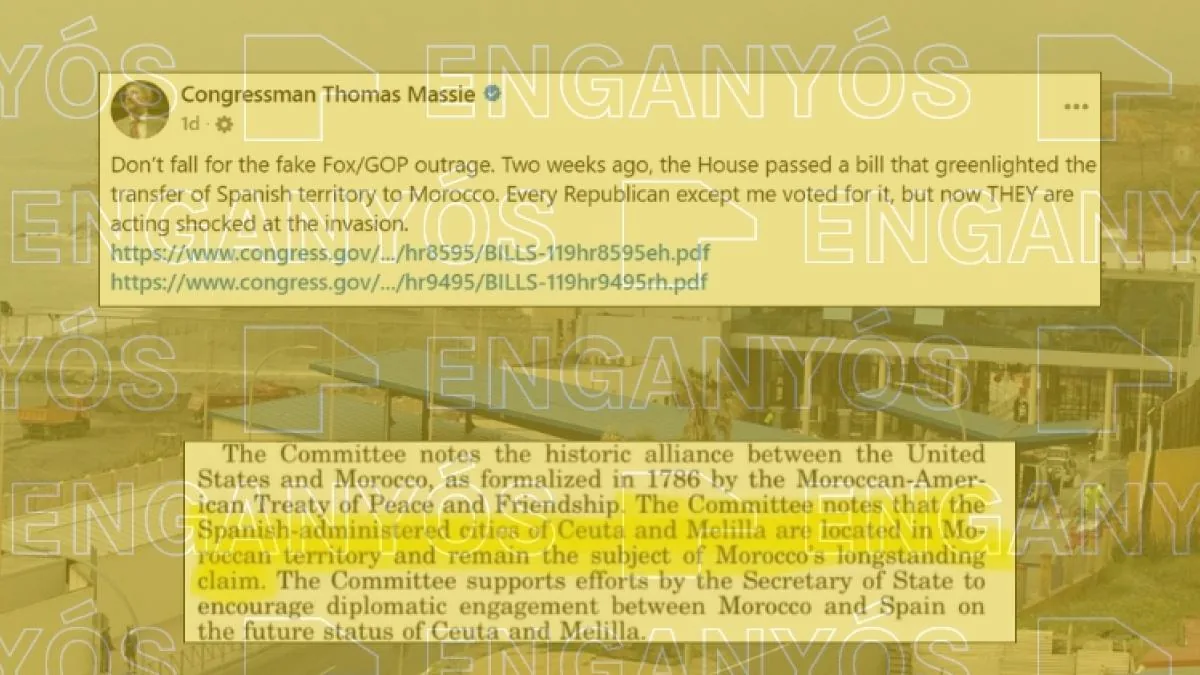
After the humanitarian crisis experienced in Ceuta, it has gone viral on social media that the United States Congress recently approved “transferring Ceuta and Melilla to Morocco,” a measure that would have facilitated the events of last Thursday. One of the most viral messages was posted by Congressman Thomas Massie, from the liberal wing of the Republican Party, and several Spanish accounts have circulated it: “Two weeks ago, the House of Representatives approved a law that gave the green light to the transfer of [Ceuta and Melilla] to Morocco. All Republicans, except me, voted in favor, and now they act surprised by the invasion.” It is MISLEADING.
In the Facebook post, Massie refers to a to provide budget for national security programs and the State Department, but at no time does it mention Spain, Morocco, or the autonomous cities of Ceuta and Melilla.
Instead, the Republican congressman attached a screenshot of a text that considers Ceuta and Melilla cities “administered by Spain […] located in Moroccan territory.” Even so, this text is not part of the law, but of a non-binding report prepared by a parliamentary committee to justify the law. Despite not considering the autonomous cities as Spanish territory, it does not call for transferring their sovereignty either, but encourages diplomatic talks.
Thomas Massie, Republican Congressman (United States)
“Two weeks ago, the United States House of Representatives approved a law that gave the green light to the transfer of [Ceuta and Melilla] to Morocco”
This decontextualized text has been used as supposed proof that the United States is behind the border error that allowed 50,000 people to cross the breakwater by swimming. In a few hours, 88 people died trying to migrate to Spain, according to the latest figure published by the city government, as reported by La Vanguardia.
A non-binding report
The report in question was drafted last April by the House Appropriations Committee, a parliamentary body dedicated to drafting laws to allocate budgets to government departments and agencies. It is a non-binding report that accompanies the law referred to by Congressman Thomas Massie to explain and justify its approval, as EFE Verifica has also explained, a member like Verificat of the international fact-checking networks.
On page 87, it refers to the situation of the autonomous cities as follows: “The committee notes that the cities of Ceuta and Melilla, administered by Spain, are located in Moroccan territory and remain subject to a historical claim by Morocco. The Committee supports the efforts of the Secretary of State [Marco Rubio] to encourage diplomatic talks between Morocco and Spain on the future status of Ceuta and Melilla.”
Read more France warns of a political nature in the letter from the 22 EU countries regarding the Ceuta crisis
In Catalonia and Spain, some media, such as ABC, ElNacional or LaSexta, have interpreted these words as questioning Spanish sovereignty over the autonomous cities.
Beyond the interpretations that can be made, these words only have symbolic weight. The document is informative and non-binding, and the approved law contains no reference to Ceuta and Melilla. Furthermore, authority over both cities remains a matter of sovereignty between Spain and Morocco, and a U.S. law could not change their status.
The United States’ reaction to the Ceuta humanitarian crisis
The day after the massive crossing of the Ceuta border, the U.S. State Department denounced a “flagrant violation of the sovereignty and human rights of Spain and Europe.” It also blamed Pedro Sánchez’s migration policy: “This unacceptable incident is the direct result of the deliberate efforts of the Spanish government to allow and facilitate massive illegal immigration to Europe.”
Spanish Prime Minister Pedro Sánchez also referred to the crisis as “a violation of Spain’s territorial integrity,” although he blamed human trafficking mafias for it.
In Europe, Italian Prime Minister Giorgia Meloni announced she would suspend the Schengen area for travelers coming from Spain. A measure that the Italian government has not detailed much, but which clashes with the fact that Ceuta and Melilla are not part of the European free movement area approved by the Schengen treaties.
Verification prepared by Ona Sindreu Cladera, Marc Masip Altimira, Ariadna Mañé, and Ruth Pérez Castro.
Verificat is a Catalan non-profit fact-checking platform. It is dedicated to verifying political discourse and content circulating on social media and to education for critical consumption of information. It is part of the International Fact-Checking Network (IFCN) and the European Fact-Checking Standards Network (EFCSN)
Read more Flick on the striker: “I have total confidence in Deco. We know we have to do something”