






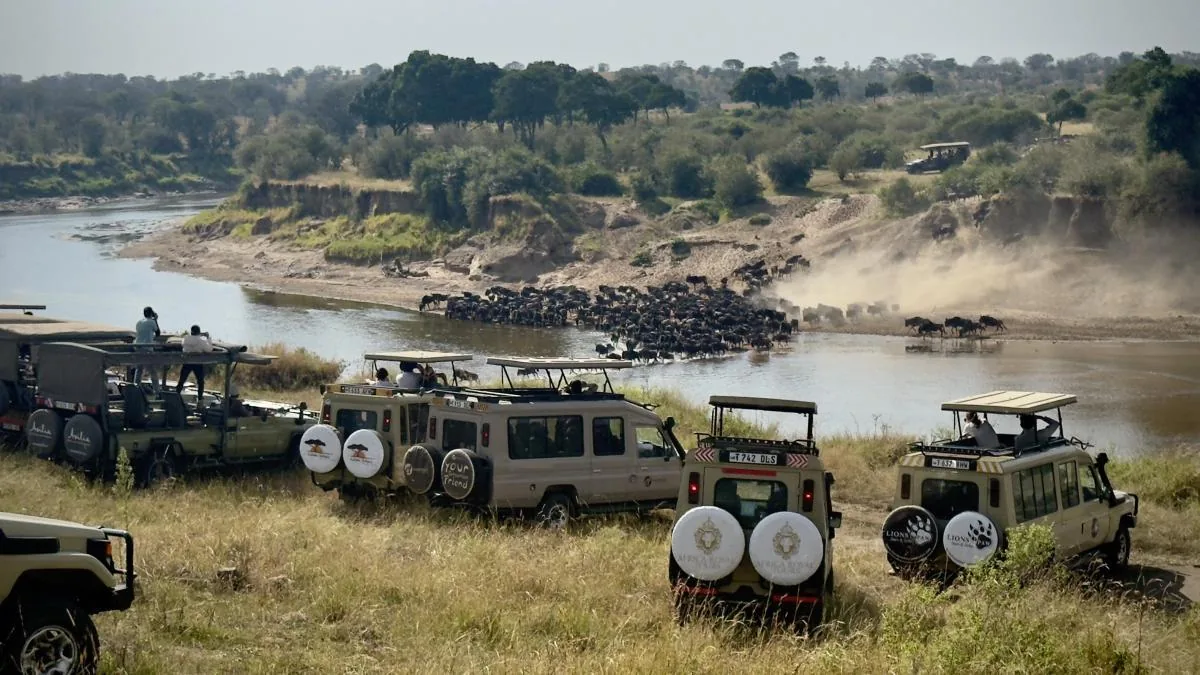
The roar of hundreds of wildebeests anticipates the stampede. On the other side of the river, the herd leaders overcome fear millimeter by millimeter and bring their hooves closer to the edge of the cliff. Suddenly, they plunge into the void: dozens of specimens rush towards the water and frantically cross the Mara River amid a cloud of dust. On the other side of the river, about thirty vehicles take positions, loaded with wide-eyed tourists with cameras at the ready. It’s no wonder. The Great Migration in Tanzania and Kenya, in which about two million wildebeests, zebras, and gazelles follow the rains across the Serengeti and Masai Mara plains, is one of nature’s greatest spectacles, especially when the crossing of crocodile-infested rivers occurs. But the purity of this treasure is in danger: a year ago, South African guide Nick Kleer published embarrassing images showing dozens of tourists outside their cars, something forbidden, in front of a barrier of 150 vehicles blocking the animals’ passage.
Read more Avalanche on Broad Peak: two bodies recovered of the ten missing mountaineers
The scandal, which led the Tanzania National Parks Authority (Tanapa) to impose a one-year work ban on six guides for “violation of professional ethics” and causing “confusion and panic among the animals,” has sparked deep reflection in Tanzania’s tourism sector to prevent the repetition of both malpractice and images of overcrowding.
“Having trained guides who understand the importance of respecting wildlife and are committed to conserving the area is essential”
Filbert Jacob
Guide at A&K Sanctuary
After the incident, Tanapa and Tanzania’s main tour operators association, TATO, met with guides, travel agencies, and other sector players to establish commitments to protect the Great Migration and ensure respect for wildlife. In addition to strengthening surveillance, authorities have developed a new code of conduct in 11 languages to set guide behavior at the 16 main animal crossing points, limiting aspects such as the maximum number of cars in each area, the minimum distance to the river, and vehicle speed when the herd begins to move.
“Guides, authorities, clients… we are all responsible for ensuring this place remains a treasure,” says Guillem Gomis of Watatu
For Filbert Jacob, a professional guide at A&K Sanctuary with 12 years of experience, the growth of tourism in Tanzania has led to inexperienced guides who are unaware of or disregard the rules, pushed by their clients who promise them a good tip. That is why Filbert believes the secret is training. “Having trained guides who understand the importance of respecting wildlife and are committed to conserving the area is essential,” he explains. TATO assures that last year’s incident prompted swift action and provided training to more than 1,000 Tanzanian guides.
Although the tourism business in Tanzania is an irreplaceable engine – according to Ministry of Tourism figures, the sector contributes 17% of GDP – several stakeholders advocate for a responsible approach to nature and avoiding excessive visitors that harm the experience. Reconciling this vision with economic interest is the crux of the matter: if in 2025 the country received 2.29 million international visits, the Tanzanian government aims to reach 8 million by 2030.
Guillem Gomis, founder of Watatu, Tanzania’s main travel agency in Spain, trusts that what happened will be a before and after. “That day a red line was crossed. That some guides allowed their clients to get out of the cars was something never seen here before, and I believe it has triggered a positive reaction. Preventing it from happening again is not only the responsibility of guides or authorities; we must also explain to clients that it is important to respect distances and be patient. We are all responsible for ensuring this place remains a treasure; we must protect it,”
he opines.
Observing nature with a broader focus would also help combat overcrowding. For Pablo Moraga, a professional wildlife guide and resident in East Africa for over a decade, the key is not to reduce the Great Migration to clichés or specific moments that encourage crowds. “Many people want to see the Mara crossing of the wildebeests, and it is spectacular, but it occurs in a limited area. That is why it is important to understand that the migration is also a herd of thousands grazing on the green plains or the pride of lions that follow the wildebeests to feed. It is an extraordinary and very interesting natural phenomenon that deserves to be discovered without overcrowding.”
Read more Why build a port if you have a beach (and slaves): what kind of dock did Barcino have?