






Wildfires are proving to be especially lethal again this year after two years of above-average rainfall that has led to lush vegetation but which, when drying out in spring, has ended up being fuel for the flames. More than half of Spain has been subjected so far this summer to conditions of high or extreme risk of fires, coinciding with a series of heat waves that have created a terrible breeding ground that has exceeded the capabilities of extinction teams
Read more Spain asks Brussels to activate the European response mechanism for the Madrid fires
Since the beginning of the year and until this June 24, 114,796.42 hectares have been affected in Spain, which is almost 5 times more than last year at this time, when the balance was 24,133.36 ha.
The balance is also very negative with regard to the number of large fires; 29 have already been registered, three times more than last year at this time, when 9 were counted. Large fires are understood to be those of more than 500 ha.
The provisional fire balance is a bad omen, but the final result will not necessarily exceed that of last year, when 350,000 hectares burned, in the worst balance so far this century according to data compiled by the Ministry for Ecological Transition.
The causes: the climate crisis, lack of prevention and rural abandonment
And what are the causes? The climate crisis, lack of prevention and rural abandonment are three of the main reasons pointed out by WWF experts as causes of large fires. And, more specifically, behind these events, “the scarce investment in prevention, the deeply rooted use of fire in rural areas, and the abandonment of the agroforestry landscape” are mentioned. And to all this is added “the absence of forest management and zero territorial planning”.
“The climate crisis combined with rural abandonment and the loss of territorial management make the agroforestry landscape increasingly vulnerable to fires,” explains Lourdes Hernández, an expert at WWF Spain. In addition, there are a large number of homes located within or near forest areas that lack adequate planning or self-protection measures, according to this organization, “which aggravates the problem”.
We need a change of strategy that goes beyond extinction and addresses integrated management based on prevention and the adaptation of the territory towards agroforestry mosaics, preventive territorial planning, and sufficient resources to face emergencies,” adds Hernández.
Read more The new ‘diamond jaw’ of Vinicius sparks speculation about several Hollywood stars
Read also
Heat waves and other elements of the debate
Numerous voices, such as those of WWF, emphasize that the limits of the current model for fighting fires “have become obsolete in the face of the new climate context.” Currently, 78% of resources in this area are dedicated to extinction and only 12% to prevention (forest management). The rest goes to restoration.
Another revealing fact is that 95% of these events are caused by sometimes negligent human activities (especially by the use of fire as a management tool in rural areas), and the remaining 5% is attributed to lightning. Therefore, there is ample room to avoid them.
Read also
The European Copernicus program highlights that Spain accounts for 40% of all the burnt surface in the EU in the first half of 2026. The situation coincides with a succession of heat waves that has increased the risk.
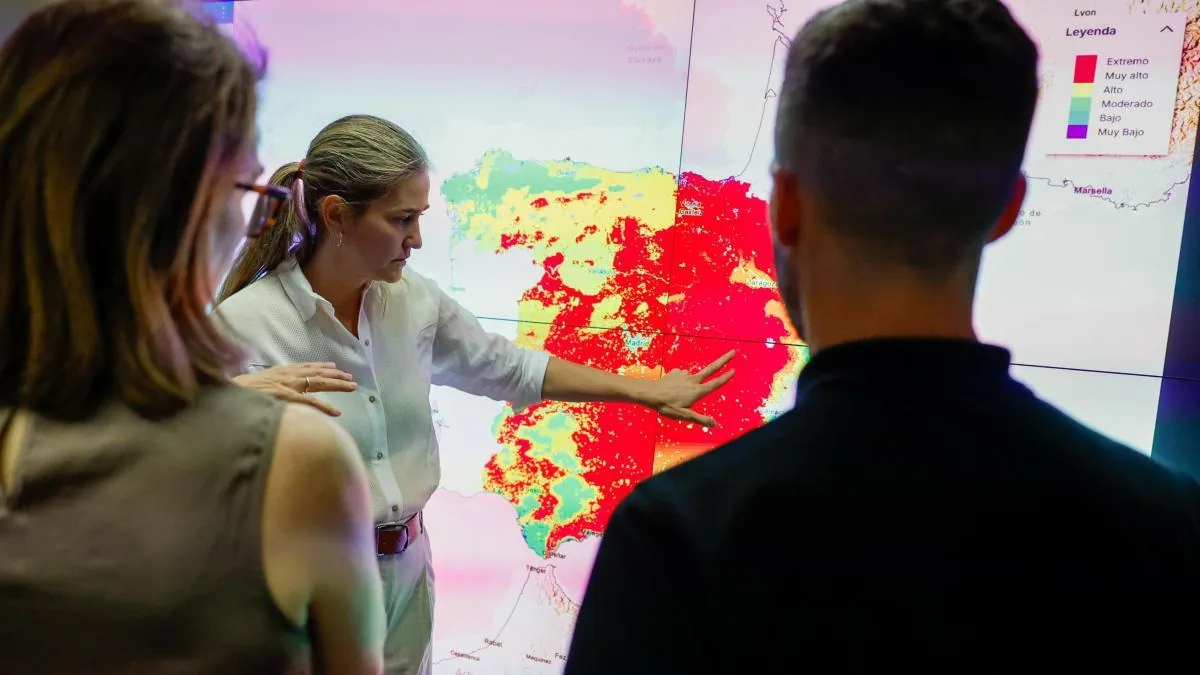
Two thirds of the Peninsulas have experienced numerous dates this summer with a very high or extreme risk of forest fire. This risk is still very high today in Aragon, Catalonia, León, Zamora, Valladolid, Soria, Teruel and Granada, although today the situation has eased in the southern and western half (as shown by this Aemet map).
Broad sectors consider a broad political agreement on this matter to be key, allowing for a comprehensive approach to prevention and adaptation of the territory. The Government attempted it through the proposed State Pact against the Climate Emergency but it did not succeed in Congress.
Read more You know I’m not good


