






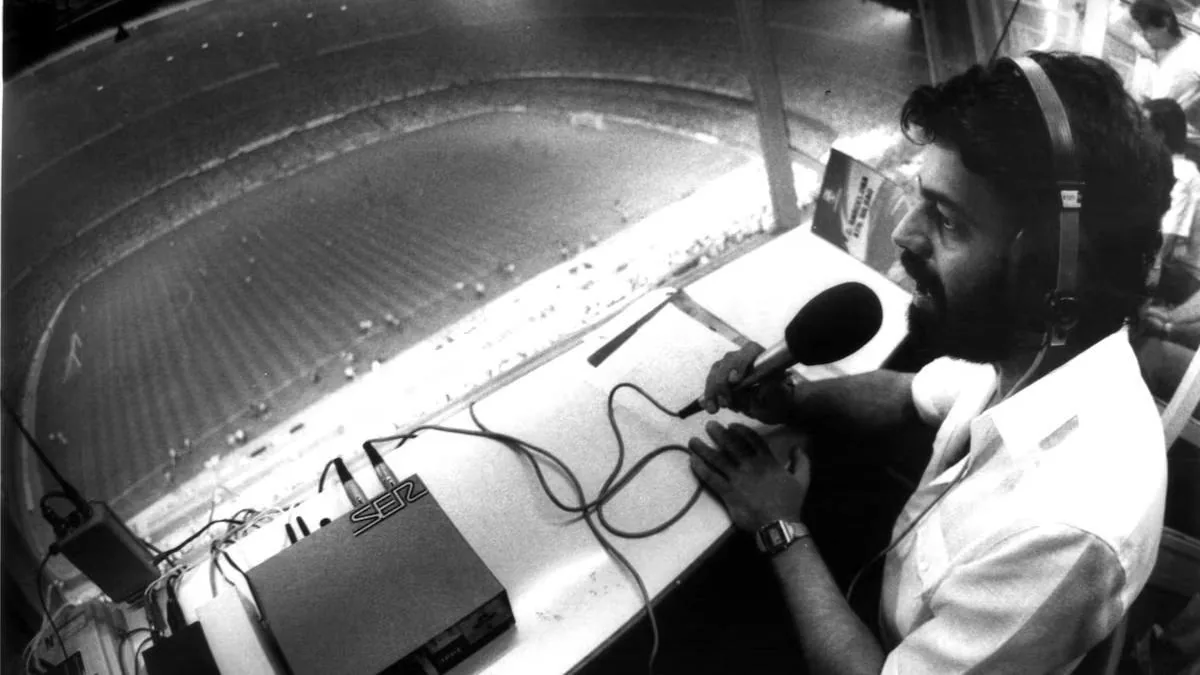
Joan Maria Pou (RAC1), Bernat Soler (Catalunya Ràdio) and Lluís Flaquer (cadena Ser) praise the figure of journalist Joaquim Maria Puyal, pioneer and reference of Barça radio broadcasts in Catalan, which celebrate 50 years.
Read more Works uncover a section of the Canal de la Infanta in Barcelona
Joan Maria Pou
From Puyal to Quim
In October 2002 Barça was playing a Champions League match in Bruges. A few journalists coincided on a Barcelona-Brussels flight. Upon landing, we went to the train station to get to the city where the match was being played. I’m not sure how I ended up next to Puyal but as soon as he saw me he asked if, while we waited, I wanted to have a drink. We had greeted each other a few times, had some short conversations at airports but that invitation surprised me. And I loved it, of course.
I had just started narrating Barça matches on RAC1 two years earlier and he had long been the Johan Cruyff of Catalan narrations, the person who changed everything, the turning point. I felt restless, expectant and lucky, Puyal treated me as an equal, like a fellow professional.
And at that moment came the first lesson: he placed the order in English and when he turned around he asked me if I knew why he had used English and not French. I was speechless because I had no idea and didn’t want to make a fool of myself. He explained that all the signs in that business were in Flemish and therefore ordering in French could have caused some antipathy in his interlocutor.
From a communicative point of view, if you had to choose, doing it in English made much more sense. Chapeau.
Then we shared the whole train journey, a full hour. We were sitting face to face and throughout the trip we talked about our language, how to care for and defend it, also about radio, of course, and even about politics and culture and how we saw our country. I was floating, feeling privileged, all my senses activated, I didn’t want to miss any detail of everything that was happening to me.
It was a conversation I will never forget: for the tone, for the generosity, for the richness and solidity of the arguments, for the wisdom that overflowed everywhere and for the way that indisputable reference listened to me when I dared to take my turn.
During that Brussels-Bruges train ride, Puyal, the voice that had accompanied me through so many hours of childhood and adolescence, the narrator who allowed me to watch Barça matches through the radio, the communicator thanks to whom I realized I also loved Urruti, the presenter who dazzled me with dense and interesting TV programs, the lecturer who filled to the brim a classroom at my faculty and gave us a top-notch talk, the person who had recovered a universe of words and expressions to be able to explain a football match in Catalan, transformed into Quim
Bernat Soler
Dear Quim
First of all, I would like to know how Puyal is. If you see him, please give him my regards, I love him very much. I know you are in great shape, living in your peculiar way which, let’s not fool ourselves, is how most of us would like to live.
I don’t know if Puyal ever told you but when I was a kid starting out in sports broadcasting, taking advantage of a trip to A Coruña to play against Deportivo, he took me to eat at the restaurant where they made the best Spanish omelette in Spain, or at least that’s what they said.
Read more Citizen outcry for the very unlikely reopening of Collserola
He didn’t invite me to join his team for lunch, no, it was just him and me. By the way, anecdote: that day I was dressed up, with a blazer and shirt, a very unusual image for covering a match for the radio in Galicia. The reason for that strange elegance was related to the fact that when the match ended and I returned to Barcelona, that same night I had to attend a friend’s wedding. Puyal might have thought I was dressed up to have lunch with him but as the Italians would say “si non è vero, è ben trovato”.
I remember little from the meal, barely enough to confirm that the omelette was good, but the feeling he conveyed stayed with me: that we were already colleagues. The boy who had grown up listening to Puyal’s goals on the radio was now his colleague, traveling with him, singing goals in the booth next door and even sharing Spanish omelette.
This virtue, making you feel close when you are the biggest figure in your country’s communication, not many people know it. I confess I have never taken a young journalist out to eat and he, who was the Master, dedicated the lunch break on a match day to a kid who tried to hide with the greatest dignity possible the impact that meeting caused him.
Over the years, and while Messi was scoring goals with Barça, we shared stadiums and airports. One day I thought it would be a good idea to make a documentary to explain who Puyal was and I proposed it to him. There will never be anyone with so much class to say no. I didn’t make the documentary but he gave me one of his books with a dedication explaining why he was turning me down. A star.
Quim, I am privileged: I have a wonderful job, I share it with very good people and I have been able to follow the steps of my professional idol, first at Ràdio Barcelona and then at Catalunya Ràdio. Now I can die!
You might think I should explain all this to Puyal, that you have other things to do, but actually I think it’s important that you know, Quim. Because many have known and admired Puyal, but you, Quim, only a few chosen ones have been lucky enough to have you close. He, if he wants, can live retired but I know you will never leave it.
Well, I send you a hug or better two, one for you and another for Puyal.
Lluís Flaquer
That photograph with the master
Enjoy, it’s not always like this…”. The phrase accompanied one of the most emotional moments of one of the most exciting nights of my life. Enchanted, I smiled while fulfilling another of my wishes. A while ago, I had narrated for Ràdio Barcelona the club’s second Champions. Before leaving the Stade de Saint Denis, I asked Puyal, with all the shame and respect in the world, if I could have one more memento of that memorable evening. My first year covering Barça on the radio ended with the broadcast of Barça as European champion and with a long-desired photograph. Years later, every time I look at that image, that phrase comes to mind. “Enjoy, it’s not always like this…”.
Personally, I had the pleasure of meeting him that year. But our relationship, although he didn’t know it, had already started long before. My grandfather Bernardí, with whom I first went to Camp Nou, explained to me that one of the first things I asked when we sat in our seat on the side of the stadium was what those stained glass windows were that could be seen at the top of the stand. “There are the radios, there Puyal narrates,” he assured me, causing me a face of not understanding much. Shortly after, on the sofa at home, the memory of the hug with my father to celebrate our first League together will always be linked to the unforgettable sound of the transistor. “Urruti t’estimo, Urruti t’estimo!”. When one of my children asked me how Barça won their first European Cup, it was impossible not to explain that “Stoichkov will touch, Bakero will stop and Koeman will score”. One Cup night, at the moment Barça scored the 5-4, I turned up the radio volume to hear how Puyal sang it. Amid the madness of Camp Nou for the comeback, while everyone was jumping and shouting, I smiled tightly pressing the headphones to my ears to be able to hear that “sos macanudo Pizzi, sos macanudo…”.
While all my friends dreamed of being Laudrup, Romário, Maradona or Rivaldo, I aspired to be Puyal. He inspired a vocation. In Paris, the vast majority wanted a photo with Ronaldinho. I asked the master. And just as he started to do with so many plays and goals, now fifty years ago, he gave voice to what he saw. Before the innocence of someone who had touched the sky in his first season narrating Barça, the warning to enjoy the moment in case, as had happened to him, years and years passed before narrating a new blaugrana Champions. We listened to him. Whether with titles or without them. We have always enjoyed and continue to enjoy a vocation that was born and made possible by what I learned as a listener from master Puyal. The man capable of always finding the right words, tone and intensity to turn his voice into the soundtrack of some of the best moments of our lives.
Read more Skin spots: why treating them from within can make a difference