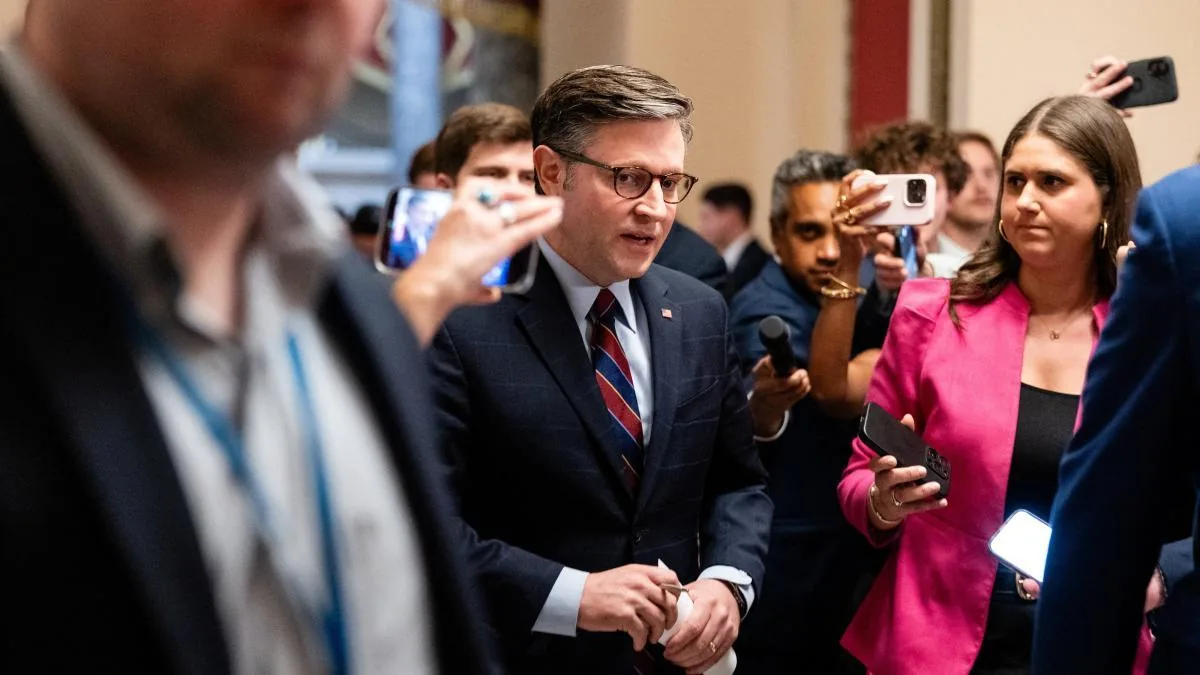
After twelve consecutive nights of US bombings on Iranian territory, which have blown up the ceasefire agreement signed last month by Presidents Donald Trump and Masoud Pezeshkian, the US House of Representatives on Thursday rejected the return of hostilities. In a resolution approved with 214 votes in favor and 208 against, this is the second time the lower house has reaffirmed Congress’s authority over war.
Read more Ayuso promises help to those affected by the Almorox fire when the damages are evaluated
Although the binding nature of the measure, which must also be approved in the Senate, is disputed, it represents a new setback for the Trump Administration, which has seen support from the Republican bench for its military operation in Iran erode since it began on February 28. Despite Trump’s party having a majority in both legislative chambers, a group of four rebellious Republicans – Tom Barrett, Warren Davidson, Brian Fitzpatrick, and Thomas Massie – has backed the measure promoted by Democrats.
Read also
These are the same legislators who last month joined Democrats to pass a similar resolution. “My position has not changed,” Barrett said in a statement. “Only Congress has the authority to authorize military action in Iran. I remain willing to work with anyone to eliminate hostile threats against our country without getting involved in another endless war.”
The measure, which does not have the force of law, is based on the War Powers Resolution of 1973, approved during the Vietnam War by a Congress that claimed constitutional power over declarations of war. In principle, this resolution cannot be vetoed by the president (should it also pass the Senate), but it will not have the label of law either. It is possible that the Trump Administration will challenge it with the aim of reaching the Supreme Court, which has never ruled on this issue.
The lower house’s rejection of the war in Iran, which according to the Pentagon has already cost 37.5 billion dollars, comes a day after the same chamber approved Defense Secretary Pete Hegseth’s budget request of 67 billion dollars in additional funds to cover, among other items, the future costs of the war.
Only 29% of Americans approve of the military operation in Iran, according to the latest Ipsos poll
It also comes at a time when Americans are expressing their greatest opposition to the conflict, in which the US has not met any of its stated objectives at the beginning of the bombings: the Iranian regime is still standing, its allied militias maintain the capacity to threaten the US and its regional allies, and it has not renounced uranium enrichment for civilian purposes. Furthermore, the war has generated an added problem, which is now the main obstacle to peace: Tehran claims control of the Strait of Hormuz, where in recent days it has attacked a series of commercial vessels attempting to cross through this critical bottleneck for the transport of oil and goods.
According to an Ipsos poll published last week, only 29% of Americans maintain their support for the war in Iran. This percentage is mainly composed of staunch Trump supporters, the Make America Great Again movement, which is estimated to represent around 25% of the electorate. However, even they are beginning to express a certain weariness, especially due to the increase in oil prices, which on Thursday once again exceeded 100 dollars per barrel for the first time since May.
The vote in Congress occurred just before the five-week summer recess, which will freeze legislative activity on Capitol Hill. “When we return in September, I bet we’ll have more people joining us to say let’s end this,” predicted Democratic Congressman Jason Crow, one of the resolution’s proponents.
Nuclear agreement with Saudi Arabia
Trump conditions pact with Riyadh on its normalization of relations with Israel
After announcing yesterday a controversial agreement with Saudi Arabia that would allow Riyadh to enrich uranium with the participation of US companies, President Donald Trump on Thursday set a condition: he will demand that Riyadh normalize its relations with Israel through the Abraham Accords, with which in his first term he managed to get several Arab countries to re-establish diplomatic relations with Tel Aviv.
Furthermore, in a post on his social media, Trump remarked that the pact does not allow uranium enrichment, clarifying that the US “does not oppose civilian nuclear facilities (without uranium enrichment).” The Saudi kingdom has said in the past that it will only normalize relations with Israel if a clear path towards the creation of a Palestinian state is established, something that currently seems unlikely.
The new nuclear agreement, which in principle should be approved by Congress to be valid, will be in force for 30 years and will involve the joint development of a nuclear program in the Persian Gulf country. According to information leaked to US media, the pact could in the future allow the construction of a uranium enrichment plant after a joint study by both countries, despite Trump having denied it.
This is a thorny issue, as many legislators fear that the agreement will open the doors for Saudi Arabia to try to produce a nuclear bomb in the future, an atomic weapon that, today, only Israel possesses in the region. Saudi Crown Prince Mohammed bin Salman has suggested in the past that, if Iran obtains a nuclear bomb, his country will also seek to produce one, which in turn would raise concerns for Israel, which has been warning for years about the risk of this happening.
Read more Four arrested for killing a man in Madrid with five stab wounds on New Year’s Day