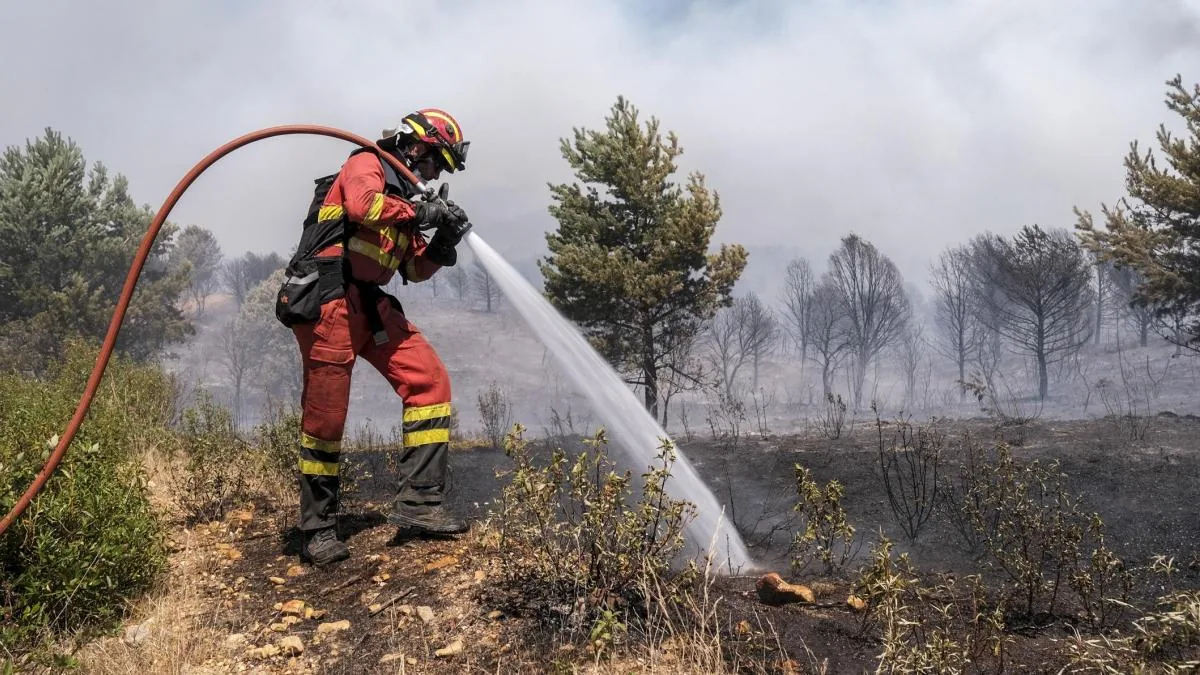
The La Mierla fire (Guadalajara), which is already the largest recorded in Castilla-La Mancha, having burned at least 30,000 hectares, has affected approximately a quarter of the Sierra Norte Natural Park. This protected area is one of the jewels of Castilla-La Mancha’s nature, an enclave of valuable forests and wolf habitat. Declared a natural park in 2011, this mountain range covers 116,953 hectares in the northwest of the province of Guadalajara across 35 municipalities.
Read more Is Spain the country that smokes the most in the European Union?
A first assessment by experts from Ecologistas en Acción in Guadalajara highlights the severe impact of the fire on this protected area, where very serious damage would have been caused to the riparian forests of the Sorbe, Bornova, and Cañamares rivers, as well as to a pine reforestation area (of lesser value).
“We are talking about riparian forests of great biodiversity with protected species, such as the alder,” says Alberto Mayor, spokesperson for this conservation organization in Guadalajara. The place is also a habitat for wolves and Bonelli’s eagles. The Pelagañinas river fluvial reserve would also have been affected.
The Castilla-La Mancha government has not yet made any assessment of the ecological impact caused by the disaster.
“The ecological damage being caused is, for now, incalculable; an assessment will be made once the real extent of the damage is known,” Mayor adds, however.
The Minister for Ecological Transition, Sara Aagesen, has assured that the central government “will be there” to cover “50% of the cost of recovering an area as valuable as this Sierra Norte.” “It is key in helping with this extinction, but it will also be there afterwards in the recovery of the territory,” she assured.
Very sparsely populated area
The forest fire has led to the evacuation of nearly 1,300 people from 34 inhabited settlements or villages and the confinement of another 14. The fight against the flames is proving very complicated because it originated in a practically uninhabited area with abundant vegetation, which facilitated its rapid spread. Furthermore, the wind has been very unfavorable.
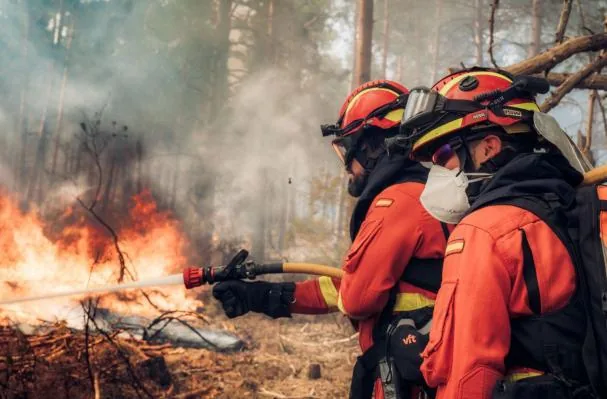
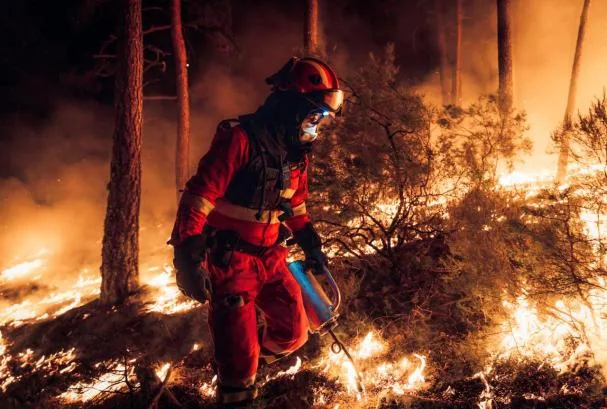
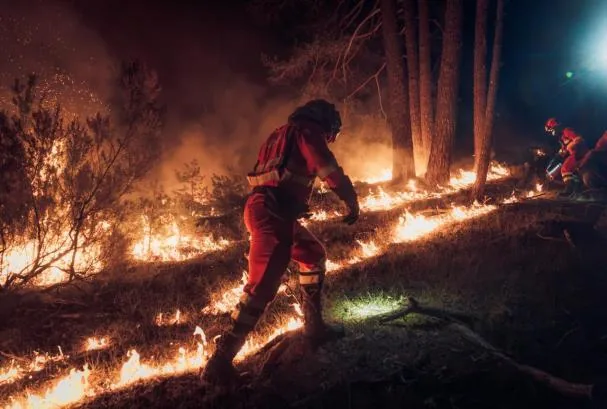
Nearly 400 personnel from the Military Emergency Unit (UME), Infocam, the Community of Madrid, and the Ministry for Ecological Transition are working in the area along with 72 ground vehicles and about thirty planes and helicopters. Alongside them, Civil Guard agents are collaborating in the evacuation tasks of residents and in ensuring road safety.
The most positive news is that firefighters have managed to “practically stop” the advance of the fire towards the city of Soria (40,000 inhabitants), in the neighboring region of Castilla y León. The President of the Government, Pedro Sánchez, visits the affected areas this Wednesday.
“Adapt resources to the new reality marked by climate change”
Ecologistas en Acción demands that administrations provide “adequate resources against sixth-generation fires and climate change.” This organization deeply regrets the devastation caused by the disaster. It acknowledges the efforts being made by firefighting resources but demands that they “adapt to the new reality marked by climate change and sixth-generation fires, given that the facts are demonstrating that they are not sufficient, despite the collaboration of different administrations to try to control it.”
One of the most extensive natural parks in the Iberian Peninsula
The Sierra Norte de Guadalajara integrates three previously protected natural areas: the Lobo-Cebollera Massif Natural Reserve, the Tejera Negra Beech Forest Natural Park and UNESCO World Heritage Site, and the Pelagallinas River Fluvial Reserve.
It is one of the most extensive natural parks in the Iberian Peninsula, made up of unique high mountain landscapes in Castilla-La Mancha, characterized by astonishing geological richness and biodiversity, to which is added a valuable cultural and ethnographic heritage.
Along with geological and vegetation values, the fauna and landscape have so far shown an excellent state of conservation, revalued by their rich ethnographic and cultural heritage.
These mountains are the origin of the three rivers that structure the territory from west to east: the Jarama, the Sorbe, and the Bornova, which form long north-south valleys that condition the landscape and life in the Park.
Read more Ice baths: between science and posturing
Surviving forests of great botanical value, especially the Tejera Negra beech forest
The territory of the natural park has exceptional botanical value. In the highest areas, there are groves of beech trees, sessile oak forests, yew groves, holly groves, and birch forests with rowan trees, with a large number of protected flora species that are unique and scarce in Castilla-La Mancha.
“This mountain range includes relict vegetation, as we find forests more typical of the north of the peninsula or more Atlantic climates; the range has impressive beech forests, such as Tejera Negra, one of the southernmost in Europe, which fortunately are not being affected now, although it is close,” says Rodrigo Balaguer Romano, a Creaf researcher, who also highlights species more typical of Atlantic climates, such as ash and birch trees, or yews or holly, typical of past climates, when there was “a more benevolent climate for these species.”
Especially valuable, therefore, is the Tejera Negra beech forest, one of the southernmost beech forests in Europe.
Relict beech forests
Beech forests are among the valuable ones. They are typical of more northern latitudes, but here they are a testament to colder past eras. After the last glaciation, beech forests spread over much of the Iberian Peninsula, but when the climate became more arid and warm in the peninsular interior, they were replaced by forests of other species better adapted to the new climatic conditions, according to the guide prepared by Luis Carcavilla, Rafael Ruiz, Enrique Díaz and Javier Luengo
For their part, the natural Scots pine or wild pine forests extend along the northernmost strip of the park, from Cantalojas to the surroundings of the Sierra de Alto Rey.
The wolf and the Bonelli’s eagle
The great variety of habitats present in the natural park favors the existence of a valuable faunal community. In this area, 260 vertebrate species are inventoried, of which 195 are protected and many of them are subject to conservation programs. Bonelli’s and golden eagles, peregrine falcons, and griffon vultures nest in its rocky areas.
In the forests live honey buzzards, red kites, and other diurnal and nocturnal forest raptors, as well as small forest birds of interest. In the rivers, it is possible to spot dippers and, in the hawthorn thickets, red-backed shrikes.
But the most unique species is the bluethroat, which in Castilla-La Mancha only nests in the high mountain pastures and gorse fields of the Park, in the company of the alpine pipit and the dunnock. Among mammals, the Iberian wolf stands out especially, a species classified as endangered that is recolonizing this territory. Roe deer and wild boar are abundant, and the large carnivore, the wolf, inhabits here.
Read also
A necessary investigation to clarify possible agricultural malpractice
Ecologistas also calls for an investigation into the causes of the fire, to clarify whether the restrictions imposed by the very high fire risk last Thursday for carrying out agricultural work were respected. Otherwise, it will consider appearing as a private prosecution against those responsible.
This organization demands that protocols and restrictions on agricultural work in case of high fire probability be reviewed, to ensure that they are carried out safely and that the risk is minimized. Otherwise, scenarios like this will become increasingly frequent, endangering the lives of firefighting personnel and the inhabitants of the Sierra Norte themselves.
“The facts show that it is not enough to only fight fires once they have occurred, but that sustained and maintained prevention policies throughout the year are necessary, as well as measures to combat rural depopulation,” says Alberto Mayor.
Read also
90,000 ha already burned, four times more than last year at this time
The third vice-president and Minister for Ecological Transition, Sara Aagesen, warned that, so far this year, more than 90,000 hectares have already been burned in Spain, which is four times more than last year at this time. In total, there have been 21 large forest fires so far this year. “Given this context, we must advocate for maximum cooperation and collaboration at a time when we are experiencing extraordinarily complicated weather conditions,” she defended before referring to the fires in Huesca, Teruel, Soria, and Segovia.
Given the new heatwave, the third since the beginning of summer, she recalled that the previous two have been characterized by “high temperatures, low humidity, wind regimes,” which, in her opinion, “causes extraordinarily complicated, very complicated fires.” In this regard, she stressed that “again we are talking about a climate emergency, climate change that gives no respite,” convinced that, “if we look at the temperature record for this year 2026, up to the current date, we will possibly find that 2026 will be the warmest year in the historical series.”
After asserting the importance of “continuing to act united, collaborating hand in hand,” she defended that, for now, with the Government of García Page, this collaboration “is extraordinary.”
At this point, she also made “a call for maximum caution” in the face of “a very complicated summer” and urged all citizens to “clearly follow the instructions of the authorities, which are basically instructions to achieve maximum protection.”
Finally, regarding the return of residents from municipalities evacuated due to fires in the region, she said she understood that “the priority is the protection of citizens.”