Only a few days remain until Pope Leo XIV’s historic visit to Barcelona, and preparations are already palpable in the atmosphere. The signage for the popemobile’s route, the placement of flags on balconies, and the anticipation of a public eager to sing the visit’s anthem, Alza la mirada. Even the pontiff himself, it is said, has already mastered his blessing in Catalan.
Read more “We have more talent than we think”: Rosa Tous and Roberto Verino champion Spanish fashion
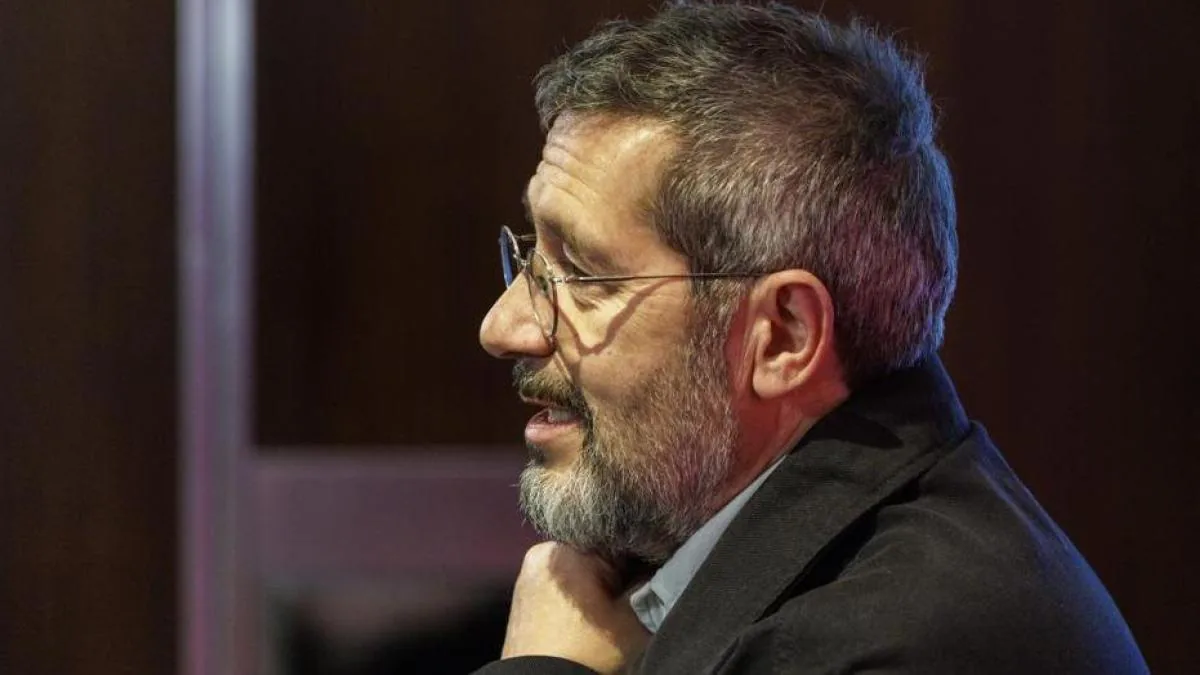
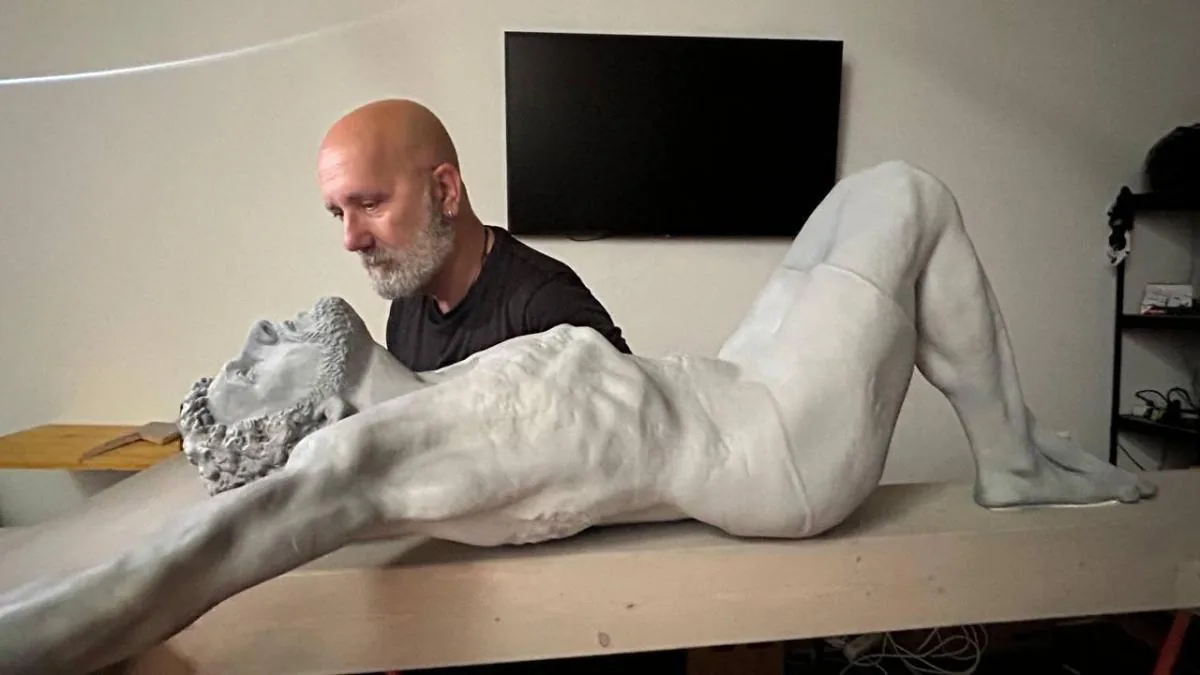
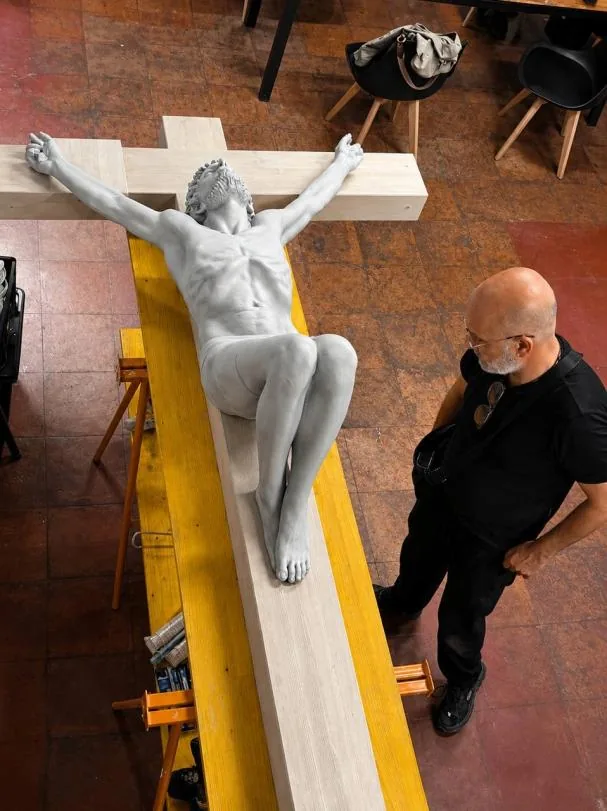
But for many of those working behind the scenes, the countdown began long ago. One of them is the Barcelona artist Xavier Bartumeus, who, from his workshop in the city center, has reproduced a large cross that will preside over the stage of the Estadi Olímpic Lluís Companys in Montjuïc during the public event that will inaugurate the visit.
He receives us in his workshop, just a few days before the work is moved to Montjuïc. His emotion is evident in his demeanor, his mind occupied with the final details of transport planning, and the tension of someone who trusts that everything will go as planned.
All his gestures convey the final moment, that moment between life and death, of total surrender to the Father”
With years of experience exhibiting in Spain and in galleries around the world, Bartumeus acknowledges: “Being part of an event of such importance is a unique challenge, something different and, above all, a tremendous source of excitement.”
The sculpture of the crucified Christ that Bartumeus worked on —almost three meters high and one and a half meters wide— is a faithful reproduction of the work by Catalan sculptor Francesc Fajula, located on the high altar of the Sagrada Familia. In turn, this piece is inspired by a previous design by sculptor Carles Mani, under the direction of architect Antoni Gaudí.
“I had the honor, at the request of Father Emili Roure, to highlight this impressive legacy of generations of Catalan artists, reproducing Fajula’s same statue but in large format.”
Alongside a team consisting of a carpenter, an architect, and his right-hand man, Miquel Balaguer —a 3D production expert—, Bartumeus had no margin for error. “I embarked on the adventure. For days, I made a series of frontal, plan, and profile drawings of Fajula’s sculpture inside the Sagrada Familia. Balaguer transformed them into a 3D mesh. From there, we corrected errors and adjusted plans, continuing with the construction until reaching the definitive form. When enlarging the original, the features must be slightly modified, made more pronounced, because they are not appreciated in small scale. In parallel, with the carpenter, we designed the cross so that the figure would fit perfectly.”
Why the choice of this figure of Christ?
It has a very powerful dramatic quality. There are very few Christs depicted like this: kneeling to the extreme, almost overcome by his own weight and, at the same time, with a gesture of hope in his gaze lifted to heaven, which coincides with the motto of the visit. All his gestures convey the final moment, that moment between life and death, of total surrender to the Father.
There are living Christs crucified, there are dead Christs with the spear, but there are no Christs in the moment before dying. That is the third way: he is going to die and he knows it.
The Pope’s visit to Barcelona has an active agenda, and on the second day, a solemn mass will be celebrated in the Sagrada Familia, which will include the blessing and official inauguration of the Jesus Christ tower, entirely significant for the city’s greatest symbol, which has been under construction for over a century. The moment coincides with the centenary of Gaudí’s death.
“This sculpture —Bartumeus continues— connects many threads, among them Barcelona’s role as a capital of faith and art. Gaudí, the greatest exponent of modernism, agreed with this figure. It is a clear example of his idea regarding piety, Christ, and the passion, and one of the most significant things that can be shown to illustrate that relationship between faith and art.”
According to Bartumeus, Barcelona and Catalonia in general have a deep Christian foundation, with places like Sant Climent de Taüll, the monastery of Santa Maria de Ripoll, Montserrat, or the Sagrada Familia itself. “Evidently, Rome is the seat, but I believe more cities like Barcelona are needed to root and strengthen faith in the world and in Europe.”
Read more Two arrested for burning alive four day laborers inside a car in southern Italy
The challenge is that, with a figure of mine, someone can begin to sow the seed of faith”
Is being a believer an added value when developing religious works?
Absolutely. I feel responsible, as a believer and as an artist, for connecting these two worlds. When I create a piece, I know that there will be people who will look at it to transcend, to turn to God, to ask, to give thanks, or to love.
I am a craftsman who helps make that happen. That responsibility is difficult to assume without faith. You cannot speak of love if you have never been in love; similarly, you cannot speak of faith if you do not believe. You can interpret it, but then it is an intellectual, aesthetic work; it lacks religious transcendence.
When you create religious figures, what do you hope to generate in the viewer: that they fall in love with the work or with God?
There’s a bit of both here. On the one hand, artistic vanity: that they fall in love with the work. But also that it brings them closer to God. If you are already a believer, it’s easier. The challenge is that, with a figure of mine, someone can begin to sow the seed of faith; that an atheist or an agnostic person sees it and, perhaps, its expression makes them think. And that this thought leads them one day to read a passage from the Bible, asking themselves: “What did the author of the work mean by this?”
Recently I painted Padre Pio. Someone called me to say that, thanks to that work, which impacted them, they started researching him and are now very devoted to this figure. That intention truly interests me: to awaken a flame that helps people approach religion and not see it as a burden, but as a liberation. I believe art is that: art liberates.
Read also
In this sense, Bartumeus does not confine himself to a single artistic field. In his early days and still today, he paints and develops secular works inspired by everyday life.
“I am a figurative artist and I am very concerned with the human aspect in my work, whether religious or secular. People should not think that, by making a sculpture of a saint, one works like Velázquez or Michelangelo. One works with current elements and iconographies.”
His leap into religious art was born in parallel with his conversion process. “Thanks to the absolute trust of Father Joan Costa, he commissioned me to produce the statues of the apostles in the Church of Bethlehem. It was my first major commission, with the responsibility that each apostle had meaning. To this day, I don’t understand how I accepted it,” he says, smiling and very grateful.
Is there a contradiction between working in secular or religious art?
I believe they complement each other perfectly and that one gives meaning to the other. I couldn’t have made a Christ if I hadn’t first learned to paint in certain ways, and vice versa. Now my secular painting —let’s put it that way— has more intellectual weight, because I think about every detail. It has ceased to be merely aesthetic. It has beauty, but also intelligence. One has helped the other, and vice versa.
I want to think like the philosopher María Zambrano, who said that a painting is the place where the gaze rests. Now I intend for my works —especially in secular painting— to invite people to pause, to contemplate, to go beyond “it’s pretty.” If they only tell me that, I feel I have failed. Before, I sought that. Now I need them to tell me: “It touched me, it moves me.” It’s a combination. When you fall in love, you don’t just fall for a physical appearance, but for a soul. The same should happen with a painting.
Does an artist fall in love with their work?
Yes, but you fall even more in love with seeing how it connects with people. A work is made to be seen. That’s why I fall in love just enough, knowing that it will eventually detach from me.
Read more Civil Protection warns of intense rainfall and rising river levels in Barcelona and Girona
Is this sculpture one of those?
Without a doubt. It’s a turning point. It has become my true love.