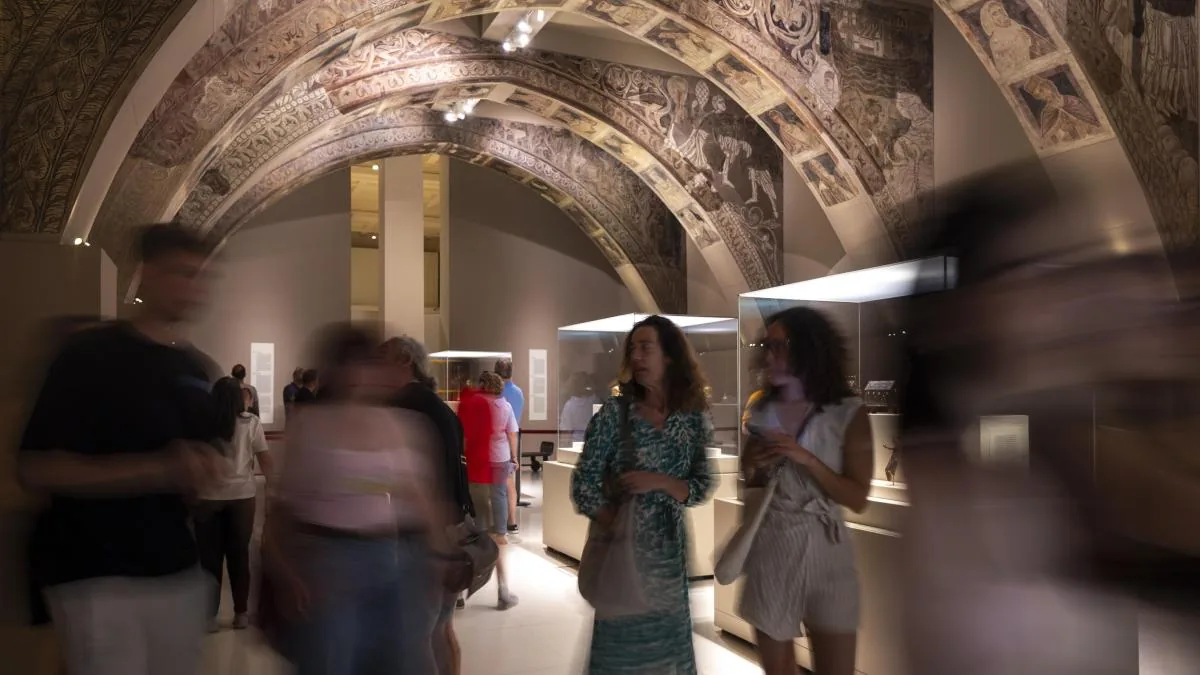
The National Art Museum of Catalonia (MNAC) believes that some of the decisions adopted by the Huesca judge Rocío Pilar Vargas, as a member of the Judiciary, “are contrary to the mandate set out in Article 46 of the Constitution, which places on all public authorities the obligation to guarantee the conservation and promotion” of Spanish historical, cultural and artistic heritage. This was communicated yesterday in an appeal for reconsideration that has the support of the Minister of Culture, Ernest Urtasun, who hours earlier stated in Congress that he abides by the Supreme Court’s final ruling, but that if any appeal were filed to protect this heritage asset, “it will always have the support of the Ministry of Culture, just as all the technical reports prepared by its board have had support”.
Read more The myth that young people don’t read: 80% of Generation Z makes books «sexy» on social media
The appeal by MNAC’s legal services is a response to the judge’s latest order from April 10, which, among other things, obliges the museum to return the Sijena mural paintings within a maximum period of thirteen months, meaning that by May 2027 the artistic ensemble would once again adorn the walls of the chapter house of the Monegros monastery. For the museum, the order “violates MNAC’s fundamental right to use all relevant evidence for the defense of its interests.” In this regard, it reproaches the fact that the order was issued “absolutely disregarding and without any assessment” of all the expert evidence presented, including reports by the great specialist Simona Sajeva or the one prepared by Iccrom, the largest international body that watches over heritage. “The Court has disregarded the expert evidence, dismissed (ignored) it, and acted as if it did not exist”.
MNAC’s legal services consider these reports to be of vital importance because, although they abide by the Supreme Court’s ruling that obliges them to return the paintings to their original location, this expert evidence justifies the alleged “technical inability to carry out the removal (disassembly) and transfer of the mural paintings (…) due to the risk of irreparable damage that such an operation is likely to entail”.
Read more Signing marathon by the journalists and columnists of ‘La Vanguardia’ for Sant Jordi
MNAC also questions the validity given to the statements of expert Rosa María Gasol, an expert who testified on behalf of the museum, to the effect that “the transfer of the paintings and their integration into the Chapter House is possible provided that the necessary measures and precautions are adopted, and provided that the paint is not separated from the canvas and the canvas from the wood.” The lawyers understand that the statements were made during a declaratory procedure and not in the current enforcement of judgment, and therefore, they believe, should be subject to a new assessment in light of the expert evidence subsequently provided.
Finally, the appeal states that the order infringes the law “by not ordering the constitution of a commission of expert appraisers despite the agreement of all parties to the present procedure.” “MNAC sincerely does not understand what reason or reasons (neither explained nor even motivated) justify the Court’s reluctance to order the constitution of the expert commission,” it states. And it questions the decisions of “absolute vagueness and indeterminacy” regarding the timeline, which the judge has set at 56 weeks, while inviting the Sijena Town Council to present its own calendar. All of this, they conclude, “is frontally incompatible with the principle of legality that governs our civil procedure (cf. Article 1 LEC), with the correct ordering of the enforcement process, and with the necessary legal certainty that this executed party needs to comply in due time and form with what is ordered by the executive title”.
Read more Ten ideas to enjoy on Sant Jordi