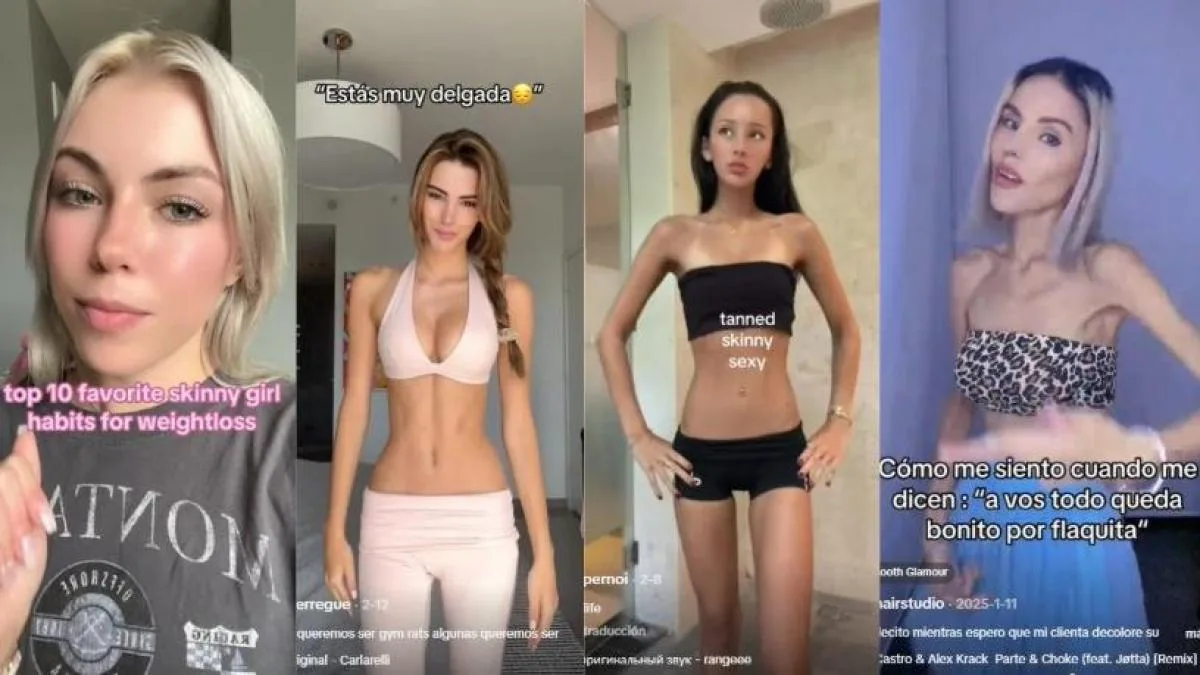
Flat abdomens, extremely thin arms and legs, almost geometric bodies with well-defined bones. A girl explains to the camera, in a soft and low voice, a series of habits that have allowed her to achieve the body of her dreams, a body that is extremely thin.
Read more The sale of homes has now seen three consecutive months of decline this year
Although the hashtag #skinnytok is banned by TikTok, other hashtags like #sk!nnytok (with the inverted exclamation mark replacing the i), #dreambody (dream body) #skinnygirl (thin girl) or #adelgazar, among others, continue to work as an entry point to what is known as “SkinnyTok,” a kind of community or repertoire of users who show their slender bodies and share their “skinny tips,” “secrets,” routines, and the “mindset” or mentality that – they claim – has allowed them to lose weight and stay thin.
Pathological behaviors such as undernourishment, extreme exercise, vomiting, laxative use, and other purging behaviors are normalized
Mireia Masià Mohedano
Psychologist
“Don’t reward yourself with food,” “food is fuel, not a prize,” “if you want to be thin, you must leave the victim mentality,” “if you are trying to lose weight, you need to obsess over the process,” “fat lasts longer than flavor,” are some of the messages they share with their followers. Some show everything they supposedly eat in a day.
Among the habits they recommend are staying excessively hydrated, walking and exercising daily, closely monitoring their weight, developing the habit of not finishing plates of food, and normalizing feeling hungry: “you can’t expect not to be hungry when losing weight.” Extreme thinness is the #dreambody, the dream body, something aspirational to achieve: “Nothing tastes as good as being thin.” Those who say otherwise do so out of envy.
Also read
Between monologues to the camera, outfit tests, skincare routines, choreographies, day vlogs, parades of healthy food plates and snacks, an unattainable beauty ideal is promoted and sold as a healthy lifestyle to a set of behaviors that are actually risky. “Pathological behaviors such as undernourishment or compensatory behaviors like extreme exercise, vomiting, laxative use, and other purging behaviors are normalized and trivialized,” says Mireia Masià Mohedano, general health psychologist at the Júlia Farré Nutrition and Psychonutrition Center.
Although the Ozempic trend is getting us used to seeing perhaps more super-thin bodies than ever, the exaltation and promotion of extreme thinness is not new. “It is not new at all and did not arise out of nowhere: it is the latest version of a culture that has been telling women for decades that their body is a permanent improvement project,” explains psychologist and doctor in Psychopedagogy, Maria Calado Otero, and recalls that what we now call SkinnyTok has its direct antecedents in the “pro-ana” and “pro-mia” blogs of the 2000s, in Tumblr pages full of images of extremely thin bodies presented as ideals, and in fashion magazines that published impossible bodies without any warning.
It used to be openly sold as beauty, now it is sold as health (…) That makes it much harder to question
Maria Calado Otero
Doctor in Psychopedagogy
The underlying logic, she points out, remains the same: extreme thinness as a symbol of success, self-control, and desirable femininity. What has changed is the discourse: “While it used to be openly sold as beauty, now it is sold as health.” The thin body ceases to be presented only as the pretty body and becomes the healthy, disciplined body that “takes care of itself.” “That makes it much harder to question because who is going to be against health? But behind that health language hides the same old message: your body, as it is, is not enough,” Calado Otero indicates.
For sociologist Clara Guilló Girard, PhD from the Complutense University of Madrid and director of the report, we are facing a cyclical phenomenon: “Every so often, very negative messages aimed at women, especially younger ones, reappear, revolving around their physical appearance and, in many cases, extreme thinness or body modification.” This pattern is part of a culture where, from a very early age, women are told that their value is linked to their image and external gaze. “It is something that is part of our identity and very difficult to deconstruct,” she points out.
“Being pretty and thin still has more social value for women,” agrees psychologist Mireia Masià Mohedano and adds: “I want to think less and less, but men tend to be defined more by other qualities: intelligence, character, sports or social skills.”
Many of her patients, the psychologist indicates, “worry more about being pretty and thin than about being intelligent or intellectually recognized. And it’s not because they are superficial, but because all their lives they have received the message that this is the most important thing.” Although she observes that body pressure is also increasing in males, “in them more athletic and strong bodies predominate, which perhaps do not encourage such restrictive behaviors, although other equally pathological ones do.” In females, the female beauty ideal is more linked to thinness and perfection.
Same messages, new media
TikTok has characteristics that make it an especially powerful vector for this type of message, assures psychologist Maria Calado Otero: “While before you had to go looking for this content, now the content looks for you.” Also, it appears more subtly and attractively, “in video format, with music, with real people telling their day-to-day, which generates an illusion of closeness and normality that magazines could not offer. Symbolic violence works better when it seems everyday.”
The platform not only amplifies this content but personalizes it. “The recommendation algorithm is extraordinarily precise, the video format generates greater emotional impact than a static image, and the consumption model is infinite: there is no page end, no natural pause moment,” she adds.
That lack of disconnection makes young women especially vulnerable to this type of content, compared to previous generations, who were not subject to such permanent exposure. “Before, these messages reached you more sporadically, for example, when watching television. Then you could retreat to a safe space where they wouldn’t reach you. Also, there were more role models and social exchange spaces outside digital,” explains sociologist Clara Guilló Girard.
“It is the generation of connection to networks and disconnection from the human,” points out psychologist Mireia Masià Mohedano. That makes us increasingly isolated and at the same time subject to unreal consumerist stimuli, which result in a feeling of dissatisfaction: “When looking at the phone, we see constant trips, multiple clothing collections per year, perfect houses. However, if we looked at our real environment, we would see that our friends have houses, bodies, and lifestyles more similar to ours, and we would probably feel like one of them,” she notes.
An algorithm crossed by the gender gap
If you are a young girl, the algorithm will tend to show you content focused on the body, thinness, diets, exercise, and physical transformation. If you are older, it will show you others also linked to image, such as aesthetic procedures, fertility treatments, or anti-aging treatments. If you are a young man, it will prioritize gym exercises, bodybuilding, physical performance, or investments and economic success. This helps to understand why a phenomenon like SkinnyTok especially affects young women.
“The algorithm is not neutral, it is designed by people and responds to economic interests. Platforms are private companies, where most decision-making positions are held by men, and whose goal is to maximize time spent,” explains expert Clara Guilló Girard. The result is a highly segmented experience.
According to what sociologist Clara Guilló Girard has been able to verify in the study on Self-perception of women’s image in new digital environments developed for the Institute of Women, this type of message “is very negative and, when men are also subject to them, they have exactly the same harmful effects on mental health, with a direct relationship to eating disorders.”
Read more Ford confirms an SUV for its Valencia plant in 2028 as part of its new European strategy
According to the report, there is an almost universal use of social networks (97% of respondents use them). The analyzed content reflects the persistence of stereotypes on networks and, according to participants’ perception, the women represented in them are of high economic status (60.2% strongly agree), thin (55.6%), without disabilities (54.9%), and non-racialized (52.6%).
Also, six out of ten advertising contents that young people receive on social networks are linked to fashion (63.5%) and beauty (61.5%), 41% relate to workouts, and 33.7% to food or diets. Additionally, 70% of young women report having frequently and occasionally received ads about aesthetic operations.
All this impacts women between 18 and 30 years old, according to the work. More than half (56.7%) express feeling pressure to look like the women appearing in digital content. Negative feelings, risk of developing eating disorders, body dissatisfaction, anxiety, and social isolation also stand out.
A beauty ideal that puts mental health at risk
The accumulated scientific evidence points out that repeated exposure to these extreme thinness ideals contributes to internalizing them and is associated with greater body dissatisfaction and negative social comparison. Thus, in predisposed individuals, they can act as a precipitating or maintaining factor of an eating disorder, says psychologist Maria Calado Otero. “I am not saying TikTok causes anorexia, the etiology of EDs is complex and multifactorial, but this content is not harmless and continuous and personalized exposure poses a real risk to mental health, especially in stages of greater identity plasticity,” she clarifies.
Receiving this type of message almost constantly at a vital stage where identity itself is still in full formation can be highly damaging to mental health. “More and more young girls come saying their behaviors started from something they saw on social networks,” assures psychologist Mireia Masià Mohedano.
“I started dieting because I saw a girl explaining how to lose weight,” “I obsessed over my belly because on social networks everyone has a flat one,” or even “I started self-harming because I saw it on TikTok,” are some of the phrases the professional has heard in consultation. Many patients – she indicates – also report fear of posting photos for fear of not getting enough likes, spend a lot of time taking photos or videos trying to look perfect, do not want to upload full-body photos, compare themselves with other girls, and even retouch their bodies with tools like Photoshop before posting an image. “Most of them feel worse after using social networks than before,” she points out.
If the harm is clear, why aren’t the measures to stop it?
If you search TikTok for “Skinny Tok,” the platform does not directly clarify that this content is blocked. Instead, a message will appear: “You are not alone,” along with help resources. According to a recent Politico article, the European Commission is investigating whether TikTok is doing enough to stop this type of content. But, in any case, it is hard to think that the phenomenon can be completely eliminated. With any type of restriction, it moves, reconfigures, and finds new ways of spreading.
These are subtle contents that do not explicitly say what they promote, which is maintaining a deficient diet to lose weight. On the contrary, they claim to promote a healthy lifestyle. Added to this is that platforms make money from this type of content, which generates a lot of traction and views. And they themselves are in charge of moderating them.
“Platforms make money from screen time, and this content generates a lot. There is no real economic incentive to proactively remove them,” says psychologist Maria Calado Otero.
After TikTok removed Liv Schmidt’s account, one of the most powerful influencers in the Skinny Tok universe, her messages not only continued and continue to be replicated through other accounts – some share, for example, what a day in their lives is like being part of their community – but she even migrated her follower base to Instagram, where she promotes her subscriber community, which she calls ‘Skinni Societé’.
Accessing this type of content remains easy. If one tag is banned, others appear that lead to the same thing. “Added to this is that many images are retouched or filtered and the platform cannot or does not want to distinguish between a real body and a digitally constructed one, and the person consuming it does not always know either,” points out psychologist Maria Calado Otero. For her, “what we need is not only content moderation but external regulation, media and digital literacy from an early age, and a serious social debate about what kind of platforms we want and under what conditions.”
Sociologist Clara Guilló Girard insists on expanding the repertoire of role models, offering greater diversity in which young women can see themselves reflected, and promoting positive messages and views about themselves and their bodies in women. “Diversity is what most favors a young woman finding her style, her path, her way of being,” she assures.
At the same time, she reminds us that the body is not a project to perfect, but what sustains life: “It is the one that accompanies you throughout your existence. It is a body that evolves with you and, therefore, will never be perfect nor always the same,” she says. She also raises the importance of shifting the value axis beyond appearance: “We must remind young people that paying too much attention to their physical appearance and being subject to the external gaze takes away time to think and do other much more valuable things.”
Read more The next disappointment in Barcelona