






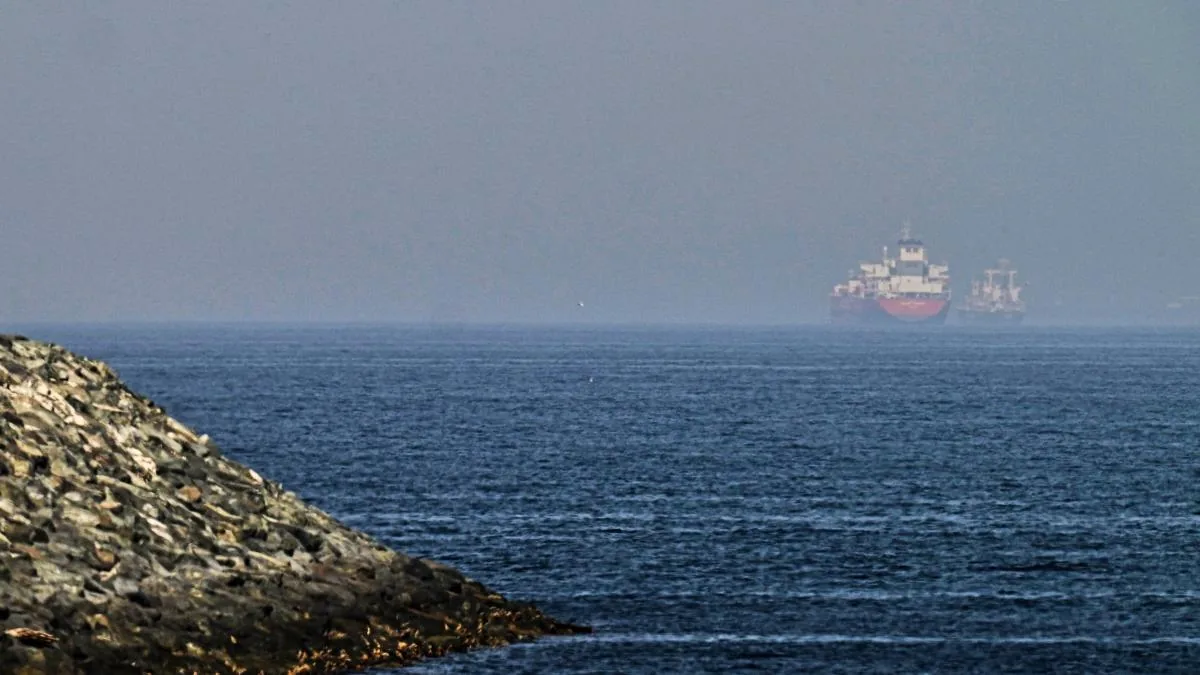
The military operation that the U.S. president, Donald Trump, announced for this Monday as a “humanitarian gesture” meant to escort ships through the Strait of Hormuz encountered its first obstacle: the Iranian navy fired two missiles at a U.S. frigate that was about to enter the maritime route through which 20% of the world’s oil passes.
Read more South Korea investigates possible attack on a ship in the Strait of Hormuz
After issuing a “firm and swift warning,” which was “ignored” by the U.S. destroyer, the Iranian Army Naval Force fired the projectiles near the port of Jask which, according to the Fars news agency, hit their target, although the United States denied it. “No U.S. Navy ship has been hit,” reported the U.S. Central Command, which later added that it has already facilitated the passage of two merchant ships flying the U.S. flag.
The announcement comes shortly after the Armed Forces of the North American country denied the attack on one of their vessels while trying to cross the strategic crude oil and goods route, whose traffic was interrupted by Iran in retaliation for the war launched by the U.S. and Israel.
Also read
Shortly before, Iran had warned that any warship, including American ones, trying to cross the strategic strait where hundreds of cargo ships have been trapped for more than two months. “We warn that any foreign armed force, especially the aggressive U.S. military, will be the target of our attacks if it tries to approach or enter the Strait of Hormuz,” declared General Ali Abdolahi, commander of Iran’s Khatam al Anbiya Unified Operations Command. In addition, the senior military official reminded “all commercial and oil tankers” that they must coordinate with the Iranian army so that “their safety is not compromised.”
Abdolahi also stated that U.S. actions to “alter the current situation will have no other result than to further complicate the scenario and put the safety of vessels in this area at risk.”
The warnings from the Iranian general came alongside the publication of a new map by the Iranian Revolutionary Guard Navy establishing a “new zone” of “control and management” over the Strait of Hormuz. The delimited area starts in the west, with a line connecting the western end of the Iranian island of Qeshm with the emirate of Umm al Quwain of the United Arab Emirates. In the east, the area ends at a line connecting Mount Mobarak in Iran with the emirate of Fujairah of the United Arab Emirates.
The publication of the map underscores Iran’s firm demand to maintain control over the corridor, a fact that before the war initiated by the U.S. and Israel was a fearsome yet unprecedented scenario.
Trump announced on Sunday the operation Project Liberty, which will mobilize more than 100 aircraft, destroyers, drones, and 15,000 military personnel to free the vessels trapped in the Strait of Hormuz by the Iranian blockade. The mission effectively began this Monday as planned: “U.S. forces are supporting Project Liberty and enforcing the naval blockade on Iranian ports,” wrote the U.S. Central Command.
Transit through the strategic Strait of Hormuz has been restricted by Iran since the early days of the war with the U.S. and Israel, which broke out on February 28. In response, the United States has also imposed a naval blockade on Iranian ports and ships in the area since April 13.
Read more María Jesús Montero: “The middle classes of Andalusia are at risk with Moreno Bonilla’s PP”