First decline of an ultra-right force in Europe and victory, albeit by a narrow margin, for the progressives. Although the result largely responds to internal factors, Sweden has surprised in a context that is accelerating in the opposite direction. Sweden Democrats (SD) have suffered a notable decline (remaining at 17.5% of the votes) after two decades of upward trend, while the Moderates achieved the overtake and regain hegemony in that political space. Is it a sign of something?
Read more Yasim, Tarek, Fitah and hundreds of other minors who know they will not be returned to Morocco
In reality, the SD has achieved a triumph in recent years: becoming part of the party ecosystem, ceasing to be a political pariah. It has gone from maintaining neo-Nazi connections in the 80s and 90s to supporting the conservatives in Parliament and, during the last campaign, managed to get the traditional right to formally accept its entry into government if they won. Moreover, they have managed that not only the Moderates but also the Social Democrats have shifted some of their ideological positions, especially on migration and security discourse.
Swedish progressives have not adopted the positions of their Danish colleagues, but they have evolved from their traditional humanitarian postulates to much more restrictive ones. In the 2015 refugee crisis, Sweden was one of the most open countries to displaced people. The Swedish Social Democratic leader, Magdalena Andersson, has now considered that was a mistake and, although she has not lost focus on defending migrants’ rights, she emphasizes much more border control and integration requirements. The so-called Danish model, on the other hand, combines economic social democracy (welfare state protection, defense of taxes and labor rights) with a very restrictive migration policy, which makes the prime minister of that country, the progressive Mette Frederiksen, the “Meloni of the north,” opposed to Pedro Sánchez. To such an extent do the Social Democrats governing Denmark follow the dictates of the far right on immigration accompanied by strong cultural nationalism, that they implemented the so-called “ghetto law,” which allowed the Executive to draft lists of neighborhoods according to education level, unemployment, crime, or income, and if more than 50% of the population came from outside the EU, particular conditions were applied, such as harsher prison sentences or less social housing to seek their dispersion. This distinction was justified precisely by the need to avoid ghettos, but European justice ruled that it was discriminatory.
In any case, these are two examples of how Social Democratic parties have assimilated a tougher discourse against immigration compared to a few years ago. And if this happens on the left, it is obvious that it also happens on the traditional right. The Swedish Moderates who have regained momentum have done so by assimilating the extremists’ discourse in that regard. It is assumed that society has shifted and these forces consider it necessary to adapt to the new demands of their voters rather than leave them in the hands of far-right formations. But this is not the case everywhere. In Germany, Chancellor Friedrich Merz does not achieve this effect in the face of the rise of the AfD.
The majority of Spaniards consider themselves centrist, just as several decades ago
In Spain, the latest polls reveal that Vox continues to rise and that the PP, which has hardened its discourse, remains steady. Some voices repeat that Alberto Núñez Feijóo should focus his narrative and not compete with Santiago Abascal, but within the party, they believe that would only open a bleeding of votes to the far right. Deep down, what Feijóo’s formation is defending is that the political center in Spain has shifted to the right. According to this thesis, the PP would only be accompanying the demands of its voters. Let’s look at some data extracted from the CIS…
The first observation is that, according to the latest barometer, the sum of right-wing parties already surpasses that of the left. But more due to the weakness of the latter than their own growth. In the 2023 general elections, the right-wing bloc attracted 46% of the votes and the CIS now indicates they would be at 42%, while the left-wing correlation would have gone from 44% to 40%. The second observation is that within the right, Vox continues to rise, with a voting loyalty of no less than 75% and very strong among young men.
Read more Europe proposes to «flexibilize» migration rules in the face of crises like that of Ceuta
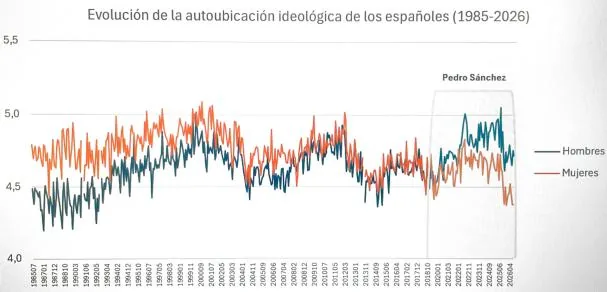
Let’s continue… When Spaniards are asked where they place themselves on a scale from 1 to 10 between left and right, Spain shows a very similar picture for decades. If in 2018, the year Pedro Sánchez came to La Moncloa, CIS interviewees mostly placed themselves at 4.7, in March of this year they are… right in the same spot!
At that point on the scale is where more than 20% of voters have coincided for many years. Spain would still be just as centrist now as in the times of the UCD… “What changes is the meaning of the center for the population,” points out Paco Camas, director of public opinion research at Ipsos-Spain. Camas adds that the only change on that scale has occurred at the extremes, increasingly polarized. In any case, he notes that during Sánchez’s years in government, there has been a progressive shift to the right, especially among men, although the latest CIS records a sharp interruption of that trend in recent months, something for which there seems to be no clear explanation (see attached graph) and which some polling experts would not hesitate to attribute to a bias of the agency’s director.
Although the majority feel centrist, 80% of the population believes that borders must be strengthened against immigration, an issue championed by the right and which has become the second concern of those surveyed. In other words, we still mostly believe we are in the center, although we have incorporated as priorities traditional positions of the right-wing agenda such as immigration, security, and taxes. Does centrality mean the same now as twenty years ago? Or is centrality where most voters gather? During the procés, for example, some leaders of Convergència and the PSC approached independence arguing that the center in Catalonia had shifted toward defending independence. Would that rather be the center of gravity around which politics revolves at a given moment?
If the agenda has focused on issues where the right feels more comfortable, the result is that the PP and Vox increasingly penetrate the center without needing to moderate their language. Sociologist Ignacio Urquizu highlighted this in a tweet with a CIS graph showing how PP voters place themselves between 5 and 10 on the ideological scale. Urquizu recalled that “always, whoever wins at 5 wins the elections, except in 2019.”
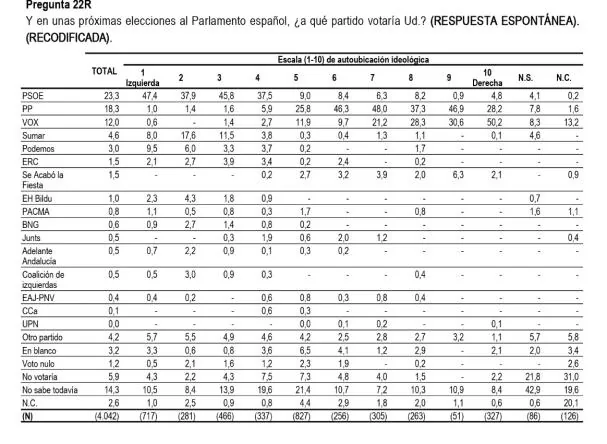
In that same graph, we can see how Sánchez’s PSOE would be very skewed to the left compared to past decades and would cover from 1 to 4 on the same scale. No less than 47% of those who consider themselves at the far left would vote for the Prime Minister. Those who place themselves in the center, center, that is, at 5 on the scale, would vote for the PP at almost 26%, Vox near 12%, and PSOE 9%. In short, the PP now occupies more of the centrality (or rather, the perception of centrality) than the PSOE. And Sánchez represents the Swedish reverse.