









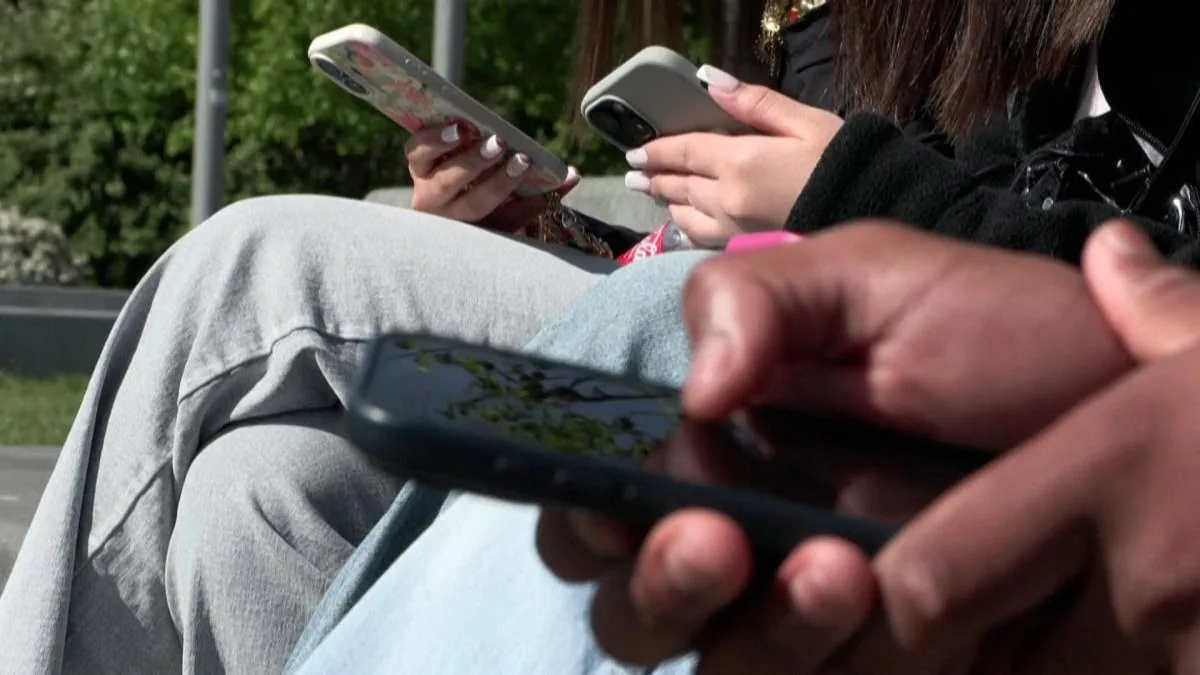
The European Commission will tomorrow present a legislative proposal to prohibit access to social networks for those under 15 years old, which will be accompanied by new security requirements for online games and artificial intelligence chatbots, defined as “virtual tools that can offer advice on mental health and personal development to minors.”
Read more ‘The Black Ball’, by the Javis, rolls towards the Oscar
Minors under 15 will not be able to open accounts on social networks and video-sharing platforms without parental authorization, while tech companies will be required to incorporate greater security measures and parental controls.
The proposal is part of the European Child Protection on the Internet law (EU Kids Act) that the President of the European Commission, Ursula von der Leyen, and the EU technology chief, Henna Virkkunen, will present this Thursday, September 17.
Companies will be required to incorporate greater security measures and parental controls
Worldwide concerns have increased about the impact that large platforms such as Facebook and Instagram, from Meta, TikTok, YouTube, from Google, and ChatGPT may have on the health and safety of minors.
Countries such as Spain, France, Greece, Austria, Denmark, Belgium, Italy, Germany, Poland, and the Netherlands are studying or processing national laws to restrict the use of social networks by minors, which has increased pressure on Brussels to present a European measure. In fact, Spain was one of the first countries to address the dangers of the internet for the youngest and has a Child Protection in Digital Environments law that is currently being processed in the Congress of Deputies.
Also read
The Commission is preparing the legislative proposal after its president, Ursula von der Leyen, delivered her annual State of the Union speech before the European Parliament. “I am aware that many consider the power of big tech companies overwhelming and that it is impossible to reverse it. I do not agree. We do not have to accept features designed to generate addiction. We do not have to accept that minors are drawn to increasingly extreme content. We do not have to accept that girls’ photos are used to generate sexualized images through AI,” she asserted.
The Commission’s proposal, which also covers gaming platforms, contemplates gradual access to different services based on age. Von der Leyen expressed this during her annual speech: “Each age has its own particularities and vulnerabilities. Therefore, each age group will have an adapted level of protection.” At the same time, the obligations imposed on companies will depend on the type of service and the age of the minors.
Read more China imposes new restrictions on traveling abroad for «at-risk» groups
Children aged 13 and 14 will only have basic accounts, created and supervised by parents
Restrictions apply to all minors under 15 and follow a gradual approach. Minors aged 15 and over will be able to create their own accounts, while children aged 13 and 14 will only have basic accounts, created and supervised by parents, with limited functionalities and time restrictions. Additionally, Von der Leyen recalled that, between 15 and 18 years old, platforms will be required to apply a “safe design.”
Accounts for minors between 3 and 12 years old will be fully controlled by their parents and can only be used for services adapted to minors that comply with strict safety standards, according to the document. Finally, minors under 3 years old will not have access to these services.
Age verifications
Both social networks and video platforms will be required to verify the age of minors when a user opens a new account, while online games will have to verify the age of minors before they can download them.
According to the Commission’s document, companies will have to pay a supervision fee intended to finance control tasks. Avoiding addictive designs and harmful content or recommendation systems are other requirements the Commission will impose on platforms, in addition to providing tools that allow minors to easily report harmful content. Meta agreed last August to pay 17.1 billion dollars to settle the lawsuit for attacking children’s mental health caused by applications like Facebook and Instagram, in which it established mechanisms to create addiction.
Also read
All these recommendations follow the guidelines of a European expert committee published in July, which proposes to completely ban access to social networks for children under 13 years old.
Details of the draft could change before the announcement. Additionally, the Commission will have to work on the draft with Member States and the European Parliament over the coming months before it can become law.
Read more Identified El Trompas as the main suspect in the murder of student Claudia Tacoronte in Mexico