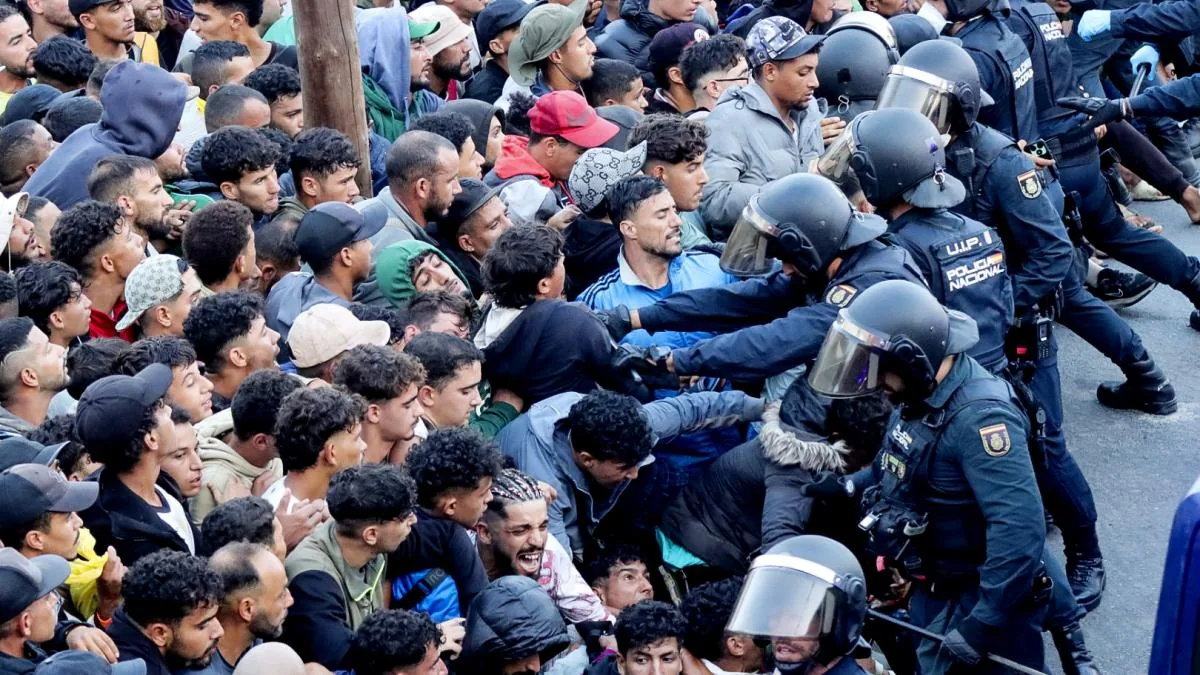
The tension and nerves within the Executive and its environment are increasing, and the Ceuta crisis has made it rise even more. The fear of a new judicial fire affecting the Government caused two moves yesterday that were appeased by the president of the judiciary, Isabel Perelló, who had to demand the “utmost respect” for the judge of the National Court María Tardón.
Read more Sánchez convinces neither allies nor adversaries about his management in Ceuta
The first move, more tactical and as risk control, was to remove the prosecutor in charge of studying the complaint filed in the National Court for the massive entry of migrants into Ceuta on July 30 and 31. The chief prosecutor of the National Court, Jesús Alonso, informed the magistrate yesterday that he would take on the matter. In nine years as chief, this is the third case he has taken on, which indicates the magnitude of the relevance and transcendence of the case.
His role now will be to inform the instructor of his position on the jurisdiction of the National Court to investigate the facts and on the possible existence of any crime. All this will be done under the baton of the State Attorney General’s Office. However, and as has recently happened in other matters that have affected the Government or the president’s environment, Pedro Sánchez, Tardón could initiate a formal investigation and admit the complaint filed by an accusation against the prosecutor’s criteria.
The second move came, again, from the Minister of the Interior, Fernando Grande-Marlaska. Along with Pedro Sánchez, from the first moment he has dissociated Morocco from the assault and denied that there were early warnings about what could happen. However, the police report delivered to Tardón this week was a frontal clash with his theses.
This caused him to ask for explanations from the Director General of the Police, Francisco Pardo. After these were offered, he took a second step which was to ask for explanations from the president of the CGPJ about Tardón’s order to police officers not to inform their superiors about the content of the requested report on the situation in Ceuta.
Perelló was quick to respond to the minister’s letter, a judge of the National Court on leave, and explained in another letter that the governing bodies of the Judiciary – and therefore she as president of the Supreme Court and the CGPJ – “are constitutionally and legally forbidden to approve, censor or correct judicial actions.”
The pointing at Morocco has a core relevance. The ministries involved in managing the crisis are convinced that their plan for Ceuta is not possible without the full cooperation of Morocco, so any misstep that bothers the neighboring country could undermine the progress of recent weeks. The autonomous city will not return to normality until all immigrants who do not have the right to international protection are expelled.
Read more Werner Herzog mimics Kate and Rooney Mara in the dreamlike ‘Bucking Fastard’
Also read
No matter how many people are taken off the street – still at a very slow pace – and the return procedures are processed – even more clogged – if Rabat does not keep the return door open for its compatriots, nothing will have served.
“In every decision made, in every step taken, the presence of not upsetting Morocco is always there. And even so, we go with the fear that it may be seen as a provocation,” admit ministerial sources.
That is why the National Court opening an investigation and the Spanish police already pointing to the “total passivity” of the Moroccan police and a possible established plan to pressure Spain generates diplomatic tension at such a delicate moment as this.
Added to all this is that the Moroccan Minister of Foreign Affairs, Naser Bourita, has informed his Spanish counterpart, José Manuel Albares, that the authorities of his country have opened an investigation into the massive entry, after the Police undermined his report of indications pointing to Rabat’s connivance, with some of its gendarmes actively guiding people around the vicinity of the Tarajal border breakwater.
This fact is not trivial considering that the Spanish justice must obligatorily verify if there is an open investigation abroad before assuming jurisdiction, according to the subsidiarity principle to avoid duplication of processes for the same fact.
However, Morocco has imposed its particular law of silence. Several Alawite NGOs raised the death toll of the avalanche to 141 on both sides of the border. Rabat does not recognize any deaths in its waters. Nor in the Spanish ones: six of the bodies that were identified, and claimed by their relatives, had to be buried in the Muslim cemetery of Ceuta because Rabat prevented the hearses from crossing the border.