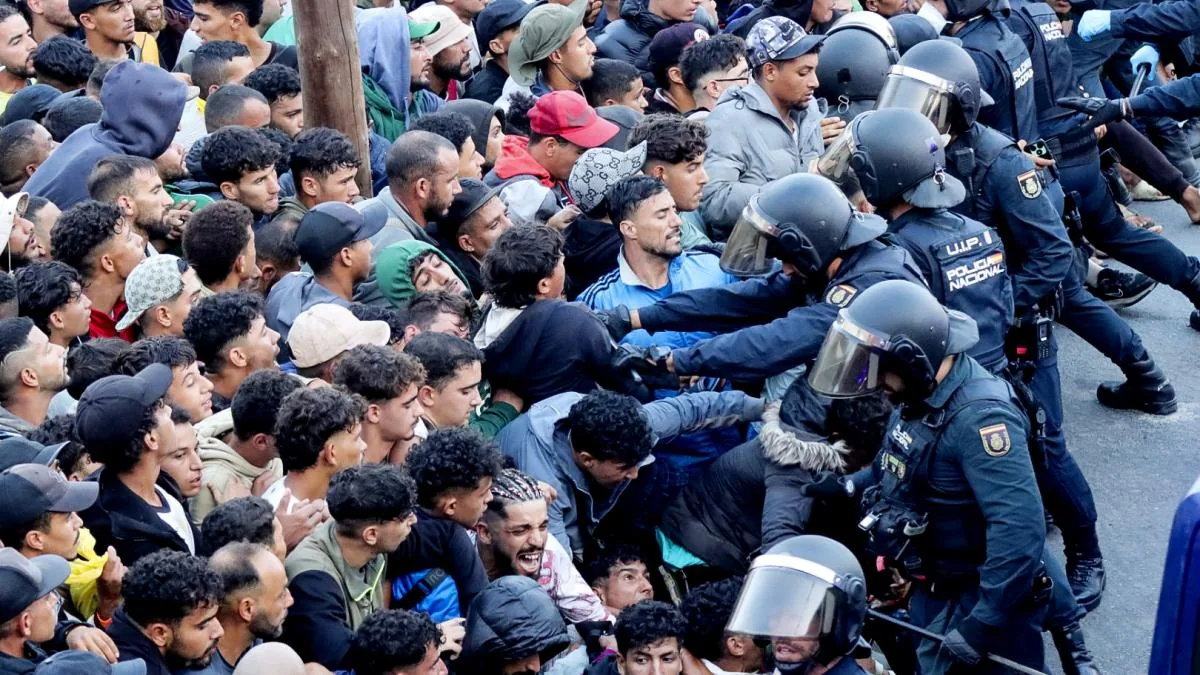
The president of the Supreme Court and the General Council of the Judiciary (CGPJ), Isabel Perelló, was quick to respond to the Minister of the Interior, Fernando Grande-Marlaska, regarding his complaints against the judge of the National Court María Tardón for her investigations into the migration crisis in Ceuta. She has asked that the “utmost respect” be given to the decisions made by the investigating judge, who has requested several judicial reports before deciding whether to initiate a formal investigation.
Read more Malkovich raises the bar in Venice with a satire about the CIA that could earn him an Oscar
In her letter, Perelló replied to his letter in which he expressed concern about the order from the investigating judge to the Police and Civil Guard not to inform their superiors about the content of the requested reports on possible perpetrators and prior alerts of the massive entry of nearly 80,000 people from Morocco on July 30 and 31.
The president of the judges’ body warns that the governing bodies of the Judiciary – and therefore she as president of the Supreme Court and the CGPJ – “are constitutionally and legally prohibited from approving, censuring, or correcting judicial actions,” as provided by the organic law of the judiciary.
She also reminds him of the function of the judicial police under the order of the judges, which corresponds to all members of the State Security Forces and Corps, “regardless of their nature and dependency.”
“In short, I am, as it could not be otherwise, fully in agreement with you in your assessments about the seriousness and extraordinary nature of the crisis we are facing, as well as that the magistrate’s actions correspond to the exercise of her constitutional functions, for which we must all show the utmost respect,” the letter concludes.
Marlaska defended in his letter that in a crisis situation like the one entrenched in Ceuta, where thousands of people continue to wander the streets or spend the night in camps outdoors because the Government has not deployed its full reception capacity, “it should not be incompatible to diligently attend to the information requests from judicial bodies while informing superiors and political leaders of any circumstances that may be relevant for decision-making in managing a crisis of such magnitude.” Such was the gravity that it forced the declaration of a situation of interest for national security, a month after the massive crossing.
For the Interior Minister, the information available to the National Police is “of great interest” to his department and for the Government to exercise “with the greatest accuracy its constitutional functions of directing internal and external policy and defending the State.” Yesterday, after the police report was made public, which included indications pointing to Rabat’s connivance in the human avalanche, the Interior Ministry stated it was unaware of this evidence, which would place Moroccan gendarmes “actively guiding” migrants near the border crossing.
Therefore, Grande-Marlaska concludes, in extremely serious situations like the one being experienced in Ceuta, it must be compatible, “without compromising judicial independence,” that the judicial police “inform the judicial bodies, for the exercise of their constitutional function, while also providing the Government and its members, also for the exercise of their constitutional function, with all relevant information for making the most appropriate decisions in defense of the general interest and, in this case, public security and national security.”
Read more Trump refers to Spain as a «ruined country» and states that the Ceuta crisis «is sad to see»