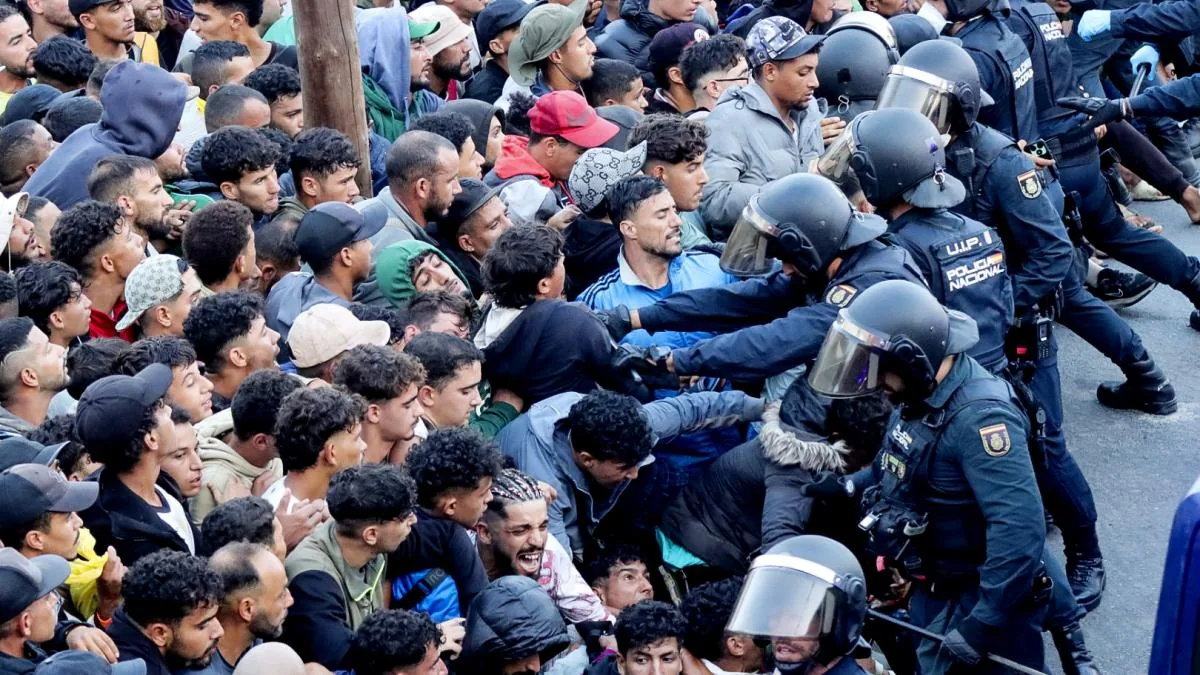
The Minister of Foreign Affairs, José Manuel Albares, has attributed the jump over the fence at the Ceuta border on July 30 from Morocco to the incitement caused by misinformation used by very interested actors whom he identified as “the reactionary international.”
Read more Serbia will bury Ratko Mladić with honors, convicted of genocide in Bosnia
The minister is still testifying at this hour in the Foreign Affairs committee, one of the longest and most detailed held in Congress this week.
Albares recalled that Ceuta and also Melilla are the most unequal borders in the world and that there are interested actors emphasizing this polarization; it is, he recalled, the only land border that connects territory of European countries with African ones.

The foreign minister has defended diplomatic dialogue with Morocco from the origin of the crisis. It was essential, said the minister, for most of those who entered through El Tarajal, at the border between Ceuta and Morocco, to return where they had come from within 48 hours, and it was also essential to prevent the situation from repeating with the new jump attempt on August 15 when a real threat was repeated. However, he also pointed out that he will “never” have conversations with this country about the sovereignty of Ceuta and Melilla, which he considers unquestionably Spanish.
Albares has tried to reconstruct the collusion of events that led to the Ceuta disaster where it should not be forgotten that more than a hundred people drowned. For the Foreign Minister, the Supreme Court ruling that, according to the law, made the “hot” return of migrants who crossed the border irregularly difficult generated a stream of information that, like in the game of broken telephone, changed meaning until it became a message saying: Spain’s borders in Ceuta are open.
That message went viral when a message on Instagram from two Moroccan girls greeting from the beach of El Tarajal, where they had arrived without problems, had four million views.
And that is where the “reactionary international” that the minister points to appears, which rides this already circulating current, amplifies it, and above all, reinterprets it according to its political positions: that of invasion and the replacement of white and Christian culture. Elon Musk sends a couple of AI-made messages that reach astronomical dissemination figures. But so do the Russians from the other side of the planet. Result: not only a humanitarian tragedy but political chaos
Europe’s and Meloni’s response
Minister Albares also referred to the response he received from Europe in this crisis, which was singularly different from that received in 2021 when a much more modest avalanche in figures and consequences than that of this August occurred.
He was especially harsh with Italian Prime Minister Giorgia Meloni, whom he accused of imposing new rules of the game in Schengen in her relations with Spain for strictly electoral reasons of domestic politics. Spain, which, as will be recalled, also imposed a limitation on freedom of movement between Italy and Spain a week later, has not yet reconsidered restoring full freedom of movement.
Read more Retirees will be able to return to work as self-employed and keep part of their pension
The minister considered that the Schengen limitation constitutes an “arbitrary” measure that implies an “unjustified and unjustifiable grievance to the dignity of Spaniards,” especially considering, as he recalled, the double filter system operating in Ceuta and Melilla makes the Schengen area “fully guaranteed.” To leave Ceuta and reach the Peninsula and therefore Europe, one must pass police controls similar to those of a conventional border.
The opposition’s turn
For their part, opposition groups and the government’s traditional allies have questioned Morocco’s role in this crisis in statements collected by Europa Press. This is how the PNV deputy spokesperson, Mikel Legarda, considered it, indicating that the July 30 crisis was a migratory overflow that “Morocco could not ignore” and that, “at the very least, had to have some tacit consent.”
For Podemos spokesperson Javier Sánchez Serna, “Morocco has been blackmailing” Spain for years “throwing its own people into the sea,” and the government is showing “weakness” and “refusal to call things by their name.” “You have not only abandoned Ceuta to its fate, but with your softness towards Morocco, you have also abandoned progressive Spaniards,” he argues.
Jon Iñarritu, from Bildu, also sees “signs of active or passive participation” of Morocco in the events of July 30: “Morocco’s behavior left much to be desired and everything seems to indicate it was to send a message to the Government or the European Union,” he opines.
Marta Madrenas, from Junts, considers that Pedro Sánchez’s government sins of a “naivety difficult to understand” with Morocco and, after what happened, “nothing fits” that it boasts of the Maghreb country’s collaboration.
“The more I listen to him, the less I understand him,” summarized the spokesperson of Esquerra (ERC), Francec Marc Álvaro, after Albares’ intervention. “It is curious that on one thing all groups agree, which is that the version you give us does not fit us. And that is indeed a consensus. And when one is driving on a road and believes everyone is against, the one who is wrong is the one going in the wrong direction,” he ironized.
Even Sumar, a minority part of the government, has criticized Morocco’s role in this migratory crisis, as it considers that Rabat neglected border control duties on Throne Day, which it calls “an act of bad faith with political consequences.”
For his part, the PP spokesperson, Carlos Floriano, has considered that “He has built a relationship in which Spain makes concessions expecting stability and then discovers that this stability continues to depend on decisions made on the other side of the border.”
Read more Illa promises decisions in the new political course that “will determine the next decade”