Tension in the European social-democratic family. The behavior of the Danish Prime Minister, Mette Frederiksen, aligning herself with the Italian Giorgia Meloni in the Ceuta migration crisis, seems to have been the last straw. The Vice President of the European Parliament and member of the PSC-PSOE, Javi López, and the Foreign Affairs head of the Italian Democratic Party (PD), Beppe Provenzano, have formally protested to the Party of European Socialists (PES) over her unsupportive attitude, in a very unusual public gesture within the same political family. It is not very common for such criticism to be raised and for the issue to be requested to be addressed in the governing bodies.
Read more We have trades/Long live Spain
The letter, addressed to the party president, the Swede Stefan Löfven, laments the lack of unity in the party and accuses the Danish leader of having adopted the framework of the radical right regarding immigration. According to the text, which this newspaper has had access to, what Frederiksen has done is “unacceptable” because “while another European partner —Pedro Sánchez— was facing exceptional pressure,” a member of her own political family chose to “align, in a coordinated manner, with the Italian Prime Minister.”
Hard line against immigration
Frederiksen and Meloni go hand in hand in the European Council in favor of camps to deport migrants to third countries
Frederiksen and Meloni have long acted hand in hand promoting their iron fist against immigration in Europe. Both leaders, with an excellent relationship, have for more than a year been accustomed to organizing pre-European Council meetings among different European leaders to promote, among other things, centers to deport immigrants like those the Italian has created in Albania. These meetings, also attended by the President of the European Commission, Ursula von der Leyen, are increasingly popular and most of the leaders of the Twenty-Seven, mostly conservatives, now attend.
The Prime Minister, Pedro Sánchez, is the counterpoint to this political vision and, along with the French Emmanuel Macron, has criticized the project of camps in third countries. He already had a notable confrontation at the last European meeting in Brussels, where Frederiksen reproached him for the Spanish migrant regularization, considering that such a measure also generates consequences for other member states.
Also read
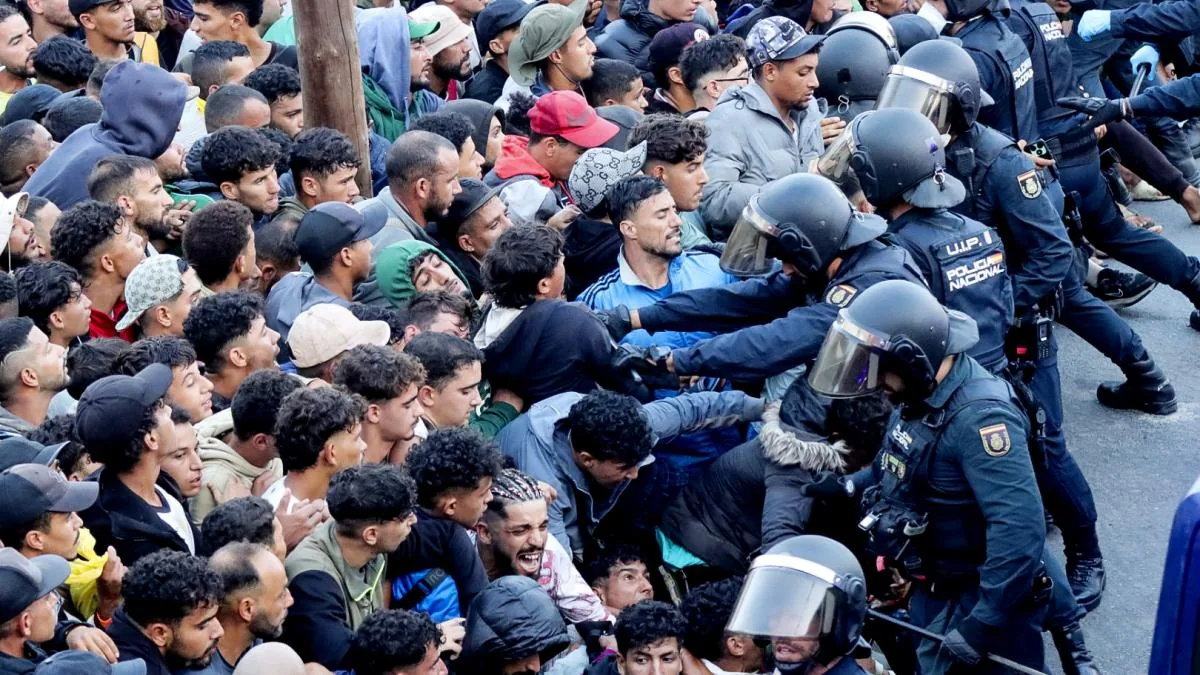
The grievance has grown after Frederiksen, a few days ago, launched a letter together with Meloni in which they directly linked the increase in irregular immigration with a rise in crime and the “recent pressure on public services and erosion of public trust.” They also demanded “increased expulsions” of people in illegal situations and the establishment of “repatriation centers in third countries, as well as other innovative solutions outside Europe.” The Dane, already after the massive arrival of about 80,000 migrants to Ceuta at the end of July, had asked the EU to consider “all options,” including the suspension of the Schengen area in Spain.
Read more More than a thousand migrants are evicted again from El Trampolín beach in Ceuta
From her position at the head of the Danish government, the social-democratic leader has promoted a series of policies controversial for the European left regarding immigration. For example, an 80,000-euro bonus for Syrian families returning to their country, programs to increase deportations of irregular migrants, forced transformation of neighborhoods to avoid “parallel societies,” or an agreement with Kosovo to rent cells in its prison to send foreigners who have committed crimes. Her party has not hesitated to link crime with migrants of certain origins while defending that her discourse is fully compatible with social-democratic values, because they believe it is a “realistic” approach since the burden of migration “goes against the working class.”
Internal unrest
López and Provenzano believe her behavior has crossed “all limits”
For all these reasons, López and Provenzano conclude that this is not a “one-off disagreement on migration policy,” but behavior that “has crossed the limits of legitimate political divergence and is generating serious political dysfunctions for our political family as a whole,” they state in the letter. In their view, in this crisis Spain has demonstrated its “capacity to manage an extremely complex situation” and protect an EU external border, so “responsibility, solidarity, and loyalty” are expected from the rest of the European partners, “especially from the social democrats.”
The leaders demand from Copenhagen the same supportive behavior that European allies showed during the Lampedusa migration crisis, when some Eastern countries suffered exploitation of migrants from Belarus, or during Trump’s threats to Greenland, a Danish autonomous territory, when all partners — including Spain — stood up in defense of Denmark.
“It is necessary to maintain a frank debate about where our common limits lie and about the minimum standards of mutual loyalty and solidarity on which we must all be able to rely,” defend the PSOE and the PD. The question is whether this bad mood among their family partners could stand in the way of Frederiksen’s future aspirations when trying to reach a European position.
Read more Human Rights Watch denounces that in Ceuta thousands of people have been left in a «legal vacuum»