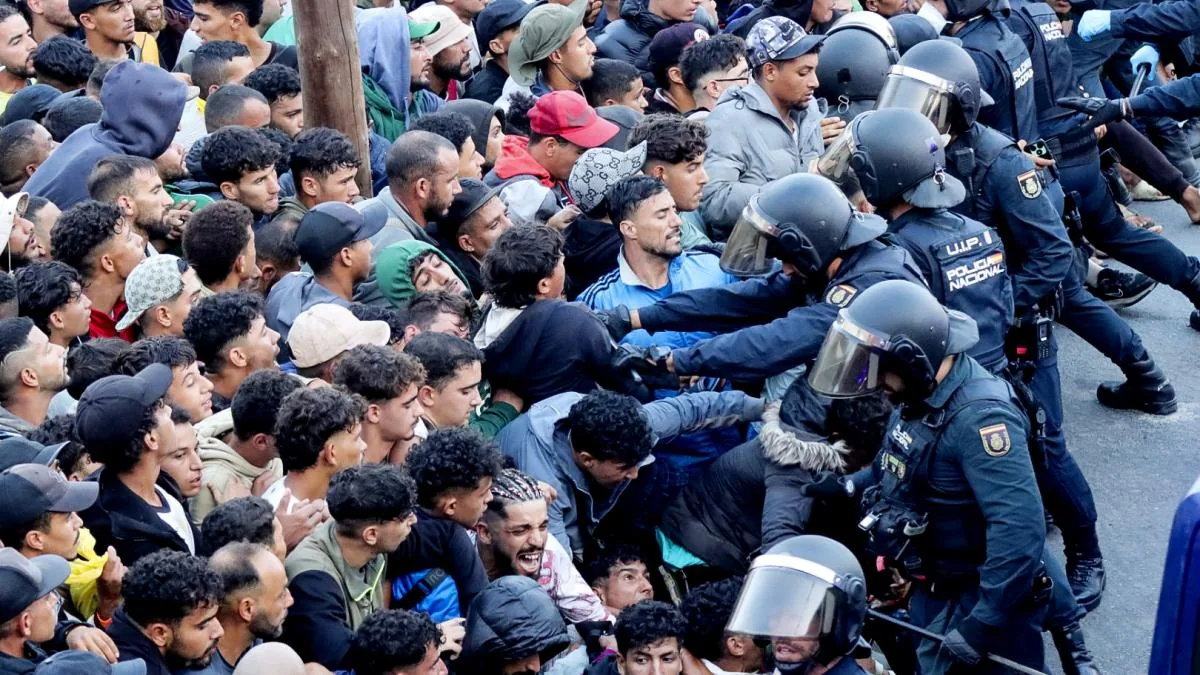
The Popular Party multiplied itself yesterday on all fronts to elevate the migration debate in Ceuta to the level of a state crisis. From the coast of Lugo to the border perimeter of the autonomous city, the opposition leadership coordinated its discourse to accuse Pedro Sánchez’s government of violating territorial integrity and to demand a structural shift that returns direct control of its borders to the Spanish institutions, moving the discussion from mere emergency management to a comprehensive questioning of the diplomatic strategy in North Africa.
Read more Official: Rodri signs for Barça until 2030
From Ceuta, where she went to analyze on the ground the aftermath of the migration episode, the PP’s deputy secretary general, Cuca Gamarra, staged alongside the Ceuta president, Juan Jesús Vivas, an unbroken agreement in the diagnosis. Both leaders noted the need to move beyond a temporary response to face deep reforms. “Structural measures must be adopted, not just see how we recover normality; more agents and more officials are needed. In short, more State is needed and on a permanent basis,” she emphasized as a summary of the needs just conveyed to her by several Ceuta social groups and union representatives from both the Police and Civil Guard.
Feijóo censures the Government for its “inert and indifferent” attitude towards the sovereignty of the Spanish people
The Populars also attacked the central government’s neighborhood policy and, in particular, its dependence on Morocco for migration control. Gamarra deemed it unacceptable to “sublease border control to a third country,” a competence that, in her view, should be exercised directly by Spanish and European institutions, through reinforcement of personnel and deployment of Frontex.
In a similar vein, Vivas called for a “shielding” against a partner who, he said, is not “reliable.”
Read more Rodri, new Barça player
This challenge to the border model found its doctrinal link in the intervention of the PP president, Alberto Núñez Feijóo. In his first public act in two weeks, on the occasion of a photographic exhibition dedicated to Leopoldo Calvo-Sotelo in Ribadeo (Lugo), the opposition leader accused the Government of acting “absent, inert and indifferent to the interests, security, and sovereignty of the Spanish people,” contrasting the responsibility of the Transition with the actions of a Cabinet to which he attributed the “degradation of the State.”
On the operational level, the explicit support granted by the European Commission to the Populars’ theses strengthened the forcefulness of Feijóo and Gamarra by insisting on the removal of all adult and minor migrants who entered Ceuta irregularly: “There is no other way out but the return to Morocco.”
Read more Brussels endorses the return of unaccompanied minors to Morocco