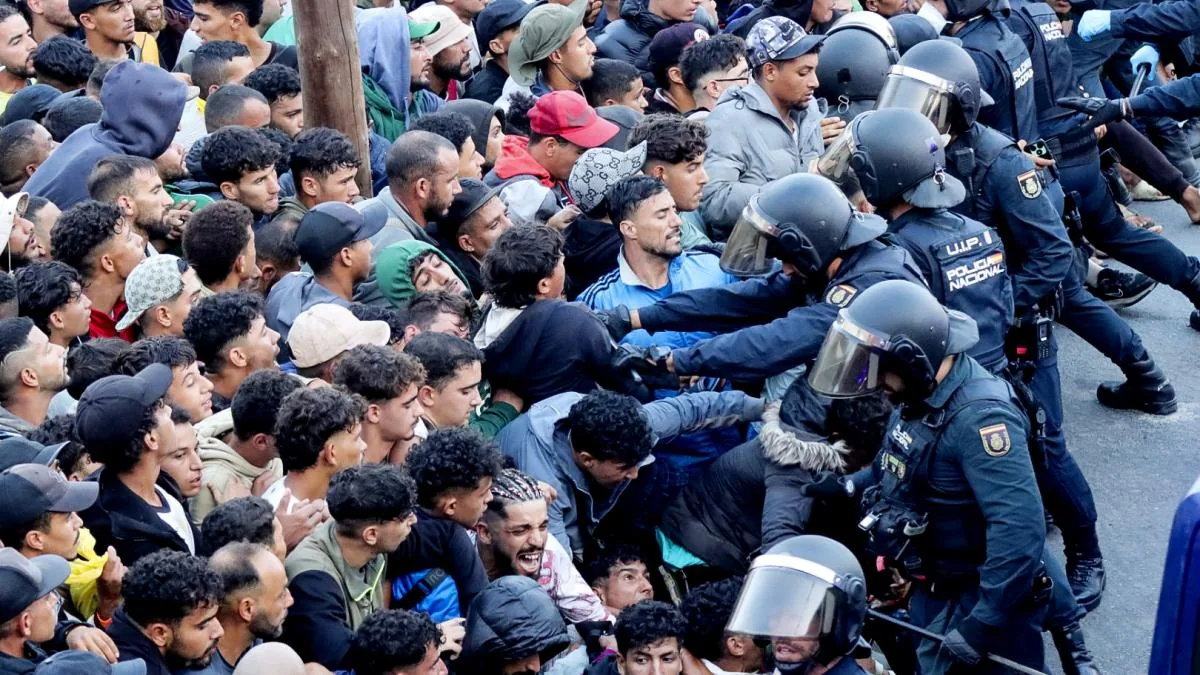
If we resort to the cold figures, as the Minister of Health, Mónica García, did yesterday, Ceuta is not suffering any healthcare collapse after the latest border assault. The healthcare pressure in the autonomous city has been decreasing since the first day of the mass crossing, when 1,149 people were attended to: last Saturday, 193 were recorded. The University Hospital of Ceuta has expanded its capacity to 212 beds, about half of which are currently empty. There are 101 patients admitted, but the immigrants occupying a bed do not reach thirty.
Read more The recent failed attack in Leipzig fuels fear of a Russian escalation
However, on the ground, at the outskirts of the city, where hundreds of immigrants remain overcrowded, another reality emerges: injured and sick people without healthcare assistance for fear that a visit to the doctor will become their expulsion passport.
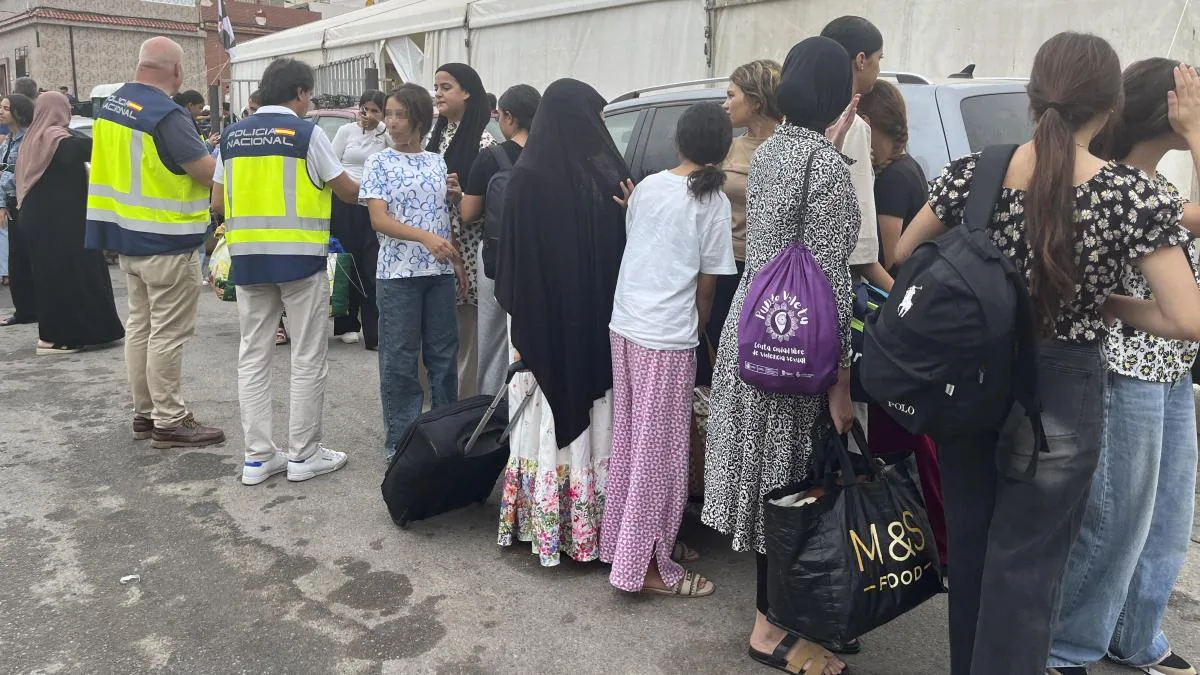
One of those margins where immigrants live is the warehouses of El Tarajal, which years ago were the epicenter of the so-called atypical trade, with which thousands of women carried goods on their shoulders back and forth across the border. The famous porters. Now, without permanent police or military presence, not even nearby, the sidewalks of the industrial estate have turned into a camp of rows of huts, where construction fences serve as walls and sheets as roofs. While the bulk of sub-Saharan immigrants concentrate on El Trampolín beach, which remains overcrowded, this point gathers Moroccan families, with children, who refuse to return to their country. They are not refugees but economic immigrants who took advantage of the last wave to cross into Spain. This is demonstrated by a white tarp on which they themselves have painted “we have a trade, invest in us”.

García denies collapse in healthcare centers but admits that “the urgent” is outside them
A few minutes past 11:00, the streets that seemed uninhabited begin to bustle. Word has spread that a caravan of Doctors of the World has just arrived. It is the second time they have come. On Saturday, 16 days after the crossing, the international organization was able to provide its first healthcare assistance there. Such has been the abandonment of these people that the healthcare workers treated infected wounds that migrants got the day they crossed irregularly. Volunteer doctors, helped by NGO interpreters, reach where the State does not. Two lines. In one, the boys; in the other, the women. Although the problems repeat in both: cuts on legs, skin infections or head trauma, gastroenteritis or fever. After the check-up, they return to their improvised homes. There is not a single portable public toilet in the industrial estate. Nor a shower.
After the Doctors of the World caravan, a Save the Children team arrives, which estimates that more than 4,000 minors remain outside Ceuta’s protection system, pending identification, location, and referral to social services. The teenagers run towards them after seeing the volunteers’ notebooks and pens. “I minor, minor, minor,” they repeat. In less than an hour, the list full of names and surnames reaches a hundred. And more and more boys keep joining the improvised queues to keep order.

The Minister of Health, who yesterday defended from Ceuta not associating immigration with disease as it is xenophobic, did admit the humanitarian crisis. That there is a public health risk in Ceuta derived from the overcrowding of foreigners, placing the epidemiological danger at a “moderate” level for migrants and “low” for Ceutans. Mónica García confirmed that two cases of tuberculosis have been detected so far: one of a minor who arrived already diagnosed and with treatment started in Morocco, and another of a Ceutan patient with symptoms of the disease. She also reported the existence of “some cases” of positive Mantoux, the test that detects possible exposure to tuberculosis or previous vaccination, which are being referred to the hospital for additional tests, and 18 cases of gastroenteritis.
Read more Can Putin be stopped?
The minister sees an epidemiological risk “moderate” for migrants and “low” for Ceutans
Asked by journalists why the Government is not able to attend to the people who remain on the streets of the outskirts if, on paper, there is no healthcare collapse nor a deficit of medical professionals, García answered that “the most urgent healthcare action” is outside the hospital and health centers, primarily involving “providing sanitary conditions to migrants, water, hygiene, cleaning, and food.” “Sheltering them, giving them a roof,” she summarized in the press conference held 17 days after the crossing.
The central Government has asked the authorities of the autonomous city to enable and provide more spaces where immigrants can stay in minimally humane conditions, to prevent possible outbreaks, as well as to carry out adequate epidemiological control. It is not an easy task. With increasingly heated moods, with residents of the outskirts neighborhoods denouncing the grievance compared to the city center, which looks recovered, neighbors refuse to have facilities for immigrants set up near their homes. Last week, after the Ceutan president, Juan Vivas, proposed creating a center to confine migrants until their expulsion, dozens of people took to the streets to show their rejection that the old Flour Factory was chosen due to its proximity to several residential areas.
The week in which 20 days pass since the crossing in which at least 141 people died, according to humanitarian organizations, begins today with an extraordinary government council convened by Vivas to adopt “the decisions deemed pertinent.” This was stated in a brief communiqué which also warned that Ceuta, which yesterday recovered normality at its border after Morocco’s military lockdown, “is in danger.”
Vivas convenes his government extraordinarily ahead of the visit of the Minister of Migrations
For its part, Moncloa maintains its presence in the autonomous city today with the visit of the Minister of Inclusion, Social Security, and Migrations, Elma Saiz, who has on her agenda to learn about the humanitarian care device, as well as to meet with Vivas to address the city’s needs. She is the sixth minister to land in Ceuta since the crisis broke out on July 30. The city has already been visited by Fernando Grande-Marlaska, Ángel Víctor Torres, José Manuel Albares, Margarita Robles, and Sira Rego.
Read more Three dead, including a minor, and one seriously injured in a shooting in Isla Cristina