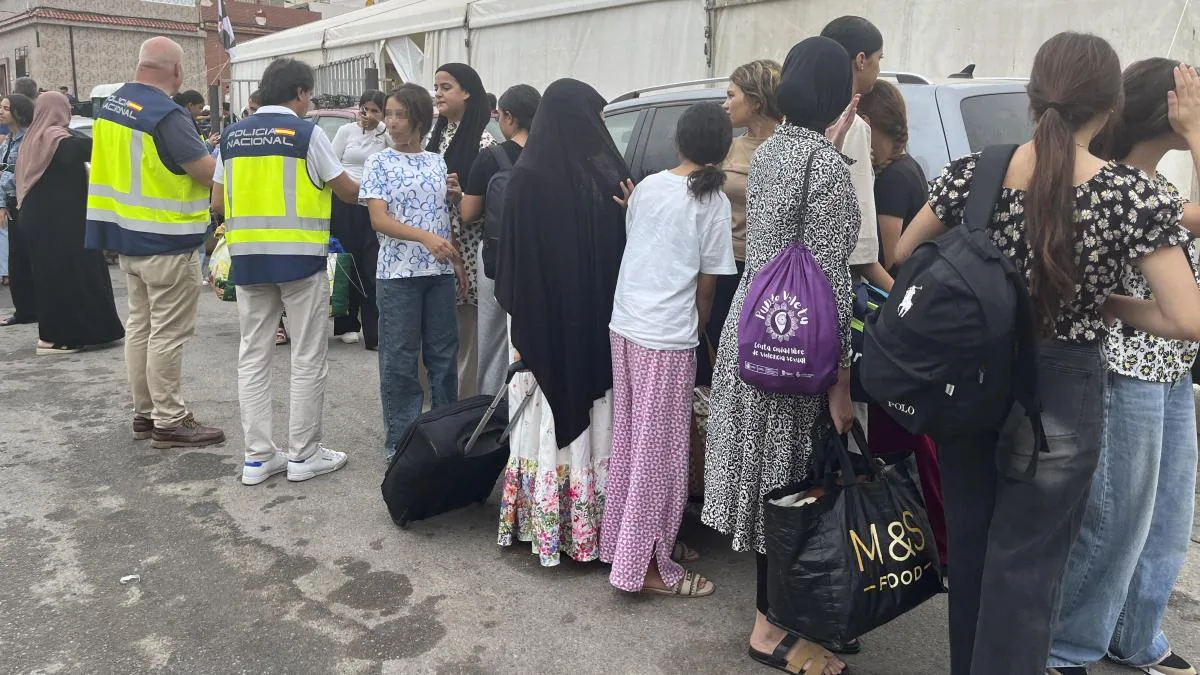
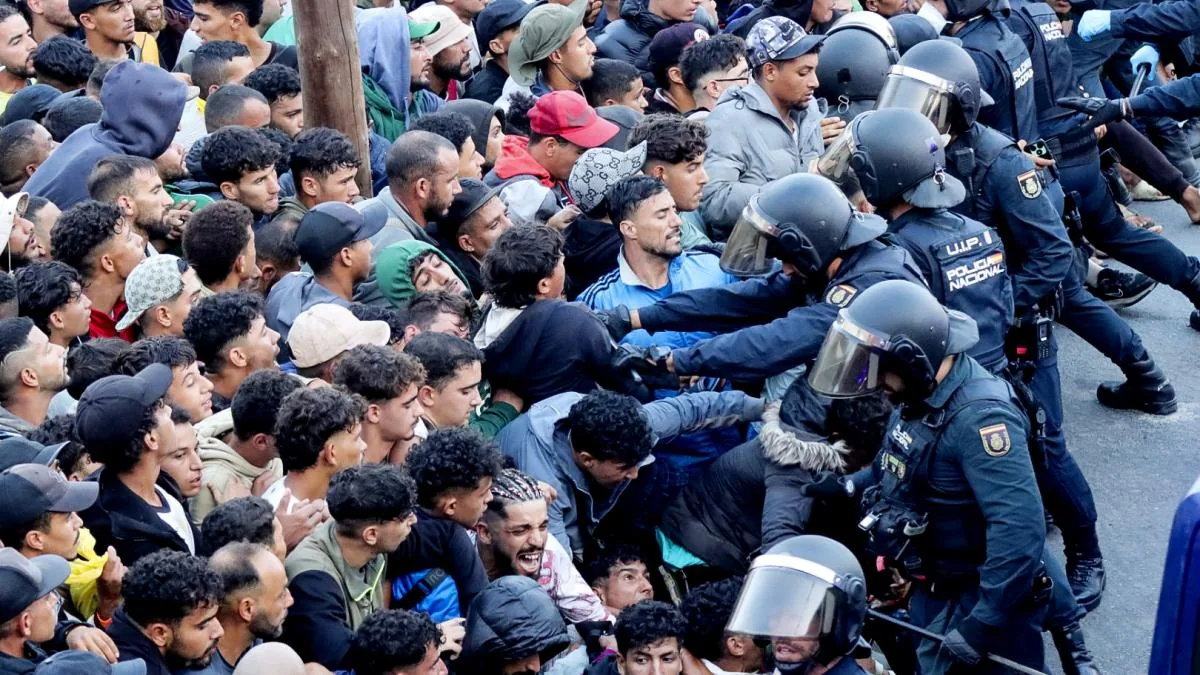
The Minister of Health, Mónica García, denied this Sunday that Ceuta is suffering a healthcare collapse following the massive arrival of migrants recorded at the end of July, although she acknowledged that there are areas “especially strained” such as Emergency, Internal Medicine, or surgical wards. In response to the PP’s request to declare a health emergency, the Minister of Health made a clear distinction between three realities that, in her opinion, should not be confused: “There is no healthcare collapse. Is there a humanitarian crisis? Yes. Is there a public health risk right now due to overcrowding? Yes.”
Read more The second miracle of Ferran Torres
After meeting with the Ceuta president, Juan Jesús Vivas, García provided the assessment of the healthcare deployment: in the last 15 days, a total of 5,800 migrants have been attended to, of whom 3,500 have been referred to the Primary Care network and 2,300 to the University Hospital. Although the day of greatest pressure recorded 1,149 attendances in 24 hours, the curve has decreased by 70% to stabilize at a daily average of between 200 and 400 attendances.
Currently, the University Hospital has 101 people admitted out of an expanded capacity of 200 beds, of which only 28 are migrants. Health frames the situation at Level 1 of the INGESA Disaster Guide, which has allowed maintaining differentiated circuits to ensure that “no consultation, surgery, or scheduled assistance for the Ceuta population has been suspended.”
García precisely placed the boundary between tension and irreversible saturation at those figures. “There are places in our healthcare system that are strained, absolutely yes,” she admitted, emphasizing that containment has been possible “thanks to the overexertion of the professionals.” As proof that the system retains response capacity, the minister highlighted that healthcare staff vacations have not had to be revoked, unlike what has been arranged for Army or Civil Guard personnel, nor has assistance been requested from other autonomous communities.
Also read
She also warned that labeling the situation as a “collapse” carries an alarmist message that may discourage some Ceuta patients from going to their medical center due to the false belief that they will not be attended to.
The Ministry’s optimistic view contrasts with the seriousness conveyed by the Autonomous City. During the meeting held at the Assembly headquarters, the Ceuta president, Juan Jesús Vivas, urged the minister to address the demands of the local healthcare collective and warned that the region is going through an “exceptionally critical” situation that has “radically” altered normality.
Read more A fight between ethnic groups in Lleida ends with three injured by stabbing and one arrested
According to the regional government, Vivas conveyed to the Minister of Health the emotional and social impact of the crisis, assuring that the population lives “stunned, with their soul in suspense,” before summarizing his diagnosis in a forceful phrase: “Ceuta is in danger.” In light of this scenario, the local government will hold an extraordinary Government Council early Monday to assess the situation—when almost three weeks have passed since the massive jump—and adopt the pertinent measures.

Despite the clash of diagnoses, they agree that the most urgent problem lies outside medical walls. “The most urgent healthcare action is to provide sanitary conditions to the migrants,” García reiterated, who estimated the epidemiological risk for newly arrived people as “moderate” and “low” for city residents. Therefore, the Ministry has again formally requested the Autonomous City to allocate plots and secure facilities to house those remaining in public spaces.
This allocation will ensure potable water, hygiene, food, and isolation, facilitating epidemiological control and early detection of diseases. Health has already detected 18 cases of gastroenteritis among migrants and has coordinated screening tests (Mantoux) to rule out tuberculosis processes. García insisted that the current risk for residents is low and care is maintained in ordinary circuits.
The disagreement with the PP, which today again demanded the resignation of Minister Mónica García, lies in the diagnosis and response. While the Popular Party demands declaring a health emergency and strengthening hospital resources, García maintains that the urgency is not resolved within medical walls: “Indeed, the problem is in the street.”
To reinforce this fieldwork, the Ministry has mobilized preventive medicine resources and will transfer means from the Coordination Center for Health Alerts and Emergencies (CCAES) for infectious disease monitoring. The Government’s response does not currently contemplate the forced transfer of professionals from other communities nor the suspension of local staff vacations, understanding that available resources allow sustaining hospital care while public health efforts are concentrated on the ground.
Read more Fire in Niebla stabilized: the 417 evacuated people can return home