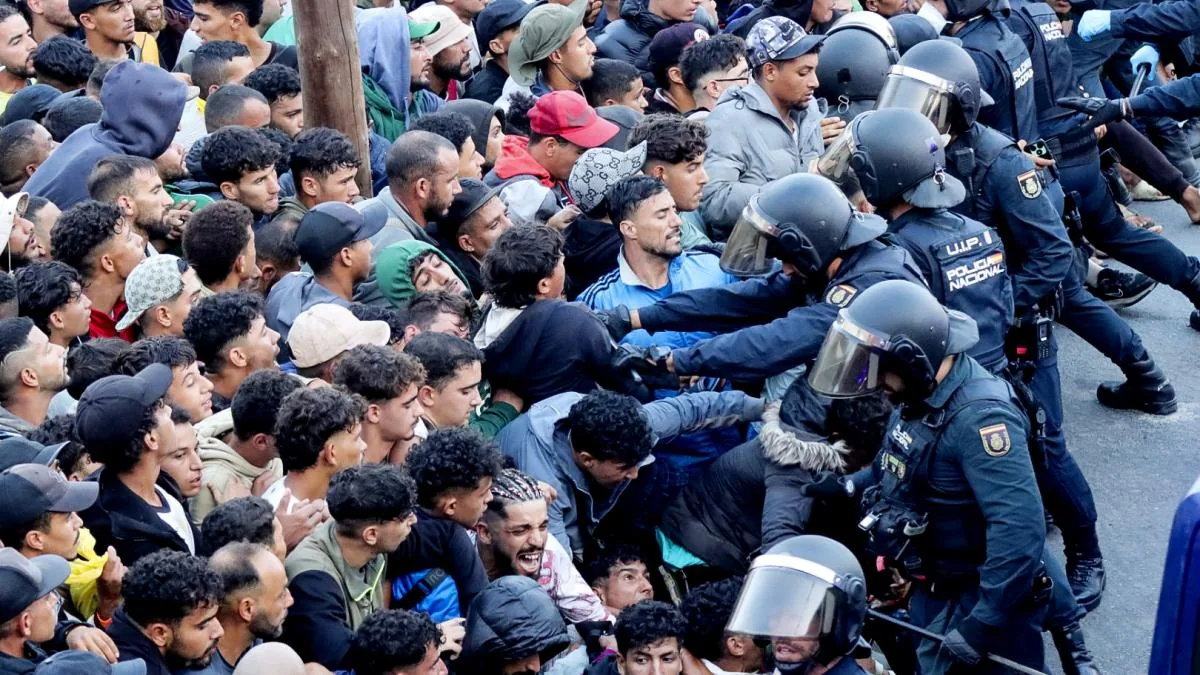
The Government began to take seriously at the beginning of the week, following alerts from intelligence services that had managed to camouflage themselves in social media groups, the possibility of a mass crossing attempt in Ceuta, which Morocco stopped yesterday. The various ministries affected by the migration issue set the machinery in motion to send the message, knowing that it is impossible to fulfill, that anyone who enters Spain irregularly will be expelled. An intense week, with a carousel of ministers visiting Ceuta, in which Moncloa has raised its tone on migration, juggling not to upset Morocco. The objectives of the plan, summarized in five points: that the avalanche at the end of July does not repeat (achieved yesterday) and that the largest number of immigrants remaining in Ceuta leave (still to be achieved).
Read more Mourinho also cries
1. Raise the tone of the discourse
Two heavyweights from the socialist wing of the Government raised the tone of the migration discourse at the beginning of the week: the Ministers of Foreign Affairs and Justice, José Manuel Albares and Félix Bolaños, respectively. The most forceful was the head of Spanish diplomacy who assured that “every last person” who entered Spain irregularly would return to Morocco as it was the “express will” of Rabat. His statements, which caused astonishment in other departments such as Interior, Migration, and Youth and Childhood, overlooked that in the repatriation of minors the best interests of the child must prevail over those of both countries. He also ignored that sub-Saharan migrants, who represent a good number of the people still in Ceuta, have the right to seek international protection. The mere acceptance of the asylum application entails, according to current legislation, authorization to enter and provisional stay in Spain of the applicant.
2. Not to upset Morocco
The Government has continued with its diplomatic line of not upsetting Morocco either for its permissiveness at the border during the mass jump through which more than 70,000 people entered or for the recovery of its sovereignty claims over Ceuta and Melilla. Not only because the Alaouite kingdom holds the key to the flow of irregular entries, but because the priority of the Executive, according to ministerial sources, remains the return of the maximum number of migrants who remain in the autonomous city. And this is only possible if Rabat, as since July 31, keeps the door open for return to its territory at the border control, through which the Police continue to return an average of 200 people per day. A figure that was greatly exceeded on Wednesday, when agents escorted 345 Moroccan adults to the border.

3. Not to talk about transfers of minors to the Autonomous Communities
The controversy over the distribution of migrant minors among autonomous communities took a back seat after the Government, through the Minister of Territorial Policy, Ángel Víctor Torres, assured that the “priority” was family reunification, as Morocco also says it prefers. Behind this shift in the argument lies, according to the same sources, the “need” to prevent the idea from spreading that migrants will end up crossing to the Peninsula, distributing among regions. That is, it was intended to neutralize a possible call effect in the making of a new mass crossing attempt. However, both Territorial Policy and Youth and Childhood know that the most viable option to relieve the minor reception system in Ceuta, as already happened in the Canary Islands, is mandatory distribution, which both ministries worked hard to approve by law.
Read more Do not underestimate the theater
4. Counteract hoaxes on social networks, as was not done before
In hindsight, the Government admits that the hoaxes that spread like wildfire about the Supreme Court ruling that determined that hot returns of immigrants intercepted at sea are not allowed and about the extraordinary regularization were not countered by official voices before the mass jump. Moncloa took the lesson learned. During this week, from channels such as the Spanish embassy’s profile on X in Morocco, successive messages with “verified information” have been launched, spreading that “entering Ceuta or Melilla irregularly does not give the right to remain in Spain or access the rest of Europe.” “Any information to the contrary is FALSE,” they added. Even the Civil Guard, in messages in three languages, joined 24 hours before the August 15 call with a “if you throw yourself into the sea, you will probably die. If you manage to cross, you will have entered illegally and will be returned.”
Also read
5. Not to confront the president of Ceuta
The Government has also not entered into confrontation with the president of Ceuta, Juan Jesús Vivas, of the Popular Party, who in his desperate calls for help to avoid another “invasion” has launched proposals that at any other time would have raised a huge dust cloud in Moncloa. Vivas has requested the construction of a temporary Foreigners’ Internment Center (CIE) to detain people who entered irregularly or even suspend the right to asylum, implicitly inviting the Government to bypass national legislation and international treaties.
Read more The questions of the Tauste case, the murder of two good people