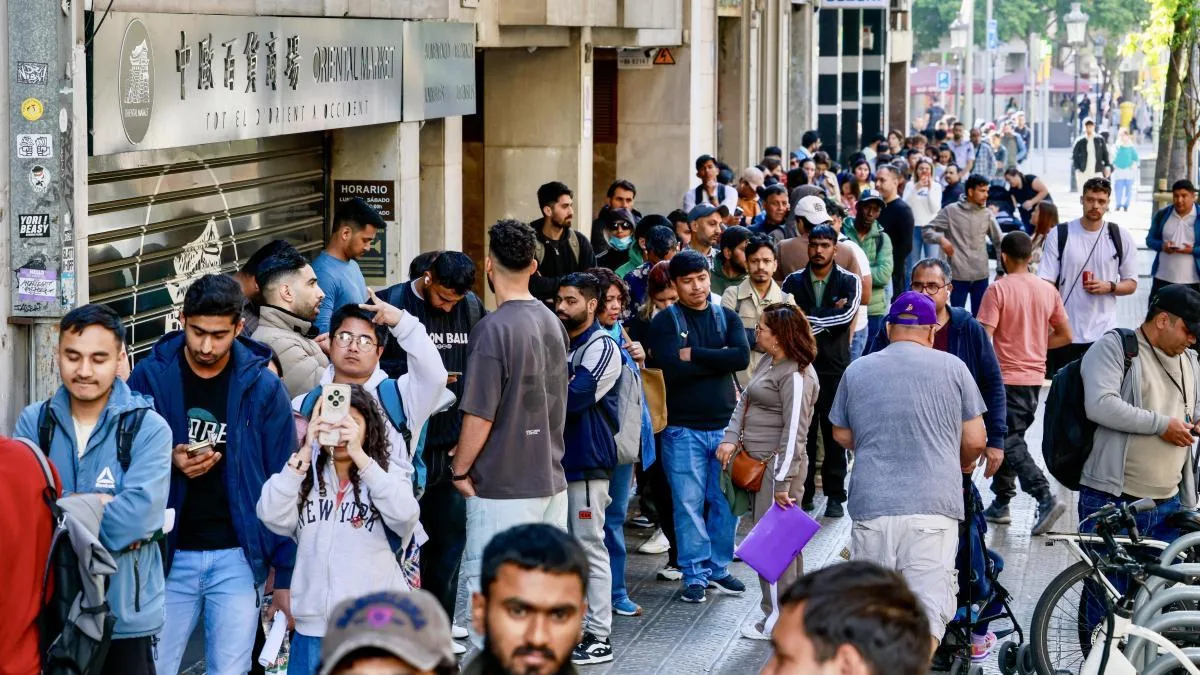
The new assault on the Ceuta border had been announced so far in advance that everything suggested that what would happen was what had happened before: that more journalists than immigrants would gather there. And yet, it did not happen exactly like that. Morocco made a show of force and set up a police barrier to prevent the access of hundreds of displaced people who did appear in a mountainous area on the outskirts of Fnideq, the former Castillejos. According to Rabat, 128 sub-Saharan Africans and about twenty Moroccans were intercepted as they headed to the border. Likewise, National Security arrested 61 suspects for inciting irregular migration through social networks.
Read more The questions of the Tauste case, the murder of two good people
The same police who last week did not intervene when about 80,000 people (a Camp Nou or a Bernabéu almost full) broke through the border coming from cities all over the country did keep the migrants at bay yesterday. A clear demonstration that, when it wants to, Morocco can solve the problem before it falls to the Spanish police.

Perhaps it was mainly about that, playing the role of the loyal ally who understands that Spain, as of today, is doing its part. Exactly what that part consists of is something we will probably not know until the diplomats who are negotiating today between Madrid and Rabat write their memoirs or tell everything to a trusted journalist.
Read more At least two dead and two injured after a flood near Ponferrada
In short, as Ramon Aymerich concludes in his article in Internacional, only Morocco “has the key.” The key to regulating a political, economic, social, and climatic crisis that is likely to worsen. The studies published so far differ greatly in figures and timelines, but it is taken for granted that the climate crisis will displace millions of people in Africa in the coming years, which may increase the vulnerability of the enclaves of Ceuta and Melilla.
In this scenario, theatrical setups like yesterday’s should not be underestimated. While it is true that theater is inspired by reality, it could also happen that a well-performed theater (Morocco’s timely commitment) ends up shaping a new and improved version of that reality. For Shakespeare’s Hamlet, ultimately, theater was a mirror in which to look.
Read more Morocco demonstrates its control over the Ceuta border by preventing another crossing