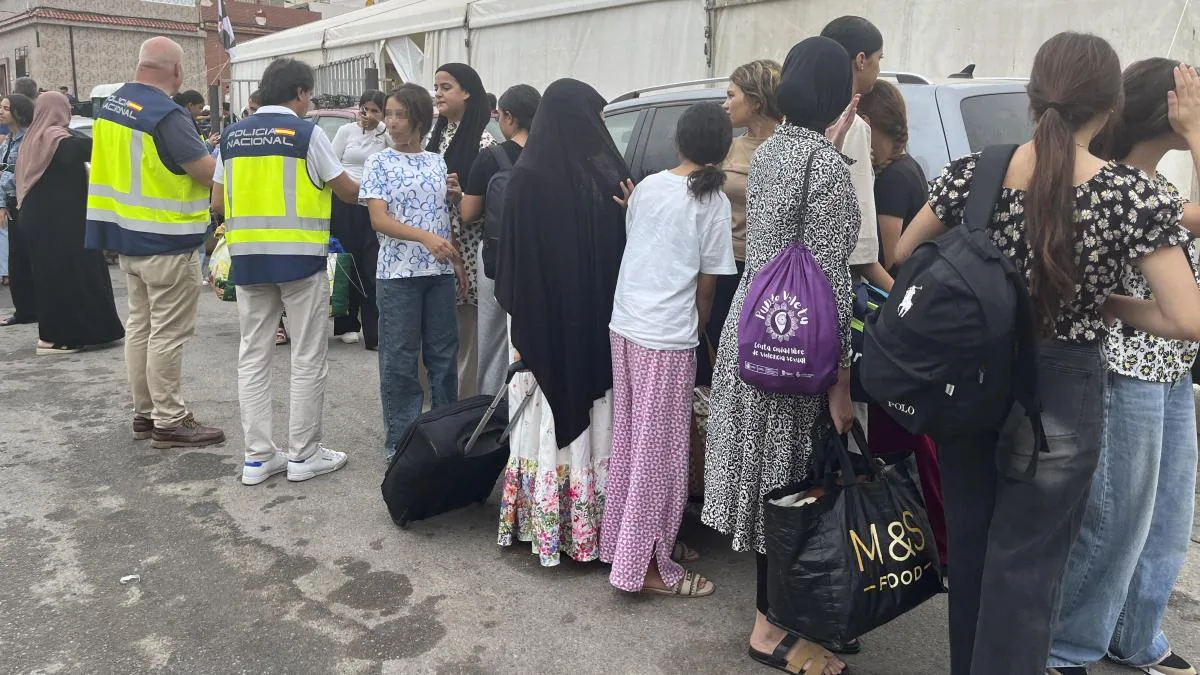
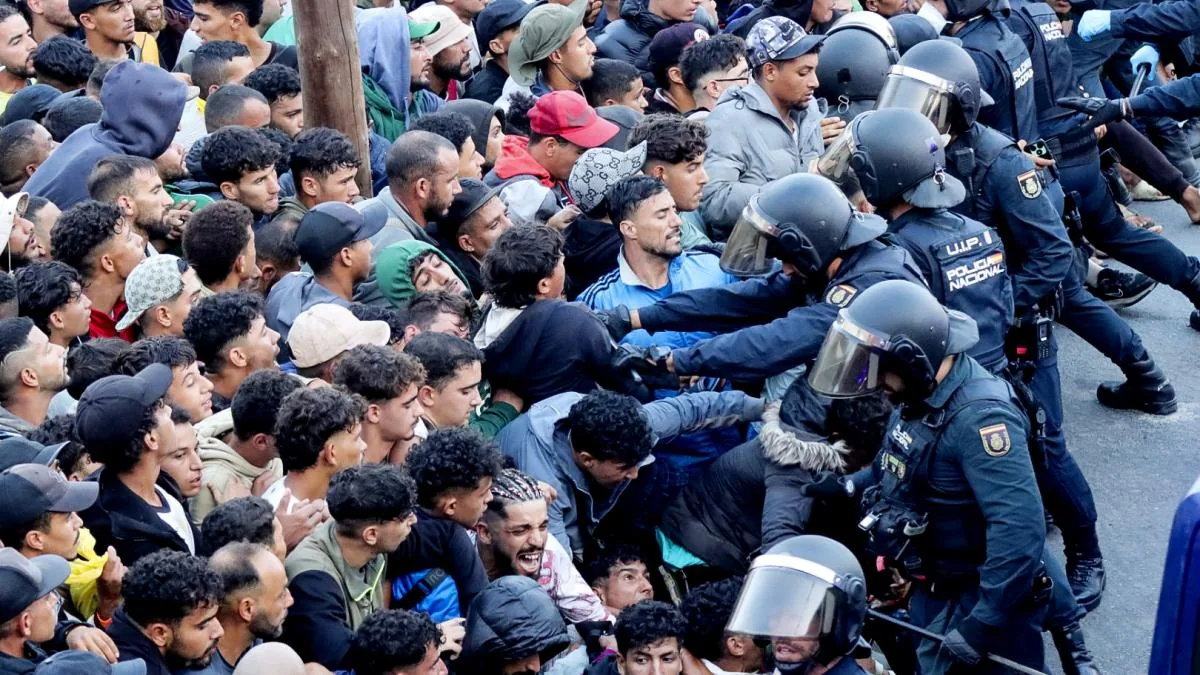
What remains of the wooden walkway that welcomed bathers to El Trampolín beach seems to divide in two the different futures awaiting the immigrants who refuse to leave Ceuta after crossing the border in a rush two weeks ago.
Read more The Government speeds up summary expulsions to clear the streets of Ceuta
On the right side, a line of riot police is organizing groups of young Moroccans who have come looking for the daily food ration distributed by the Red Cross. Some have been waiting for hours, with milk cartons on their faces to protect themselves from the sun. They know, from what they see among their compatriots, that sooner or later they will be expelled from Spain.

On the other side of the walkway, there are hundreds, perhaps a couple of thousand, sub-Saharans who have turned the beach into a real camp, where it feels like life moves slowly, despite the humanitarian emergency they are suffering. Migrants who guard, like precious gold, their documentation with the stamp of their country, from which they have fled: the key to obtaining asylum.
They know their return will not be swift. That is why the left side of El Trampolín beach increasingly looks like home. Even if it is inhumane.

Playa del Trampolín
Mohamed Latif, who was born 27 years ago in the port city of Larache, 100 kilometers from Tetouan, moves like a fish in water among “friends” from sub-Saharan Africa. As if blending in with them would serve as a safe-conduct to obtain international protection. Since the European migration pact came into effect, Morocco is on the list of safe third countries, making it almost impossible for his application to be approved. But he remains. And he offers to act as a guide through the settlement of reed huts, greeting some and others among campfires that gain strength late in the afternoon and mats on the sand that serve as mattresses.
They group by nationality. Issa Abdarhaman, 19 years old, speaks for his Sudanese friends, with whom he swam across the El Tarajal breakwater on July 30. They have been making the round trip to the Temporary Stay Center for Immigrants (CETI), which remains overwhelmed, for two weeks. He says he does not understand why no one takes responsibility for them.
Violent episodes on the outskirts lead neighbors to denounce neglect compared to the city center
Around another hut covered with plastic, there are Senegalese, who have taken on the role of keeping the area clean. Also Yemenis and Chadians. Or an Egyptian who is unable to get up due to a knee injury that, according to his detailed account, was inflicted by a police officer during the mass crossing.
Read more The railway chaos of the eclipse highlights the lack of foresight that hinders Rodalies
And then, before the point on the beach where the Moroccan guide wants to arrive, two Syrian friends – one with more than half a century behind him – break down in arguments to prove they are Christians, belonging to a community undergoing a massive exodus in the face of the new Islamist authorities in their country.
Wasim Ibrahim and Basem Esber entered swimming, after covering three kilometers in about four hours, on July 28, a day before the Moroccan gendarmes abandoned their breakwaters. By now, without the rush, they would have already entered the CETI. Now they are in limbo. And there, almost at the end of the beach, Latif shows what he wanted from the start: a horseshoe snake over a meter long, which was killed at dawn while crawling through the camp and which highlights the conditions in which they live.
Also read
The beach ambulance team is overwhelmed. Their care, as denounced by the Elín Association, is limited to covering basic needs, no antibiotics are supplied, and only in very serious cases can they arrange a referral to the hospital. They ask for more showers, toilets, and cleaning and hygiene products. Yesterday, the Ombudsman opened an ex officio investigation, requesting information from the central government, Ceuta, and the Prosecutor’s Office to understand the humanitarian situation.
The calm at El Trampolín Beach, sometimes interrupted by scuffles recorded among migrants, contrasts with the climate of citizen insecurity settling in the autonomous city which, if the figures given yesterday by President Juan Vivas are confirmed, would still be hosting 9,000 more people than its population. The Interior Minister, Fernando Grande-Marlaska, estimated yesterday that 5,000 adults remain after entering irregularly. In these two weeks there have been stabbings, rapes, and thefts, according to police sources. All incidents reported in the media these days have a common factor: the alleged perpetrator is an immigrant. But there is also another element they share: they occur in the peripheral neighborhoods of Ceuta, whose center regained normality days ago.
The Government estimates 5,000 adults remain in Ceuta, but Vivas raises it to 9,000
Neighbors in the outskirts, like Mohamed H., say they feel more abandoned than exhausted. He denounces that in his neighborhood, El Príncipe, it is not even worth calling 091 because no one responds to calls for help. “The problem is that our names are not Paco or Pepe. Yes, Ceuta is Spain, but we are second- or third-class Spaniards, even though we pay our taxes,” laments the taxi driver who prefers not to give his last name. His frustration is at its limit. The announcement made yesterday by the Interior Minister about the addition of fifty new agents to “guarantee citizen security” sounds like a bad joke to him.
“The outskirts do not have the same resources as the city center. We are tired of all serious problems falling on the same neighborhoods. We are reaching the limit,” explained Abdella Mustafa, representative of the Sidi Embarek neighborhood, which has been providing shelter to dozens of people who arrived in Ceuta for two weeks. Now, they are considering bringing that shelter to the center. “So it can be seen.”
Read more The diplomacy of the deer