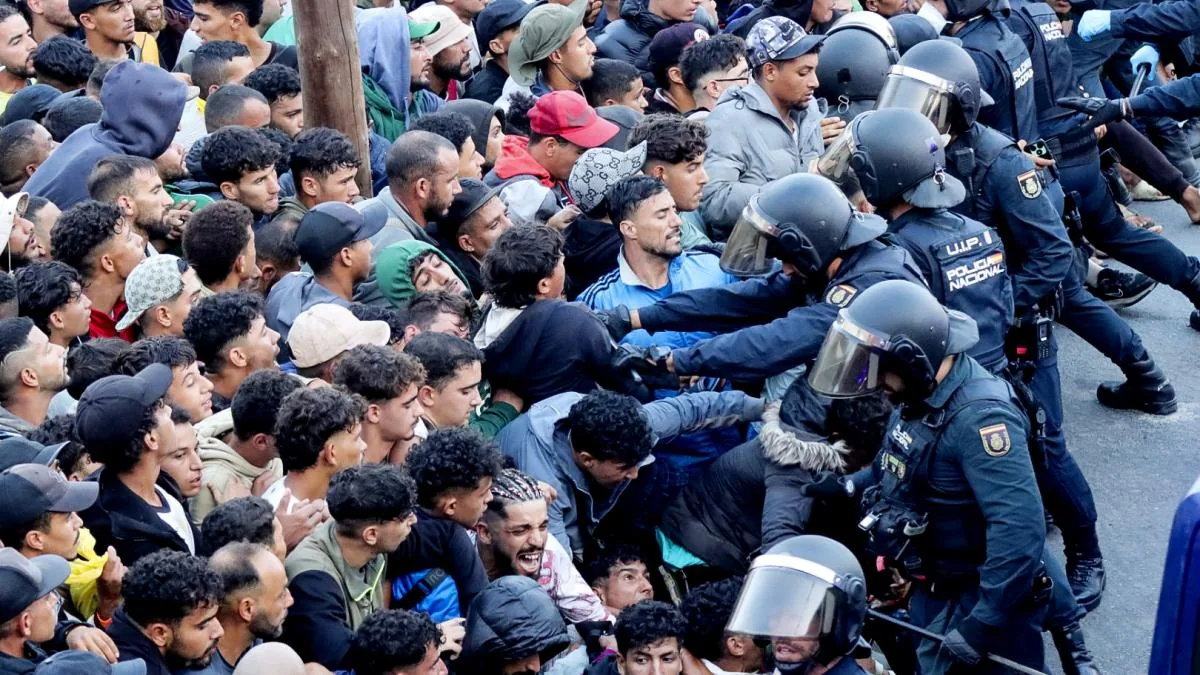
“Assault,” “invasion,” “humanitarian crisis.” The adjectives have been numerous to define the largest mass entry of migrants into Spain, in this case Ceuta, all at once. The figure, which may still grow, is 72,000 entries and 82 bodies recovered in the Spanish area. The majority, of Moroccan nationality, returned voluntarily upon discovering that on the other side of the breakwater there was not even water or food for them.
Read more Count Trash challenges the far right
A week later, there are still adults, of different nationalities, and minors wandering around the autonomous city until the administration finds a solution for them. According to government data, it is estimated that about 2,500 immigrants remain in the autonomous city, although the president of Ceuta, Juan Jesús Vivas, raises the figure to between 8,000 and 11,000 people who still need to return, at a time when the numbers are being used for confrontation.
Having overcome the initial shock of the emergency, it is time to look back in order to resolve what comes next. Again, the courts will have to determine whether there were warnings about what was happening and, if so, why no measures were taken to prevent not only the mass entry but also the hundred deaths by drowning. A Supreme Court ruling warned that physical obstacles should be placed in the sea, the Ceuta government and the government delegate warned of increased migratory pressure, police unions warned of lack of resources amid increased entries, intelligence services and Morocco warned of a security breach in the city. However, these alerts did not measure the magnitude of what was to come.
08/07/2026
The Supreme Court ruling as the origin of the crisis
The Supreme Court issues a ruling that favors an Algerian who had been rejected at the Ceuta border, which he reached by swimming. This migrant, with the help of several associations, had been litigating for his rights for two years. Finally, the Contentious-Administrative Chamber rules in his favor. The Immigration Law establishes that for the two autonomous cities, direct rejection at the border can be carried out for anyone trying to cross a containment element. The rule was made thinking of fences. But the sea does not have that element, and drones or thermal cameras serve a surveillance function but do not physically prevent crossing. Therefore, in the case of entering by swimming, a return must be carried out, which involves a different type of procedure than rejection.
The Supreme Court sets the pace: “Nothing would prevent that, if containment elements were established in the sea to protect the border line, the rejection at the border could be applied.” From this moment, the disinformation machinery begins to operate, making people believe on social networks that Spain has opened its borders.
09/07/2026
A floating buoy in the face of a possible migratory surge
Just 24 hours after learning of the Supreme Court’s decision, the Ministry of the Interior already has on the table, as the most plausible possibility, the placement of a floating buoy that extends the El Tarajal border breakwater into the sea. A consultation period begins with the Government Delegation in Ceuta and the Civil Guard, which will be led by the Secretary of State for Security, Aina Calvo. They consider that the floating border will provide the Civil Guard with the necessary legal security to carry out rejections. The buoy is not proposed as an impassable wall – since it will protrude only 30 centimeters above the surface and will not submerge more than one meter – but as a deterrent element to avoid the call effect. The problem? The buoys will not begin to be placed until Saturday, August 1, after the mass crossing.
15/07/2026
Reports show arrivals increase by 149%
Biweekly, Fernando Grande-Marlaska’s ministry publishes the irregular immigration report. The overall data show that Spain is containing irregular arrivals, thanks to the declining figures on the Canary route, which has decreased by 61.2% due to Mauritania’s cooperation. However, there is a striking figure in the statistics: since the beginning of the year, 2,826 people have entered Ceuta by land (as swimmers are counted), 149% more than last year. The latest National Security report, published in mid-May, warns that migratory pressure in the autonomous city has been “notably increased” due to the “swimmer phenomenon.”
A couple of figures help to gauge the impact of the Supreme Court ruling. In the first half of the month, 244 migrants arrived in Ceuta in swimwear; while in the second half, before the massive jump where counting was impossible, 1,009 people did the same. Also, on July 15, according to data provided by the Ceuta government, the city was caring for 213 minors. The number rose to 718 on July 28. The last figure rose to 1,342. And it will keep rising.
16/07/2026
The Civil Guard leadership at the National Court
At that time, the leadership of the Civil Guard, the body responsible for border control, was focused on another matter. Both the director general, Mercedes González, and the deputy operational director, Manuel Llamas, that is, the two highest representatives of the armed institute, had been charged and summoned to testify. They had refused to resign, so from their official positions they had to prepare their statements in the so-called Leire case. The National Court judge Santiago Pedraz suspects that both used their capacity within the Civil Guard to block investigations by the central operational unit (UCO) against the PSOE or people close to the Prime Minister, Pedro Sánchez. On the 16th, both went to the Court to be interrogated. González had to return the next day, the 17th, on which day Llamas was also summoned to the corresponding Senate committee to give explanations. All this while the greatest assault on Ceuta was quietly brewing, behind everyone’s back and no one’s.
23/07/2026
Interior focuses on the national emergency
Meanwhile, the evolution of forest fires declared in the Community of Madrid and Ávila leads the Minister of the Interior to declare a national interest emergency. Grande-Marlaska takes command of mobilizing a significant volume of resources from various public administrations, evacuations or preventive confinements of populations, and road closures in the affected regions. All a week before the massive crossing that the Interior Minister himself estimated at 72,000 entries. Local media such as El Faro de Ceuta have been reporting for days about early mornings with strong migratory pressure, causing the Temporary Stay Center for Immigrants (CETI) to begin to overflow. The Unified Police Union (SUP), in a letter to the Superior Headquarters accessed by La Vanguardia, warns of the “migratory peak,” which is generating “situations of extreme operational saturation” for police staff who process migrants arriving irregularly.
24/07/2026
The CNI warns of the effect of the Supreme Court ruling
The National Intelligence Center (CNI) detects that the Supreme Court ruling was causing a call effect among swimmers, which was on the way to causing a security breach at the Ceuta border, according to ministerial sources. This was reported to the Interior Ministry, responsible for border control. From Grande-Marlaska’s department, they say they were already working on that scenario before receiving that information from the secret services. In any case, so far, it was limited to a migratory peak that, although the Supreme Court decision could encourage swimming crossings, occurred during the summer period, which is usually very prone to surges due to the fog that often envelops El Tarajal beach. Interior maintains, in the minister’s words, that the final magnitude of the border onslaught was not alerted. Not even that it could resemble the 2021 event, when between 5,000 and 10,000 people entered Spain with Morocco’s permissiveness. Only six days later, seven times more people than in 2021 crossed at once, by swimming or on foot. In those same days, according to official Moroccan sources, the neighboring country also warned that the Supreme Court ruling compromises “migratory cooperation.”
Read more Carrara is not just a thing for oligarchs
26/07/2026
Bodies on one side, messages on social networks on the other
The week ends with one of the most tragic days at the border, with the recovery of three bodies. With those three bodies, the death toll rose to 27 so far this year. Eight of them in July. Beyond the tragedy, the search for bodies in the sea left a very symptomatic image: the Civil Guard’s GEAS and the Royal Moroccan Navy combed the area side by side. A sign of Rabat’s cooperation on migration that four days later would be put on hold when Moroccan gendarmes stood aside while the human avalanche skirted the El Tarajal breakwater.
Meanwhile, on the other side of the border, social networks – Facebook, Instagram, and TikTok mainly – begin to heat up more and more with messages encouraging crossing into Spain due to the border’s porosity. The youngsters who will finally cross en masse keep those messages, which they show to the media from Ceuta. They talk about the border crossing being open and include words like “al-hajma” (onslaught, offensive, attack, incursion…)
27/07/20260
A joint statement that causes great discomfort
Emergency meeting in Ceuta, between the delegation – the government’s eyes in the autonomous city – and local authorities. Numbers are put on the table: 1,000 swimming entries in the last week. At the end of the meeting, a statement is issued between both institutions – which creates enormous discomfort in the Interior Ministry – stating the “extraordinary pressure” on reception resources, causing “the collapse” of the minor system and “the saturation” of the CETI. The statement assures that the situation has been “urgently” conveyed “to the highest institutional level.” According to local sources, the Ceuta president, Juan Jesús Vivas, calls Pedro Sánchez, but he does not answer the phone. “Don’t worry,” they tell him, even though arrivals at sea reach 200 daily, with a police estimate of about 150 adults and 50 minors. The Moroccan Navy also continues rescuing swimmers.
29/07/2026
Castillejos is a hive of migrants waiting
The Castillejos promenade is a hive of young people from different parts of Morocco waiting their turn to jump to Spain. Most are teenagers, but entire families have come to the city. Interior continues to frame what is happening in Ceuta “within the framework of irregular immigration.” Grande-Marlaska gives an interview to La Sexta, still wearing the Civil Protection vest, focused on extinguishing the fires. In the last question, the presenter asks about Vivas’s cry for help. The minister appeals to the “absolutely close, loyalty-based” relationship with Morocco. He assures that the situation is “extraordinary,” but hopes that “soon” it can be “resolved.”
Several mainstream Spanish media begin reporting on the Supreme Court ruling, and its content starts spreading like wildfire in Morocco. As this newspaper verified on the ground, many messages could be translated from Arabic as “the border is open.” Who is behind what was cooked up on social networks remains a mystery, although more and more voices point out that it was not a spontaneous phenomenon.
30/07/2026
Bodies on one side, messages on social networks on the other
The government’s agenda remains marked by the fires. The head of the Executive moves to the advanced command post in Ávila to announce the end of the national emergency. He is accompanied by Marlaska and his team, who think that after marathon days they will have a break. Early in the morning, the Interior Minister keeps on his agenda attendance at a party at the Moroccan Embassy in Madrid. Rabat celebrates its national day, Throne Day. But around 9:30 a.m., the massive jump begins. The migratory surge turns into an avalanche – now impossible to stop – that Sánchez will describe a day later as a “violation of Spain’s territorial integrity.” Young people, but also entire families, enter Ceuta shouting “Long live Spain.” It is not until the end of the day that the Ministry of Defense orders the military to be deployed on the streets. Despite images showing how Moroccan gendarmes abandoned the border, the government states that “Morocco is cooperating loyally and permanently” with Spain to address the situation.
01/08/2026
Marlaska denies that the CNI informed about the mass jump
Grande-Marlaska, from Ceuta, assures that he did not receive any intelligence service report warning of what was approaching the border, causing great discomfort in the Ministry of Defense, which oversees the National Intelligence Center (CNI). The government, through its spokesperson, supports the Interior Ministry despite publications suggesting there were warnings or alerts. In the following days, Marlaska will reaffirm that no report, alert, or warning reached his office.
04/08/2026
The National Court investigates the alerts
Tensions rise with cross accusations about whether there were warnings or not. National Court judge María Tardón decides to ask the Civil Guard’s intelligence headquarters if there was any kind of warning and, if so, what measures were taken. Three days earlier, she had received a complaint and had opened proceedings before deciding whether to start a formal investigation. First, she asks the Immigration Police station if criminal organizations could be behind the assault, and three days later, she expands the requests to the armed institute to find out if there was any prior negligence. Meanwhile, Morocco, which denies complicity in what happened, prosecutes 86 people, including organizers of irregular crossings.
07/08/2026
The possibility of another jump begins to take flight
While Ceuta continues trying to return to normality, despite having the minor reception system collapsed and hundreds of immigrants still in its streets, Spanish intelligence services evaluate a new call in social media groups with thousands of followers, with the same objective: al-hajma. Also of unknown origin, dates, departure points, and even logistical issues are being shared, according to police sources. The Civil Guard gives credibility to the call, although it warns that the planned date of August 15 may change. Interior says it is ready to face any situation. The alert is now issued.
Read more Udinese surprises a very sophisticated baby Barça and takes the triangular