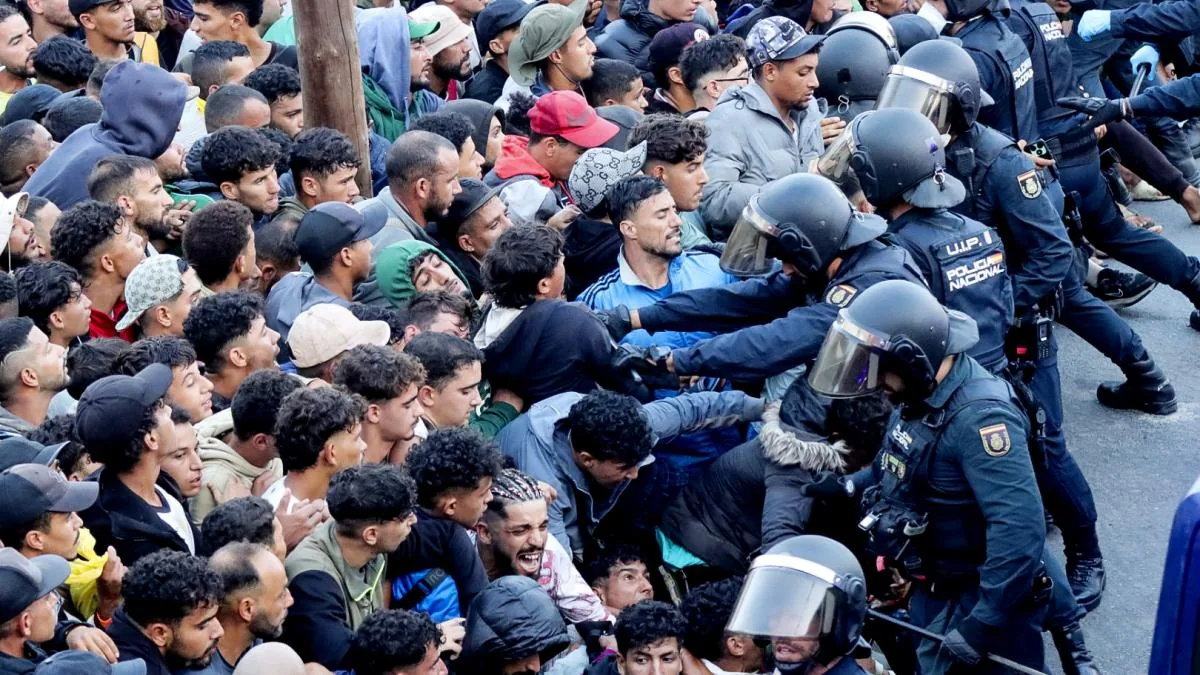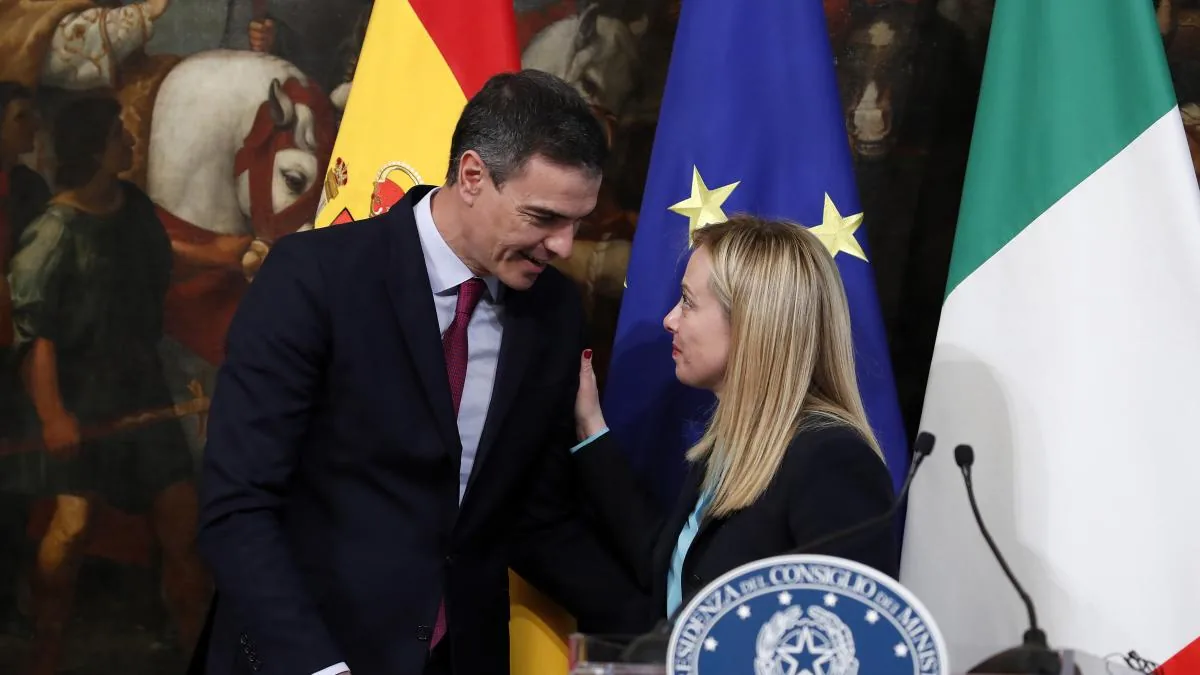
The Government of Giorgia Meloni rejected this afternoon Pedro Sánchez’s demand to remove border controls with Spain that Italy reintroduced on August 1 due to the massive and irregular entry of immigrants in Ceuta on July 30. In a note from the Chigi Palace, the Italian Executive assures that Italy “does not accept ultimatums or impositions from abroad” on national security matters.
Read more U.S. loses 23,000 jobs in July, complicating the Fed’s strategy against inflation
The Spanish Government threatened Italy this Friday with “proportional measures” if Italy maintains border controls next Monday, according to a statement from the Executive, which describes this measure as “unfair” and “unprecedented in recent history.”
However, the Italian Government has confirmed that it will maintain the partial suspension of Schengen at least until August 15, considering that security risks still exist, and has recalled that, according to the Spanish authorities themselves, a new migratory wave in Ceuta is expected by that date.
The Interior Minister, Matteo Piantedosi, reinforced this position by stating that “it is difficult to argue that these risk conditions do not exist at this moment,” since European treaties allow exceptional measures when there is a potential danger to national security.
The Interior Minister also added that, once August 15 has passed, the Government will evaluate whether conditions exist to lift the suspension, insisting that it is a “temporary” measure, applied selectively and without consequences for European Union citizens.
At the same time, and for the first time since the diplomatic crisis erupted, the Italian Government has left the door open to a negotiated solution and has asserted that it is willing to maintain a “constructive dialogue” with the Spanish Executive as soon as the circumstances that, in its view, justify the partial suspension of Schengen disappear.
At noon, Pedro Sánchez’s Executive had warned in a statement that the reintroduction of controls affects “the mobility of thousands of passengers” and generates “legal uncertainty” during the summer period, highlighting that it was adopted “without prior notice, unilaterally, and with spurious arguments that do not conform to either the Schengen Borders Code or the truth.”
In this regard, the Government warns that none of the migrants who entered Ceuta irregularly last week could or can freely enter the Schengen area because the autonomous city of Ceuta has a special regime within it and that virtually all of them have already returned to Morocco.
Read more «The armorer is a locker»: Civil Guard associations call for strengthening the custody of weapons
However, the statement adds, “Spain has never introduced controls for Italy.” In fact, the statement recalls, “it has always shown solidarity with it,” hosting some of the migrants who arrived in Lampedusa in 2023 and recurrently opening its ports to migrants rescued on the central Mediterranean route.
For all these reasons, Pedro Sánchez’s Government, which today held a videoconference coordination meeting with four of its ministers and the number two of Foreign Affairs to analyze the situation in Ceuta, concludes that the measure adopted by the Italian Government “is unfair, contrary to the interests of the EU, and discriminatory for the Spanish population” and urges Giorgia Meloni’s Executive to rectify.
That is, to end the controls and treat Spaniards “like the rest of European citizens.” “If it does not do so before the end of Sunday, August 9, Spain will be forced to adopt proportional measures to protect the interests and dignity of its citizens,” the Spanish Government threatens.
“We trust that Europeanism, common sense, and good faith will prevail,” wishes Sánchez’s Executive, which closes the statement with a reflection for the Italian administration: “Governments are meant to promote understanding between countries and the general interest of their populations, not to create fractures and sterile conflicts driven by internal electoral motivations.”
The Spanish Foreign Minister, José Manuel Albares, has assured that “there is no reason” for Italy to maintain controls at the air and sea borders with Spain and has highlighted that the Ceuta migration crisis, which triggered the Italian measures, is already “channeled and redirected.”
“There is no reason to introduce these measures. The situation in Ceuta and Melilla is very broadly channeled and redirected. Most of the people who entered Ceuta irregularly have already been returned,” Albares stated, who accompanies King Felipe VI in Cali on the occasion of the inauguration of Colombia’s elected president, Abelardo de la Espriella.
During the first two days of the measure’s application, hardly anything changed at Italian airports and ports connected with Spain. Security forces limited themselves to carrying out selective targeted controls, according to the Ministry of the Interior, aimed at “third-country nationals.”
Read more The Ukrainian street vendor victim of a Russian ‘human safari’: “I only had garlic in my hand”