About 4,000 municipal police officers and a thousand health personnel will be deployed during Pope Leo XIV’s visit to Madrid from June 6 to 9, according to details provided by the mayor, José Luis Martínez-Almeida, at the press conference following the Government Board meeting, accompanied by the deputy mayor, Inma Sanz, and the delegate for Urban Planning, Environment, and Mobility, Borja Carabante. In addition to these forces, the capital will have the support of the National Police and other police bodies of the central Government, meaning the City Council will have to work closely with the Government Delegation, despite political disagreements, to ensure security during those days of the Pontiff’s visit.
Read more The most spectacular scenic trails in Europe (and there is one in Spain)
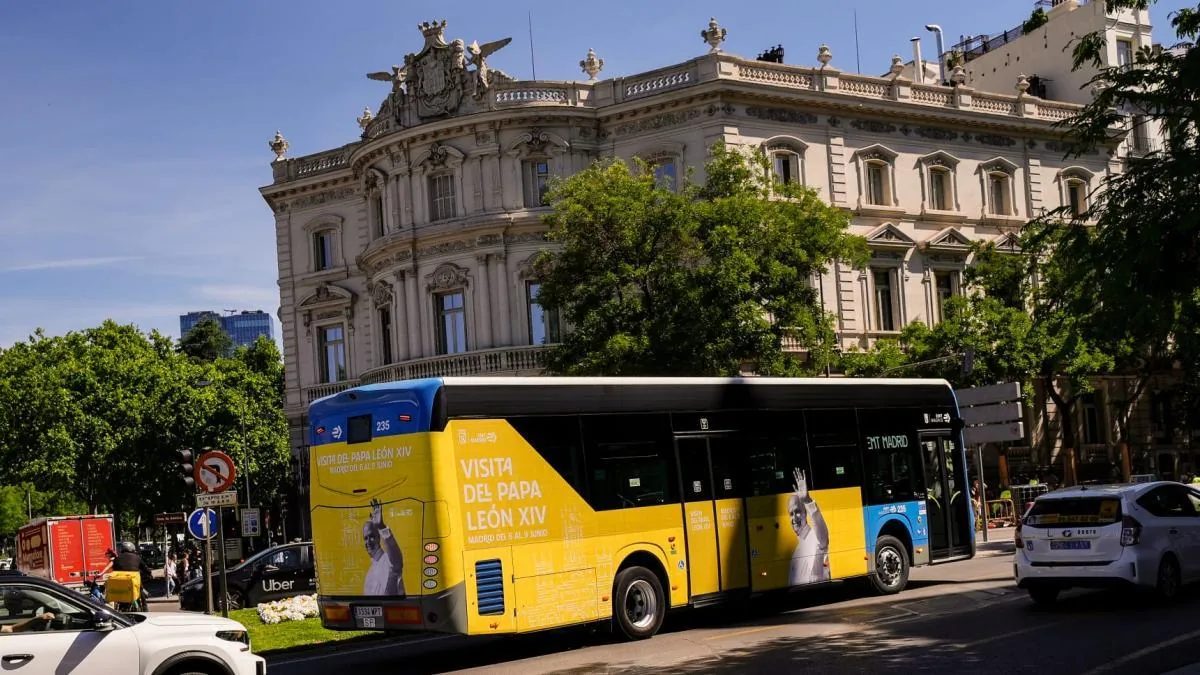
Almeida has announced that the visit will require significant traffic cuts on the axis between Cibeles and Plaza de Lima. Free access to the Municipal Transport Company (EMT) is planned between June 6 and 9, and teleworking during the week of the visit has been recommended.
“An unprecedented event”
The capital’s mayor pointed out that the logistical and organizational demand for the City Council “is practically unprecedented,” surpassing the NATO summit in duration and massive attendance. He explained that they have been in contact with the organizers to minimize the impacts that will occur during the four days of the visit, as well as in the “ten days immediately before the Pope’s arrival and the two days after the Pope leaves the city of Madrid.”
The mayor detailed that two places will be “especially affected” and that impact the main north-south circulation axis in the city. On Paseo de la Castellana: Plaza de Lima and Plaza de Cibeles. On the Recoletos-Castellana axis, at Plaza de Cibeles, today, May 21, material will be unloaded for the installation of the stage where the Pope’s mass will be held on Sunday, June 6.
From May 23, there will be a “permanent occupation of one lane of Paseo del Prado northbound.” From May 25, “three lanes will be occupied to set up structures intended for the choir,” and on June 4, there will be a “total closure to traffic of the entire Plaza de Cibeles axis.” The City Council will incorporate the incidents into navigators such as Google and Waze.
Hotels at 82% occupancy
The Madrid Hotel Business Association (AEHM) estimates that hotel occupancy from June 5 to 9 will be close to 82%. The highest occupancy level will be reached on Saturday, June 6, with 87.18%; followed by Sunday, June 7, with 85.35%, and Friday, June 5, with 83.30%.
International visitors represent 58.48% of the total, compared to 41.52% of domestic travelers. The main source markets are the United States, France, and the United Kingdom. For the executive vice president of the association, Mar de Miguel, the coincidence of Pope Leo XIV’s trip and Bad Bunny’s concerts “will energize the city.”
All territorial police stations will participate in the security device to especially reinforce those areas where the main events will be concentrated, with special attention on June 6 and 7, when a greater influx of people is expected.
Police stations with different functions
The Special Services Police Station will be responsible for the dynamic protection of movements, in coordination with the National Police, Civil Guard, and Vatican delegation, while the Central Security Police Station will protect the spaces in coordination with the General Citizen Security Police Station.
The Road and Urban Analysis, Road Support, and Transport Police Stations will work to prevent any problems in road management and in the transport of goods and passengers.
The Technical Security Police Station will be dedicated to controlling the different events and installations through the Air Support Section and the Inspection and Evaluation of Services Section (SIES).
The Canine Section will be part of the control of dangerous elements (drugs and explosives) and the service of the Integrated Video Signal Center (CISEVI) will be intensified for the visualization of cameras operated by the Municipal Police, as well as those of the Mobility Management Center.
The Diversity Management Police Station will be reinforced for possible religious discrimination, and the Information Analysis Section (SAI) will strengthen the social media testing service to detect possible threats, an activity it has been carrying out for weeks in coordination with the Provincial Information Brigade.
Read more More than a hundred directors of Valencian schools submit their resignation to the Corts
Firefighters and health personnel at all coordination centers
The Fire Department will also move through the main areas of the visit with three fire engines and a command vehicle that will move around to, among other aspects, check emergency lanes from Chamartín to Atocha. Firefighters will be present at all operational coordination centers (CECOR) held and preventively in the city’s fire stations.
Likewise, nearly a thousand health personnel from Samur-Protección Civil will be available to all those attending the mass events, particularly the vigil and the mass. To this end, six advanced health posts will be installed in Plaza de Cibeles and four health posts in Plaza de Lima.
In both cases, several advanced health posts (PSA) will be installed: six in Cibeles and four in Plaza de Lima. Additionally, Samur-PC will reinforce its coordination center and deploy health volunteers with rapid intervention units on foot (ECO), bicycle (Linces), and motorcycle (Halcones).
About 2,400 volunteers for the papal visit
Additionally, 2,400 volunteers will be trained in person for the papal visit, including 600 team and sector leaders who will receive specific training in emergency detection and first aid.
The mayor has confirmed that the City Council is “in permanent contact and collaboration with both the Government Delegation and the Superior Police Headquarters,” regardless of his belief that the delegate, Francisco Martín, “is not a figure that fits the position and the institutional representation that corresponds to him.”
Sector table with the police: next May 27
The delegate for Security and Emergencies, Inma Sanz, reported, as was previewed yesterday in the relevant commission, that the sector table from which to continue formal negotiations of the new labor conditions agreement for the Municipal Police will meet next week, on the 27th, to which all unions are summoned.
“We are absolutely convinced that with the usual professionalism this service will be guaranteed. We continue talking, we continue negotiating, we continue looking for ways to improve those working conditions, as we already did in the previous agreement,” Sanz declared.
The deputy mayor pointed out that they came from “a period where the municipal police had not been well treated,” referring to Manuela Carmena’s government, “but substantial improvements were already made in the previous agreement,” especially with overtime, “which was paid with a lot of delay.”
“I am convinced that we will make progress during this time, that we will be able to reach a good agreement, as we have done with them before and also as we have done with Firefighters and Samur-Protección Civil,” she declared, also “convinced that the professionalism of the officers will ensure that the device (for the Pope’s visit) unfolds without any problems.”
She also did not overlook that the dates of Leo XIV’s visit and Bad Bunny’s concerts at the Metropolitano will coincide, for which the operations are being sized.