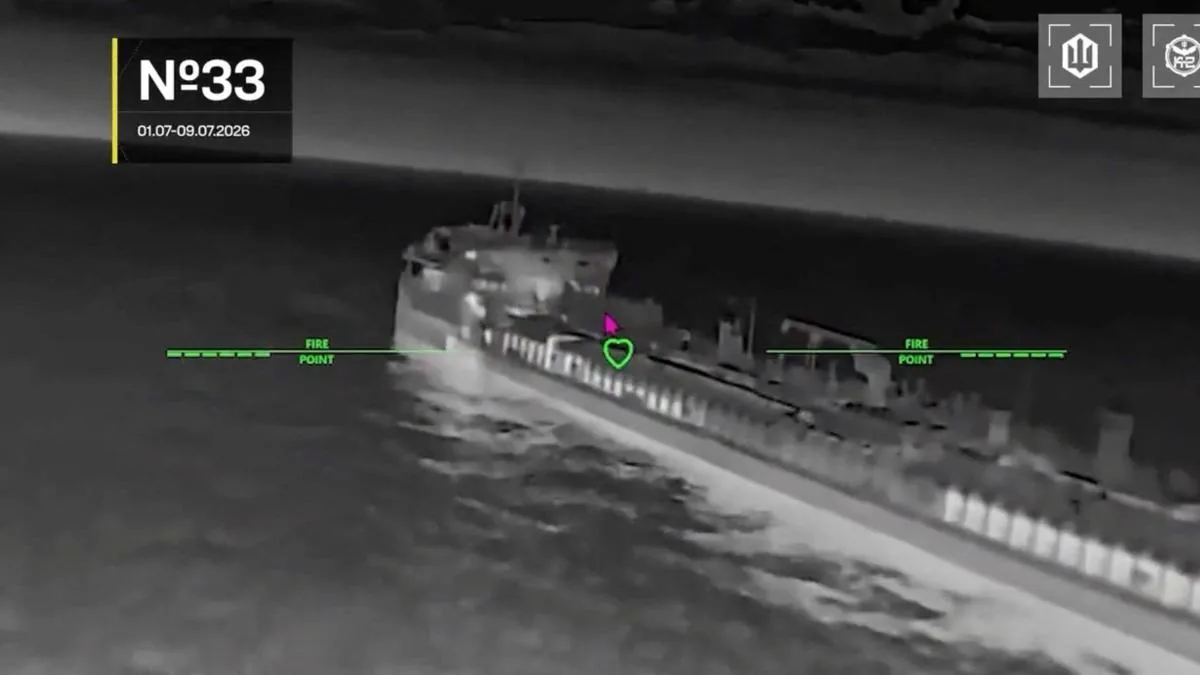
If in recent months Ukraine has directed its swarms of drones against refineries, oil export ports, and other energy infrastructures inside Russia, now the attacks are focusing on the Sea of Azov. Their main objective is to disrupt the transport of fuel and oil of the so-called Russian “ghost fleet,” but they are also forcing Moscow to redirect maritime traffic so that its grain exports are not affected this summer.
Russia, which is the world’s largest wheat exporter, acknowledged this Tuesday the damage caused by Ukrainian attacks by saying it is seeking “alternative transport routes.” Two Russian government departments, the Ministry of Agriculture and the Ministry of Transport, are studying measures to address the situation.
Moscow develops “alternative routes” in other regions of the country
The first stated on Telegram that the attacks on cargo ships in the Sea of Azov will not affect Russia’s export capacity. Currently, “alternative routes are being developed,” he explained. And he added that “delivery logistics” could be “redirected.” The ministry emphasizes that Russia has “significant agricultural cargo transshipment capacities in different regions” of the country.
Ukraine’s maritime attacks add to the wave of strikes against Russian refineries that have caused a severe fuel shortage across the country in recent months and have forced the Moscow government to temporarily ban the export of diesel, gasoline, and aviation kerosene.
The Azov is an inland sea located north of the Black Sea between Russia, the Ukrainian territory under Russian control, and the Crimean Peninsula, which Moscow seized from Kyiv and unilaterally annexed in 2014. For Russia, it constitutes an important transport route. On one hand, it uses it for its ships to carry fuel to Crimea, the region most affected by the gasoline crisis. On the other, agricultural products and cereals are exported from the Russian ports of this sea, especially from summer onwards, after the grain harvest.
Lavrov accuses Kyiv of “terrorism” for attacking commercial ships
More than one hundred Russian ships have suffered attacks by Ukrainian drones in the Sea of Azov in the last week, said the head of the Ukrainian army’s drone forces, Robert Brovdi, this Tuesday in Kyiv.
According to this commander, on the night from Monday to Tuesday his troops hit 10 Russian vessels: five oil tankers, four cargo ships, and one tugboat. With these attacks, the number of ships attacked from the so-called “ghost fleet” that Russia uses to evade international sanctions reaches 116 in nine days, he said.
Brovdi explained that the Russian oil tankers navigating the Sea of Azov are small and medium-sized. According to him, Russia uses them to transport crude oil to larger tankers waiting in the Black Sea that, due to their size, cannot enter the Azov ports. By way of comparison, he said that between 12 and 15 of these small tankers are needed to fill one of those large ones.
Read more Arrested a fake pilot traveling to Barcelona for carrying ten kilos of cocaine hidden in his body
Russian Foreign Minister Sergey Lavrov accused Ukraine of attacking commercial ships both in the Sea of Azov and the Black Sea, in what he called acts of “terrorism.” “What the Kyiv regime is doing goes beyond even piracy. Pirates, at least, loot and keep the loot. But this benefits neither them nor anyone else: the goal is to cause damage and intimidate. It is terrorism, plain and simple,” declared the head of Russian diplomacy.
Ukraine hits two refineries and Russia, fuel depots
In August, it will be four and a half years since the start of the war between Russia and Ukraine, which began on February 24, 2022, when Russian President Vladimir Putin ordered his army to enter the neighboring country.
Besides the fighting on an extensive 1,200-kilometer front, Moscow has attacked Ukrainian territory almost daily with drones and missiles. Over time, Kyiv has managed to develop its drone industry and sometimes its attacks, which are also usually daily, outnumber those of the Russians.
In the bombings on the night of this Tuesday, Russia attacked the Ukrainian capital, and its Ministry of Defense claims to have hit “Ukrainian military industry facilities,” where components for Neptune-MD guided missiles, FP-7, FP-9, and Grom-2 tactical missiles are produced. In the southern province of Odesa (Black Sea), Russian weapons hit the port of Yuzhni, dedicated to fuel unloading; seven fuel depots and a cargo ship.
Ukrainian military claimed to have shot down five of the eight Russian Iskander-M and S-400 missiles.
On the other hand, the previous night’s Ukrainian attacks hit two Russian oil refineries, one in Krasnodar (Black Sea) and another in Bashkiria (Urals). And Sevastopol, the largest city in Crimea, was temporarily left without electricity again.
Read more The law on vicarious violence: end of parental authority for parents convicted of abuse