






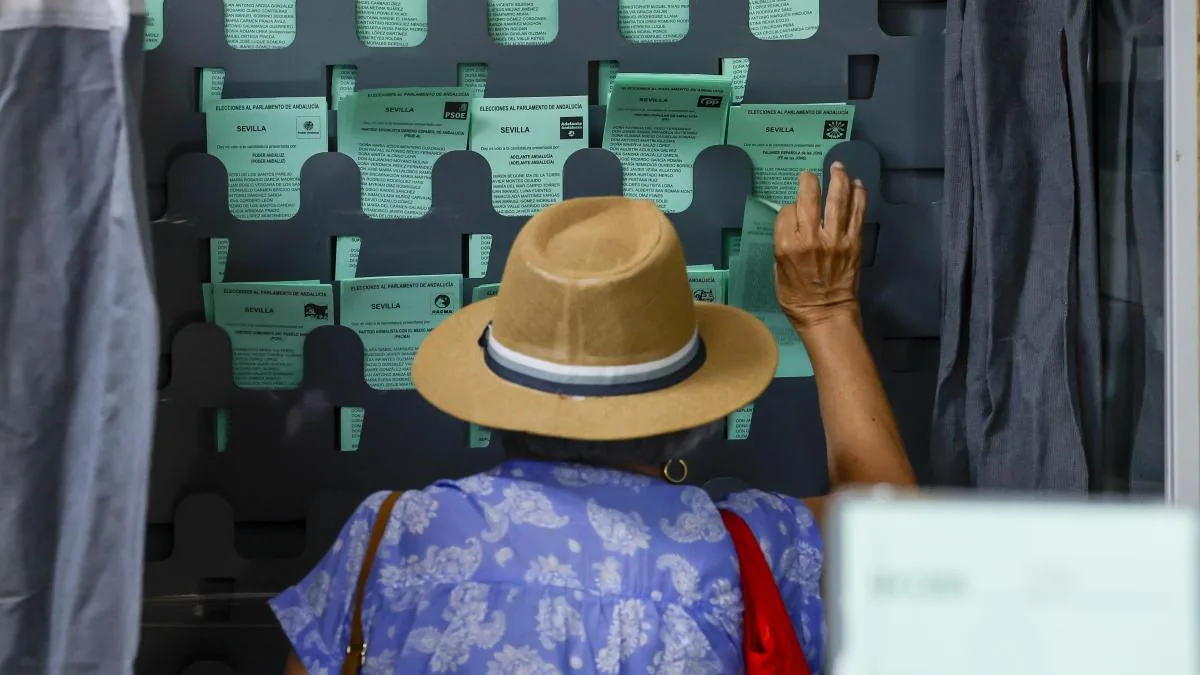
Abstention was expected to be one of the major fears in these elections, but the day is disproving that fear with data in hand. Andalusians are going to vote and are doing so to a greater extent than in 2022. This is confirmed by the third (and final) participation update, offered by the Minister of the Presidency, Antonio Sanz, from the Data Center. By 6:00 p.m., 51.65% of the census had already voted, more than seven points above the 44.51% recorded at the same time four years ago.
Read more The election night is expected to be long in Andalusia, with the counting pending the last vote
A behavior that, to a large extent, was already anticipated by the CIS in its pre-election barometer, where more than half of Andalusians said they were following these elections with interest. So far, that expectation is translating into greater mobilization at the polls.
Growth is recorded in all provinces
The growth is also being homogeneous throughout the territory. In Almería, participation reaches 50.36%, with an increase of 8.59 points; in Cádiz, 48.63% (+7.27); in Córdoba, which is again among the most participative, 55.12% (+6.64); and in Granada, 53.54%, with one of the largest increases of the day (+9.07).
It also rises strongly in Huelva, where participation is 48.10% (+8.21); in Jaén, with 53.82% (+6.61); in Málaga, which reaches 50.66% (+7.02); and especially in Seville, which leads in absolute terms with 58.82% and an increase of 8.04 points compared to 2022.
The question now is not so much whether participation is rising (because it clearly is) but who benefits from this increase. The acting president, Juan Manuel Moreno (PP), hopes to renew his absolute majority (55 seats out of 109), while left-wing parties have argued during the campaign that greater mobilization could activate a discontent electorate that did not go to the polls in 2022.
All parties called for votes and all candidates, from the polling stations where they cast their ballots this morning, have insisted on this message. Moreno did so as did María Jesús Montero (PSOE). Manuel Gavira (Vox) also appealed to the need for citizen mobilization, as did Antonio Maíllo (Por Andalucía) and José Ignacio García (Adelante Andalucía). These last two candidates aiming to reach San Telmo claimed throughout their careers that they were connected with abstention. So far, the data does not allow anticipating which way the balance is tipping.
Election results will begin to be known from 8:43 p.m.
The evolution of the day, in any case, draws a clear curve: from less to more. At 11:30 a.m., the first update placed participation at 15.10%, with a slight drop of 0.34 points compared to 2022. Three hours later, at 2:00 p.m., the figure had already turned to 37.25%, three points above the previous elections. And now, at 6:00 p.m., that momentum is consolidated with a jump of more than seven points, confirming that mobilization has been growing as the hours pass.
All this on a day that is unfolding normally, after the constitution without notable incidents of the 10,403 tables spread over 3,759 polling stations. The only disruptions have been occasional delays in some centers that will require extending the voting hours. In fact, results will not begin to be known until 8:43 p.m., when the last polling station closes in Sevilla Este, where the delay in constituting six tables has forced the schedule to be extended. Until then, Andalusia continues voting… and, judging by the data, it is doing so more than ever on this day.
Read more Candidates for the Board take the ballot boxes on a key day for the future of Andalusia
Also read