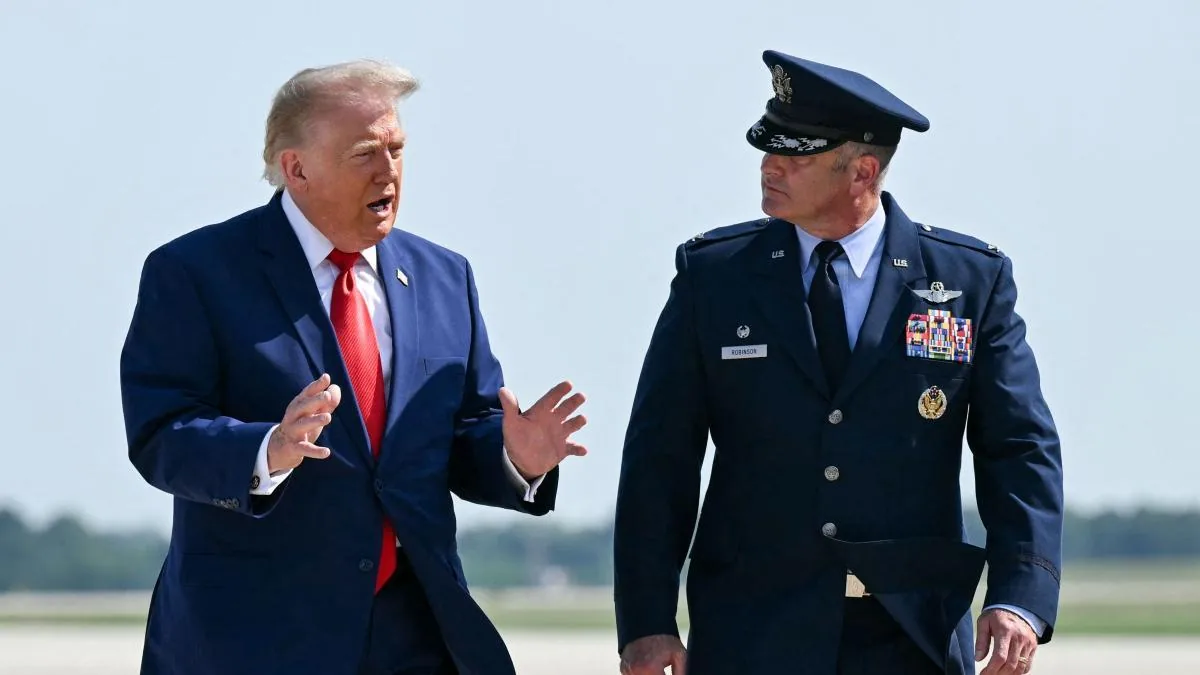
The President of the United States, Donald Trump, has launched a new threat against Iran’s civilian infrastructure through his platform, Truth Social. After Washington bombed the Persian country last night for the eleventh consecutive day, the president has warned the Islamic republic that “every time it fires at a ship in the Strait of Hormuz, whether with a missile, a rocket, a drone or any other device or weapon, the U.S. will bomb and destroy a bridge or a power plant”.
Read more The Supreme Court returns Aldama his passport to continue his businesses abroad
This maritime route, through which a fifth of the world’s oil passed before the war, remains the main stumbling block to peace between the two countries, which last month signed a 60-day ceasefire agreement, but it fell apart and both Tehran and Washington have reimposed their respective naval blockades. In the last eleven days, they have exchanged attacks against both U.S. bases in the region and Iranian territory, which, given the failure of negotiations, indicates that the two countries are once again heading towards an all-out war.
The Pentagon estimates the cost of the war at 37.5 billion dollars and requests another 67 billion from Congress
The bombings against civilian infrastructure, which have been occurring since the U.S. demolished a primary school on the first day of the war, have been criticized by human rights associations, as they violate the provisions of the Geneva Conventions (1949), which prohibit attacks directed against civilian targets.
Trump is scheduled to attend tonight the funeral of the four soldiers killed over the weekend at the Muwaffaq airbase in Jordan and the Erbil airbase in Iraq. The deaths of the military personnel, who have been identified as two men and two women aged 19 to 30, have brought the number of U.S. casualties to 18 since hostilities began on February 28.
Defense Secretary Pete Hegseth testified yesterday before the Senate, where he sought to defend the Trump Administration’s changing strategy regarding Iran, as well as the request for 67 billion dollars in additional funds to cover the costs of the war. The Pentagon chief estimated the current cost of the conflict at 37.5 billion dollars, although independent research centers place it above 100 billion.
Read more The European Commission receives Puigdemont’s lawsuit but refrains from commenting on it
Read also
The failure of the diplomatic path, with a memorandum of understanding that the U.S. celebrated as a success because Iran had committed to reopening Hormuz and diluting its most enriched uranium, has led the Pentagon to return to the military path to try to achieve its objectives. Amidst this new regional escalation, Iranian-backed Houthi rebels in Yemen announced on Monday a blockade against oil shipments from Saudi Arabia, a U.S. ally, through the Red Sea.
So far, U.S. bombings against military and civilian infrastructure in the cities of Bushehr, Chabahar, Bandar Mahshahr, and Bandar Imam Khomeini have not managed to curb Iran’s attacks in Hormuz. Although the justification of the U.S. Central Command (Centcom) is the need to “undermine Iranian military capabilities used to attack ships transiting Hormuz,” the locations hit indicate an expansion of the conflict beyond the military sphere.
Although the two countries have kept the door open to dialogue, on Tuesday Trump expressed pessimism about the possibility of a new in-person meeting, as the U.S. “has no interest in meeting” while Iran maintains its position in Hormuz. He also advanced that the Pentagon could soon attack an Iranian nuclear facility under construction, Pickaxe Mountain, buried under a mountain near the uranium enrichment plant in Natanz, which was bombed by the U.S. last summer.
Read more The two private parties of the Spanish National Team: without phones and with notable absences