


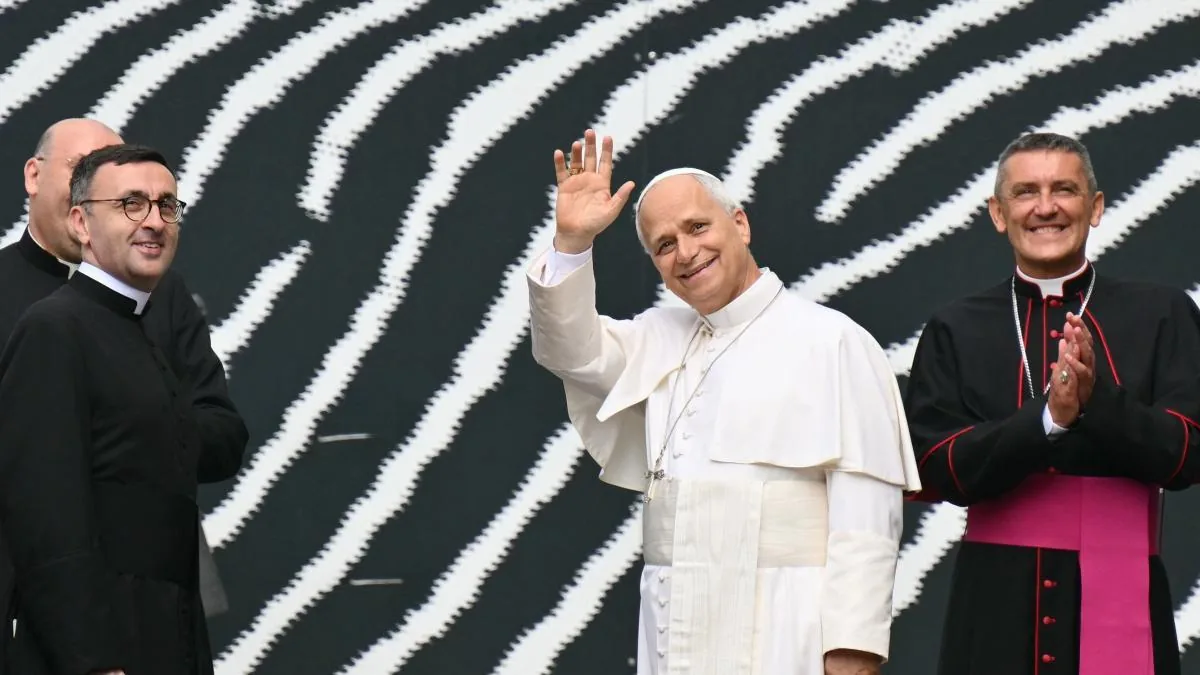
From the Vatican, the debate on artificial intelligence that has erupted in the United States is being followed with great attention. It is not the style of the house to say “we had already warned,” and Leo XIV does not either. But within the Leonine walls, it is observed that many of the doubts raised today by the very directors and researchers of the large technology companies were already at the center of Magnifica Humanitas, the first encyclical of the pontificate, published last May.
Read more Who should win the Ballon d’Or, Mbappé or Lamine Yamal? Today on ‘Hay Partido’
Reread in the light of the alarms of these days, some passages of the text seem almost to overlap with the current debate or even, as some are beginning to argue across the Atlantic, to have somehow contributed to raising it. Ultimately, as Vatican sources acknowledge, the Pope from Chicago has played a “prophetic” role in what is happening. And, as a sign of how much this is one of the issues that worries him most, the pontiff will deliver a speech at the UNESCO headquarters in Paris on September 25.
Prevost will take the debate on artificial intelligence to UNESCO in Paris on September 25
In the text, Leo started precisely from the speed of the technological race and a paradox that today is openly admitted even by some of its protagonists: “All of us, including those who design them, know little about their effective functioning,” he wrote about the new AI systems. In another passage, he warned of the “race to develop increasingly powerful technologies, or to secure their control,” a dynamic that, he noted, “seems to know no limits.” But, above all, he denounced the concentration of enormous power in the hands of a few private groups, capable of controlling data, infrastructures, and computing capacity and, precisely for that reason, increasingly difficult to subject to public control. The response proposed by the encyclical was political: clear responsibilities, independent verifications, and effective controls. “A more moral AI is useless if that morality is decided by a few,” Leo warned, calling for “a more present policy, capable of stopping where everything accelerates.”
It is no coincidence that the encyclical was born from dialogue with sector experts. At its presentation in the Vatican on May 25, Christopher Olah, co-founder of Anthropic and head of research on interpretability, participated. Precisely Anthropic, creator of Claude and one of OpenAI’s main rivals, is now at the center of alarm. One of its researchers, Jacob Coxon, resigned warning that the competition among the big labs puts humanity at risk. And Evan Hubinger, head of research on alignment, has placed the probability that AI could cause human extinction in the next decade above 10%.
The prophetic role of the encyclical has also been emphasized by Father Paolo Benanti, a Franciscan, professor at the Pontifical Gregorian University, and one of the main reference voices of the Pope and the Holy See on artificial intelligence. Considered one of the greatest Vatican experts in AI ethics and governance, Benanti has participated for years in the main international debates on the regulation of these technologies and has also been part of the high-level advisory body on AI created by the United Nations Secretary-General. In light of the latest alarms from Anthropic, he explains that this is “exactly the point where Magnifica Humanitas has something to say”: the issue is not only how justified the most catastrophic forecasts are, but who has the power to decide how far to take these systems. Therefore, he argues, the security mechanisms of the companies themselves are not enough: independent controls and an external authority capable, if necessary, of stopping the race are needed.
Read more The PP is going to «Europeanize» the Ceuta crisis and believes that it «has worsened»
Benanti, one of the Pope’s main advisors: “Independent controls and an external authority capable of stopping the race are needed”
But Leo XIV’s role gains even more strength in the United States. On September 9, just as the new alarm about AI was growing, Georgetown University in Washington dedicated a public debate on Magnifica Humanitas with experts in technology and digital policies. Jasmine Sun, a journalist from The Atlantic specializing in the culture and politics of artificial intelligence, explained that even in a San Francisco little suspected of Catholic fervor, a moral leadership is sought, and that is precisely what, in her opinion, Magnifica Humanitas can offer.
A significant recognition has also come from Bill Gates. At the end of August, the Microsoft founder, reflecting on the risks of uncontrolled AI development, said he was “fascinated” by Leo XIV’s encyclical, which, in his opinion, “lays solid foundations for the work that remains to be done.”
Bill Gates declared himself “fascinated” by the encyclical: “It lays solid foundations for the work that remains to be done”
The debate is now destined to return directly to the Pope’s hands. His speech in Paris will be heard by an increasingly bewildered community of visionaries and perhaps also by Donald Trump, who yesterday dismissed warnings about AI as the work of “very negative forces” that raise scenarios that “will not happen.” The U.S. president made his priority clear: not to stop the race against China because, he said, “whoever wins AI, wins.” For Leo XIV, however, stopping means preventing the race from dragging us all along.
Read more Judge Tardón demands the case against the Government delegate in Ceuta