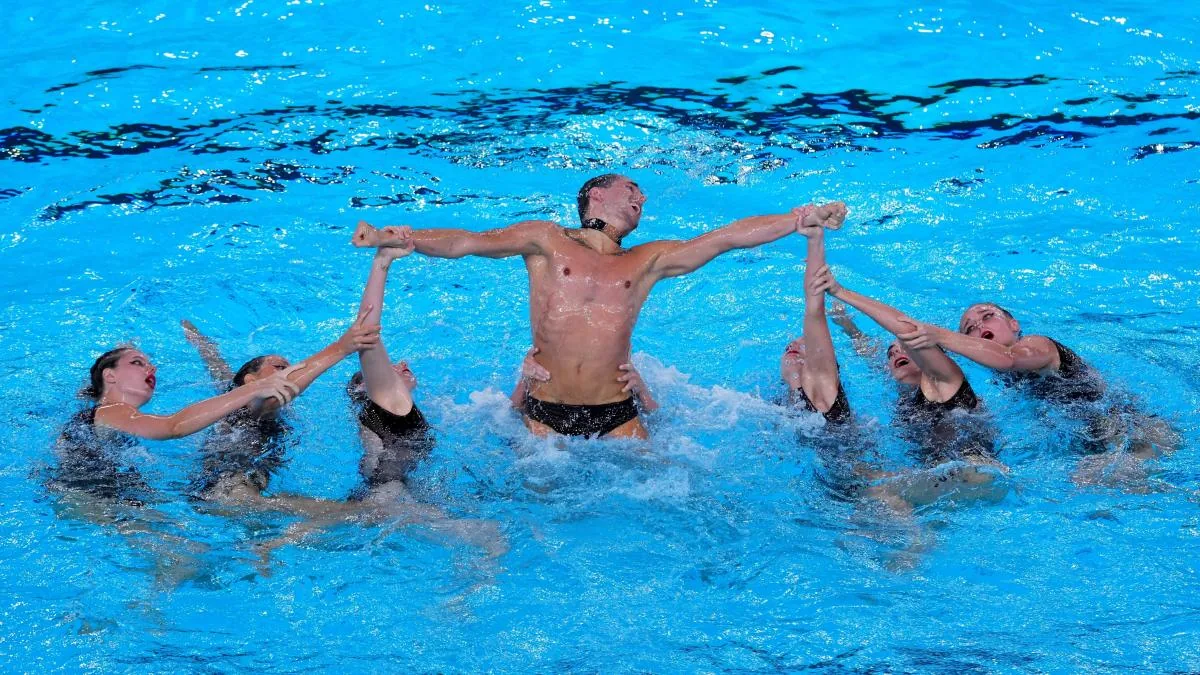
There are golds that over time get lost in any box and silvers that are remembered forever. The eternal dichotomy between winning or leaving a mark, which often do not go hand in hand. This metaphor explains the result of the last event of the artistic swimming at the European Championships in Paris, the acrobatic, which crowned Russia on the podium, achieving a triple in the team events, but also brought Spain to the top in the memory of the synchro family.
Read more Civil guard who shot his ex-partner dead at the Llanes barracks dies
On this occasion, Russia went out before Spain, with a routine accompanied by electronic music that left the spectators speechless. Paris has been the selectivity of the new Russia, which is once again for all intents and purposes the country that dominates artistic swimming by teams with the three golds won against Andrea Fuentes’ Spain.
The eastern team has always stood out for having great acrobats, a key quality in current synchro, which allows increasing difficulty with impossible figures, like those in this choreography accompanied by electronic music. It is not something difficult. Synchronized swimmers sprout like mushrooms in the refined Russian structure, so it is not necessary to dedicate time to teaching, as happens in Spain or most countries.
Russia obtained a score of 244.8221, with up to seven tens in the elements (148.2221) and the artistic (96.6000). The bar was very high for Spain, but perhaps Fuentes’ team’s mission was different.
The choreography of Rosalía’s Berghain, which began to be conceived in the head of the coach on a car trip from Barcelona to Tarragona around November, enchanted the judges so much that it received up to six tens in artistic impression to add up to a score of 100.2500, the highest in the history of this routine, an example of how the Spanish team has put all efforts into a daring choreography, polished like a sculpture and visually and aesthetically impressive.
Read more The socialist El Sayed defeats the Democratic establishment in the Michigan Senate primaries
In it, titled ‘Divine Intervention’, the Spanish team, which included Iris Tió, who finished with six medals, and Dennis González, who will become the first man to compete in the Olympic Games in Los Angeles 2028, weaves a perfect story to the voice of Rosalía, with the most spectacular acrobatics of all performed by the Hispano-French hyperextended-legged Lilou Lluís and with the participation of all its members, such as Paula Ramírez, who is in a retirement process. Without a doubt, it would be a grand farewell.
In Spain’s routine, things happen. A bridge where Lluís holds herself on the heads of her teammates, the solo of Iris Tió, and a duet with Dennis González, who has a relevant role in it.
Spain, again, was just a hair away from Russia, as happened in the other two team routines (242.2428), barely 2.6 points behind. The difference was in the level of difficulty, lower than Russia’s, which was what tipped the balance and reduced the score in the elements (141.9928). The Berghain has been Spain’s big bet and it did not disappoint.
In the team events, Spain has taken a step forward in Paris. It has succumbed to the feared Russia as always, but it is close to making a radical synchro, in the opposite direction, where the artistic leaves a mark and the choreographies are not hidden in a box, but in a corner of memory. At the World Championships in Budapest next July, they will face each other again a year before the Games.
Read more Morocco displays a congratulatory message from the King to Mohamed VI sent before the Ceuta crisis