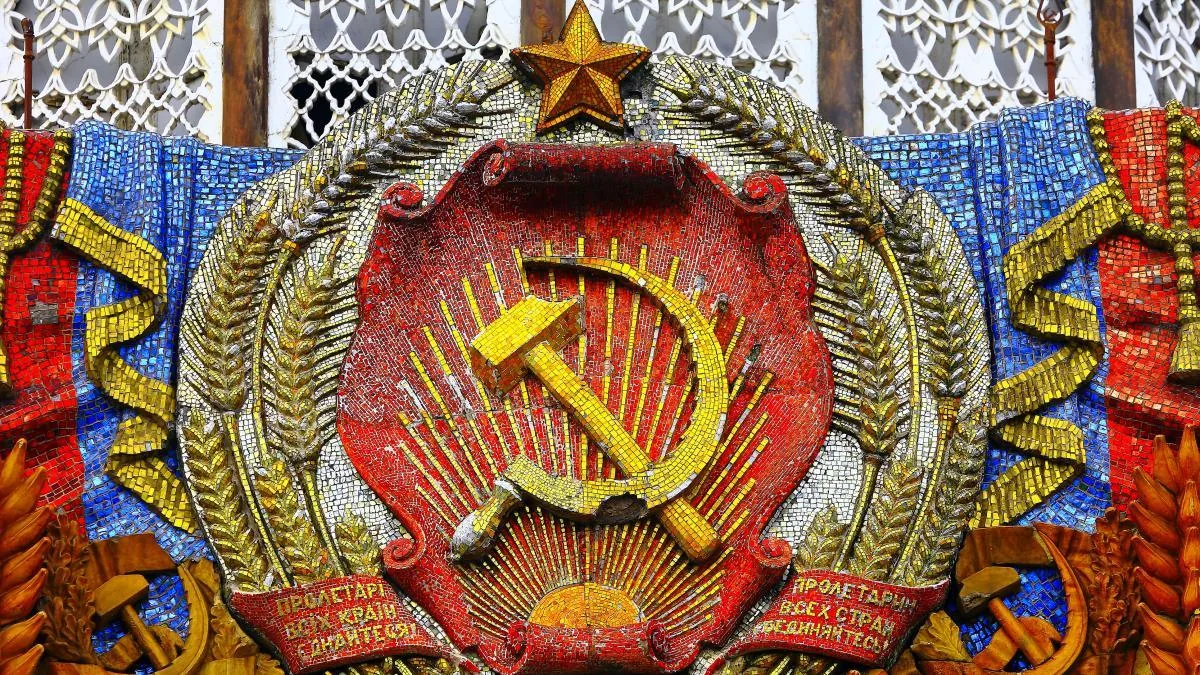
Mikhail Gorbachev was not the last leader of the USSR, because the Soviet Union still exists and has been hijacked by a private company called Russia. All the bills that its citizens pay, such as electricity, gas, or mortgages, not to mention taxes, are illegal…
Read more Spanish right blue card
Thousands of Russian citizens, according to FSB data, live in this parallel reality 35 years after the Soviet disintegration.
Vladimir Koriakin presents himself as the legitimate successor of Soviet power and “General Secretary of the CPSU”
The self-proclaimed general secretary of the Citizens of the USSR movement, also called the Union of Slavic Forces of Russia (or USSR, by its Russian acronym), is Vladimir Koriakin and he spent July 13, his 81st birthday, in a Moscow cell. Last week he was arrested and charged with extremism.
For years, Koriakin has refused to use modern documents, such as the Russian internal passport (equivalent to the national identity card). He and his followers do not recognize Russian laws. Based on his fictitious position, in 2019 he addressed the UN by letter. In it, he presented himself as the legitimate successor of Soviet power and the elected leader of the Communist Party of the Soviet Union (CPSU).
According to various estimates, Citizens of the USSR, an organization that functions like a sect, currently has about 10,000 followers worldwide. In 2018, when the Russian justice system brought the first case against the movement to court, the Russian Security Service (FSB) believed it had 150,000 adherents.
Nostalgic groups of the extinct USSR emerged in 1995 but the Union of Slavic Forces of Russia appeared in 2010
Last June, a resident of the Kaliningrad region (in the Baltic Sea) violently confronted an electricity company inspector who came to disconnect her power for not paying a debt of 30,000 rubles (342 euros), and then stole his phone. According to her, she had the right to use electricity for free.
In 1995, nostalgic groups already appeared who still considered themselves citizens of the Soviet Union. But the movement as such began to take shape in 2010 after a somewhat anecdotal episode.
Read more Albares reproaches the PP for its confrontational policy with neighboring countries
Sergey Taraskin, a dentist from Dushanbe (capital of Tajikistan) had moved to Moscow and opened a clinic. He could not pay the loans he had taken out and before the Arbitration Court of the Russian capital declared that he was the “interim president of the USSR.” Taraskin argued that, since he had taken a loan in the Russian Federation, he was not obliged to repay it.
Around this idea, an organization began to form. Years later, the Russian justice system began to act. In 2018, the first case reached the courts, when the self-proclaimed leader of the Soviet Sverdlovsk region, Andrei Zlokazov, was accused of calling for extremism. During the search of his home, it was discovered that he manufactured and sold USSR passports and other documents, or Soviet vehicle license plates. After the trial, he was placed under mandatory psychiatric treatment.
In 2019, the justice system declared the Union of Slavic Forces of Russia (USSR) an extremist organization and banned its activities in the country. Three years later, it sentenced its “president” Taraskin to eight years in prison for organizing activities of an extremist organization.
This fake movement exploits the pain of the empire’s disintegration, hatred of bureaucracy, loneliness of the elderly, or nostalgia for the country of youth
This fake movement exploits the pain of the empire’s disintegration, hatred of bureaucracy, loneliness of the elderly, or nostalgia for the country of youth. But it is also sustained by the fraudulent market of documents and passports, the belief that in a still-living USSR any debt will be canceled and, of course, by the fees of believers, which are not paid with money from the imaginary country.
The ideas and way of acting of this Russian movement are not native. Because of its ideas, it has been compared to the so-called “sovereign citizens” of the United States, who reject the jurisdiction of the State, its taxes, permits, and courts; and with the Reichsbürger Germans, that is, the “Citizens of the non-existent Reich,” who do not recognize Germany as a State and include some radical and violent organizations.
If the Moscow courts declare Koriakin guilty of extremism, Gorbachev’s successor in his nostalgic parallel reality could spend the next six years in a prison that, unfortunately for him, does exist.
Read more The history of Spain-France: Arconada, Raúl’s penalty, the 2006 World Cup, Lamine…