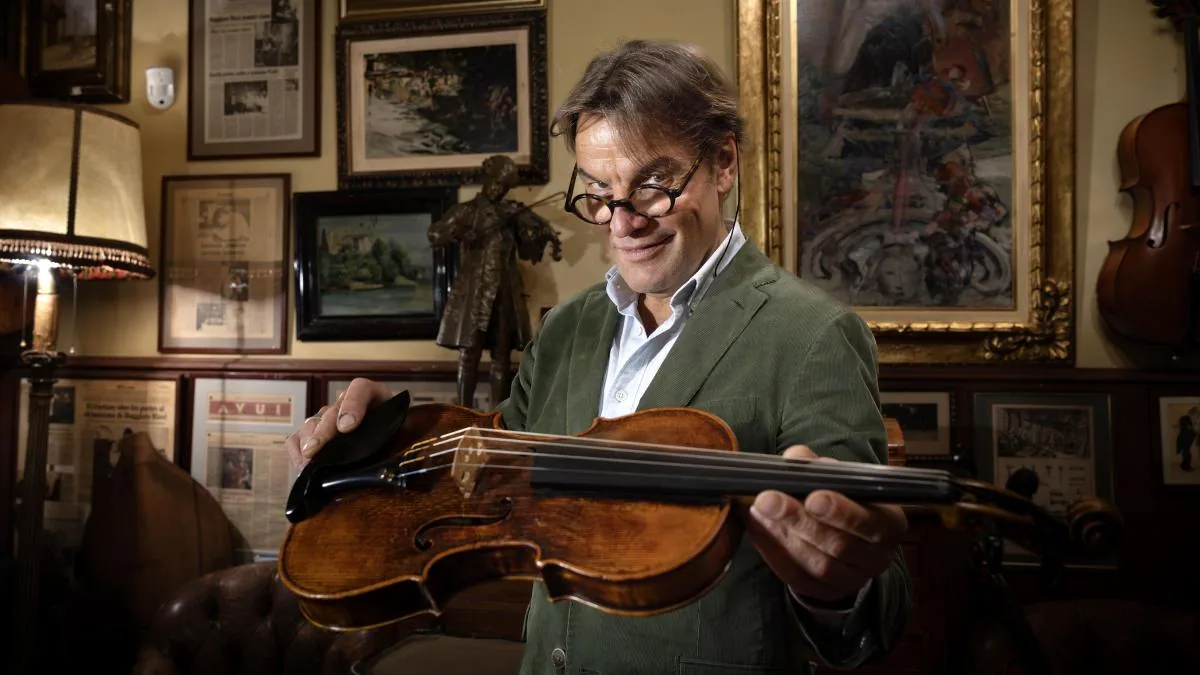
“Dying didn’t matter to me, but stopping making violins…”. The phrase perfectly defines its author, David Bagué (Barcelona, 1964), considered one of the best luthiers in Spain and with the greatest international projection. Beyond having a Creu de Sant Jordi, which is no small feat, the Vienna Philharmonic has three of his instruments (two violins and a cello) and Leonidas Kavakos, one of the best violinists in the world, owns between four and five of his violins. However, at the age of 28 (now he is 61), Bagué began a ordeal that almost took away what he loves most in this life and which is his reason for being: making violins. He was diagnosed with Wegener’s granulomatosis, a rare disease in the group of systemic vasculitis, which recently had its world day.
Read more Was the grandfather a Nazi?
It all started with joint problems. Especially in the hands, his working tool. “I remember perfectly the first day I felt the pain,” he tells La Vanguardia. He was in a restaurant with some friends and suddenly felt a sharp pain in an ankle. He didn’t give it much importance.
I remember perfectly the first day I felt the pain”
David Bagué
Luthier
However, it persisted. And it didn’t stop there. It moved to the other ankle shortly after. And later to the shoulder, becoming polyarthralgia, that is, multiple joint pain. After visiting several doctors, he ended up with a rheumatologist who diagnosed him with rheumatoid arthritis. “It is also an autoimmune disease, but it wasn’t what I had,” reasons Bagué. They started treating him with corticosteroids and chemotherapy pills, the most aggressive available at that time.
With the treatment, the pain stabilized, although the worst was yet to come. Suddenly, he developed very high fevers accompanied by intense coughing. And an X-ray set off all alarms: it showed two lung lesions, 8 cm and 10 cm respectively, which required immediate hospitalization. “I went through horrible days: vomiting, soaring fever…”.

His pulmonologist, who worked at Vall d’Hebron, was clear. “It looks very bad,” he said, and told him he suffered from an autoimmune disease, although he didn’t know which one yet. Also, at the hospital, they associated his lung lesions with the joint problems. Over time, the diagnosis came: Wegener’s granulomatosis.
“This pathology affects small blood vessels, those that go to organs (kidney, lung, brain…)”, explains Dr. Roser Solans, a specialist in autoimmune diseases who has been treating Bagué at Vall d’Hebron for 30 years.
This pathology affects small blood vessels, those that go to organs”
Roser Solans
Specialist in autoimmune diseases at Vall d’Hebron
She explains that it can be confused with rheumatic diseases because sometimes the patient’s joints swell. “But the pathology is much more than that,” she warns. “It can start like that, but then inflame the vessels of the organs,” she adds.
Depending on the disease one has from the group of systemic vasculitis and the organs affected, the treatment is more or less intense. Usually, it is treated with very high doses of cortisone. Immunosuppressants are also administered to reduce the number of white blood cells, which attack the body. “If it affects the kidneys [not the case of the luthier], they can stop working and the patient ends up on dialysis within days or weeks. These are serious diseases,” recalls Solans.
The disease is devastating”
David Bagué
Luthier
Indeed, Bagué reached the limit. “My deterioration at that time was very significant. The disease is devastating. I had the feeling I was leaving this world, to the point that I said goodbye to my family,” he argues.
After two very intense years – hospitalizations, weekly lab tests, countless biopsies and also, again, chemo – he began to see the light. Until today, when fortunately he is asymptomatic, although he undergoes check-ups every six months. “Public healthcare saved my life,” he states. However, he carries sequelae: he is hypertensive, suffers some osteoporosis… A few years ago he even had a thrombosis, so he also takes anticoagulants.
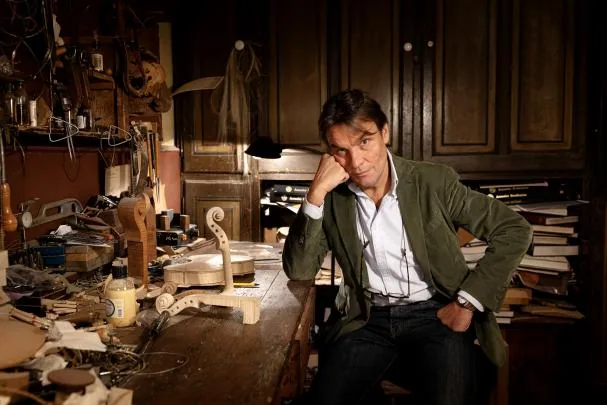
“Being alive is very dangerous, extremely dangerous,” asserts Bagué. This is how, with sarcasm, he says he has managed to cope with everything. He has also been helped, although it may seem contradictory, by the health problems he has had since childhood: dyslexia, ADHD, and hip dysplasia (he has had prostheses for about five years) that forced him to wear orthopedic devices at school. “The burden I have always carried taught me many years ago to understand that existence is finite.”
Being alive is very dangerous, extremely dangerous”
David Bagué
Luthier
His greatest fear was always having to stop making violins. “I want to die like Molière, in the workshop, which is my sanatorium,” he concludes.
Read more The electoral board validates the endorsement of Enrique Riquelme, who will face Florentino