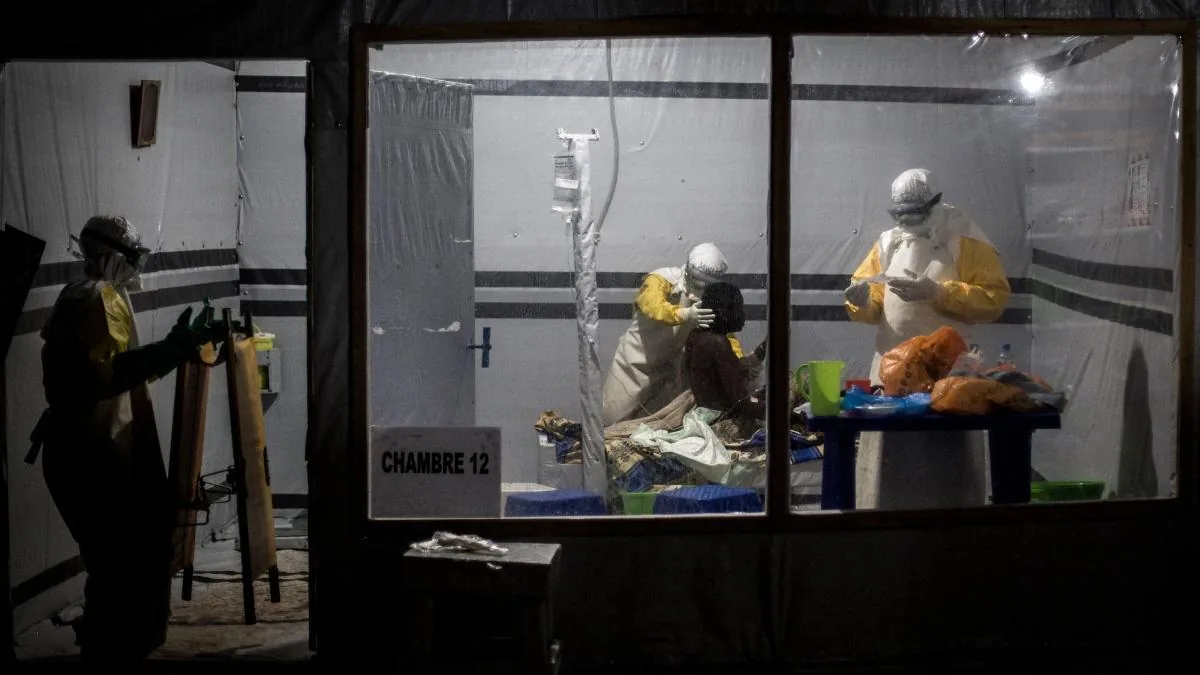
Unease is growing over the Ebola outbreak in the heart of Africa. The Director-General of the World Health Organization (WHO) expressed today his “deep concern” about the “speed and magnitude” of the epidemic that emerged on April 24 in the northeast of the Democratic Republic of Congo and has already recorded cases in highly populated cities such as Goma, the capital of North Kivu province, and even in the capital of neighboring Uganda, Kampala.
The head of the WHO, Tedros Adhanom Ghebreyesus, pointed out that there are already at least 500 suspected cases and 131 suspected deaths from Ebola since the new outbreak began, including one confirmed death and one confirmed infection in Uganda. Despite the concern, there is positive news: the suspected case being analyzed in Kinshasa, the Congolese capital, has finally tested negative and is not infected with Ebola.
The late detection of the first cases, the fact that it is the Bundibugyo Ebola variant, for which there is no vaccine, and that it originated in the Ituri province, a mining area bordering Uganda and South Sudan, with high mobility and in an unstable and violent context, have led experts to warn that we are probably facing what will be one of the worst Ebola epidemics in history. In the largest epidemic of this virus ever recorded, with 28,646 cases and 11,323 deaths between late 2013 and 2016 in Sierra Leone, Liberia, and Guinea, infections in cities were one of the factors that most contributed to spreading the infection in West Africa.
In this situation, last Sunday the WHO declared a Public Health Emergency of International Concern (PHEIC), its second-highest alert level, even before convening an emergency committee. “It was the first time a Director-General declared a PHEIC before convening an emergency committee, but I did not make that decision lightly,” Tedros emphasized this Tuesday in his general speech at the organization’s annual assembly in Geneva.
According to the WHO leader, there are several reasons for concern regarding this outbreak, including the cases reported in the cities of Kampala and Goma, the latter city controlled by the rebel group M23 where the Congolese government does not operate, which does have experience dealing with this type of epidemic emergency.
Additionally, deaths among healthcare workers have been confirmed, indicating transmission associated with medical care, and in recent months there have been significant population movements in the region due to the intensification of the conflict, with the displacement of more than 100,000 people.
Read more The White House defends compensating insurgents who attacked Capitol police
Ebola virus infections among people occur through contact with the blood or other bodily fluids of an infected person, but not through respiratory transmission.
From the humanitarian organization Doctors Without Borders, with extensive experience in combating Ebola epidemics on the continent and which has already initiated a large-scale response to contain the current emergency on the ground, they also expressed their concern. For Trish Newport, head of the MSF Emergency Program, “the number of cases and deaths recorded in such a short time, along with the spread to several health zones and now also beyond the border, are extremely worrying.”
The number of cases and deaths recorded in such a short time, along with the spread to several health zones and now also beyond the border, are extremely worrying”
Trish Newport
Head of the MSF Emergency Program
Additionally, Newport pointed to the added problems caused by an unstable context in the epidemic’s ground zero. “The limited capacity to access healthcare and the insecurity context in Ituri make a rapid response essential to prevent further spread.”
This epidemic caused by the Ebolavirus Bundibugyo species has only two precedents. The first, in Uganda in 2007-2008, was controlled after 37 deaths among 149 cases, with a mortality rate of 25%. The second, in DR Congo in 2012, caused 29 deaths among 57 cases, with a mortality of 51%.
There is no precedent in previous outbreaks and epidemics of sustained Ebola virus transmission outside Africa.
Read more Trump says he was «an hour away» from attacking Iran and gives a timeframe of days for a deal