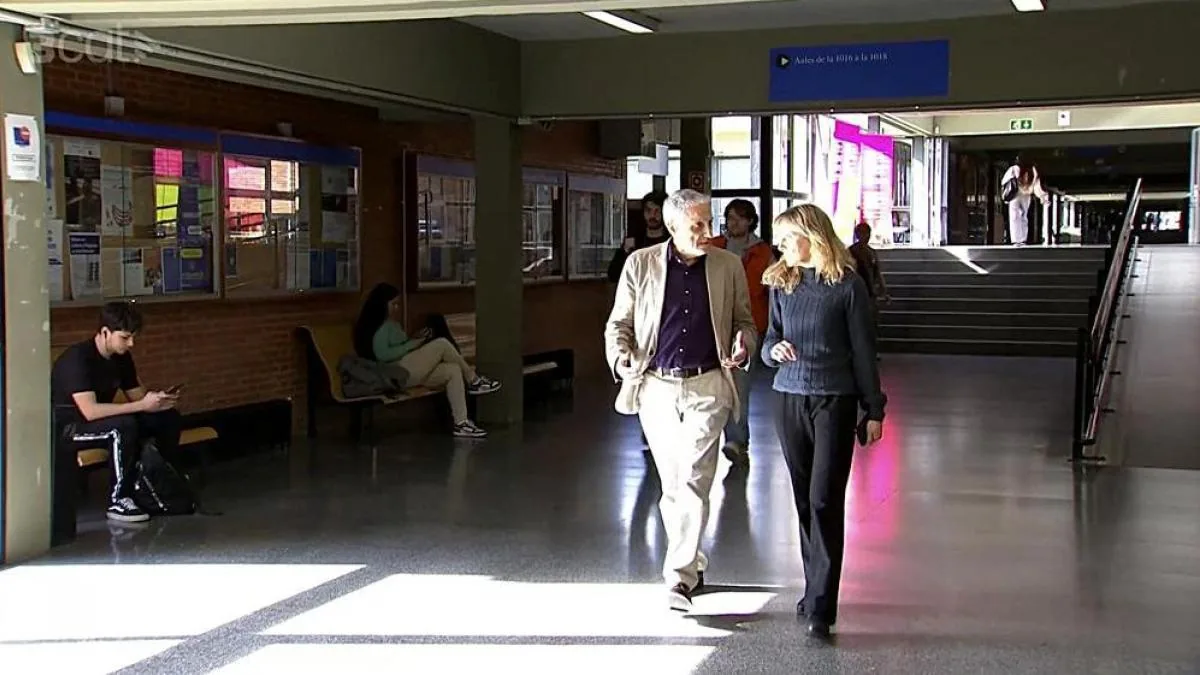
The contentious administrative court number 14 annuls the decision of the rector of the University of Barcelona (UB) to suspend a Sociology professor from employment, involved in the alleged abuses of Professor Ramón Flecha, and obliges the institution to reinstate “the full exercise of her teaching, research, and management functions from which she was provisionally suspended.”
Read more Shock in Mexico over ten bodies of businessmen and officials hung by cartels
According to the ruling, to which La Vanguardia has had access, the judge rules that the UB violated the rights of Professor Lidia Puigvert, protected by article 24.2 of the Constitution, by not being heard before the university made the decision to remove her from her job. Precautionary measures of this nature can only be taken, without giving prior audience to the worker, if there is a special parameter of urgency, a circumstance non-existent in this case.
With this, there are two rulings that declare null and void the precautionary measures dictated by the rector of the UB last December. The first ruling, issued in June, refers to Professor Marta Soler, also a close collaborator of Flecha, who was also not given a hearing before that decision was made.
The judge does not question the necessity of the precautionary measures but the way they were adapted
The rector decided to preventively remove these two professors after learning the result of a report from a commission of experts, promoted by himself six months earlier due to a complaint from 16 researchers, which warned about possible sexual and labor abuses at the UB, allegedly committed by Professor Ramón Flecha and his circle. The commission, which advanced the result earlier than expected, asked the rector to take “urgent measures” given the repetition of statements and documents that painted a repeated picture of serious events. The rector transferred these indications to the Prosecutor’s Office, which are in the process of criminal investigation, and, in parallel, removed the professors from their jobs while maintaining their salaries. Both appealed.
In the new ruling, the judge expressly recognizes that her resolution applies the criterion already established by her court colleague in the Soler case, invoking the principle of unity of doctrine and the need to guarantee equality in the application of the law. And it includes part of the ruling in which the magistrate underlines the seriousness of the complaints. It specifies that “sexual coercion, psychological coercion, habitual and psychological abuse, manipulation of thought and behavior, professional or servitude and intellectual exploitation for the benefit of their leader or the group, pressures, humiliations, punishments, emotional domination, etc.” are being investigated. Likewise, it dismisses – as the Soler ruling already did – that her right to the presumption of innocence was violated.
The UB will hear, as it has already done with a previous professor, this professor and the legal services will assess a new opening of precautionary measures
The two magistrates emphasize the proportionality and suitability of the precautionary measures, recalling that indications of apparently criminal conduct can endanger or risk members of the community and also hinder the judicial or administrative investigation into what happened. But they recall that a prior hearing of the workers was necessary. They also highlight the importance that the suspension of functions has for a public official in their own work as well as in their personal and family life.
Read more Trump threatens to destroy “a bridge or power plant” each time Iran fires at a ship in Hormuz
Sources from the UB emphasize that both rulings, issued by different judges, endorse the proportionality and suitability of the precautionary measures adopted against the two professors, and that they only uphold the appeals regarding the lack of prior hearing. According to the same sources, the university is executing the ruling by giving a hearing to those affected. In Soler’s case, the UB has already completed this procedure and has collected her allegations; it is now up to the university’s legal services to evaluate them and decide whether to adopt a new precautionary measure. For Puigvert, the institution will follow the same procedure: it will give her a hearing to present the allegations she deems appropriate, before deciding whether or not to adopt a new precautionary suspension.
The ruling can be appealed before the High Court of Justice of Catalonia, the same route that the UB is considering using against the ruling in the Soler case.
The judge has dismissed Puigvert’s defense’s claim to condemn the UB to issue an institutional statement that “repairs the honorability and reputation” of the professor. The ruling recalls that the object of the lawsuit is limited to determining whether the challenged administrative resolution violates fundamental rights – presumption of innocence and due process – and therefore restores the full exercise of her teaching functions, but it is not competent for “the imposition of institutional obligations unrelated to the resolution.”
The ruling has been well received by the CREA environment, which has echoed it on social networks. The website Diario Feminista, close to the CREA group, published an article that frames both rulings as the only judicial pronouncements to date in relation to what it describes as 16 anonymous accusations against a group of feminist academics. The text states that those affected consider what happened a case of “isolating violence” against them.
These two rulings only resolve the administrative route opened by the professors against their precautionary suspension, apart from the criminal investigation that is still ongoing. The Barcelona Prosecutor’s Office continues to investigate the complaints filed by former members of CREA against Flecha and his circle for alleged practices of sexual coercion, abuse of power, psychological manipulation, and labor exploitation. Six months after the opening of the proceedings, the Public Ministry continues to take statements from the alleged victims.
Read more The Supreme Court returns Aldama his passport to continue his businesses abroad