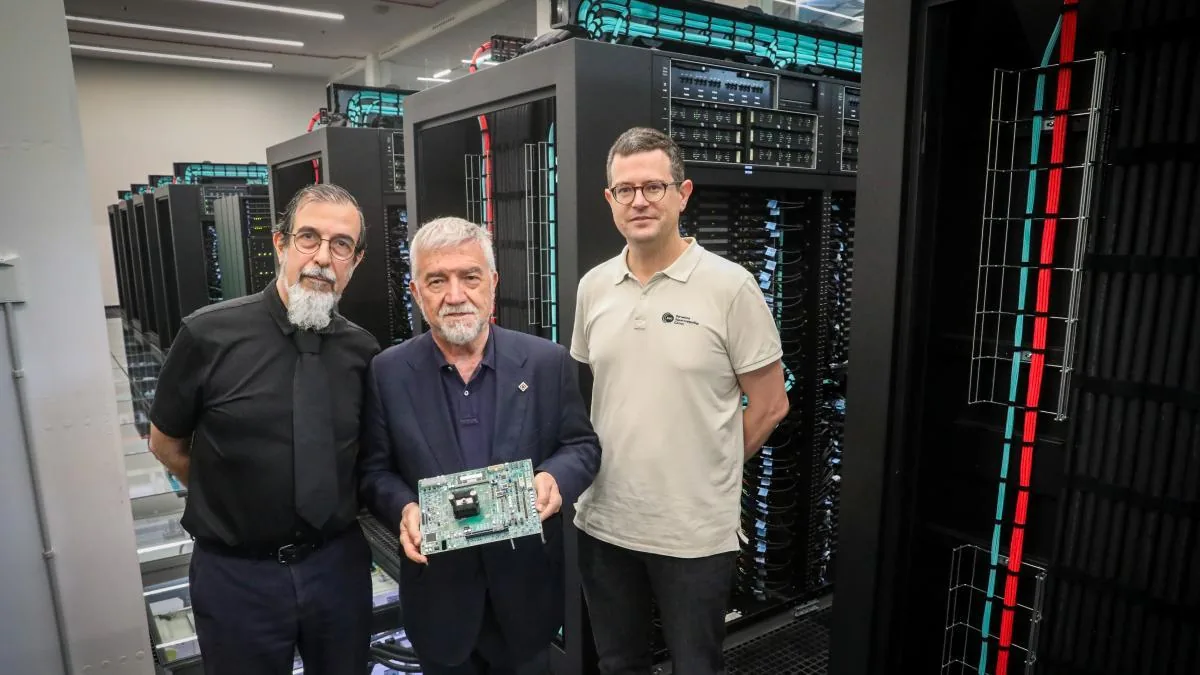
The Barcelona Supercomputing Center (BSC) has developed the most advanced open-source microchip in Europe. It is a tiny chip, whose transistors measure barely 1.8 nanometers. This microchip is capable of processing information very quickly and consuming less energy than the chips that are more widespread in the market, whose transistors measure between 4 and 5 nanometers.
Read more Has absenteeism increased at the university? A Faculty Dean opens the debate
“We want to advance towards European technological sovereignty and this prototype represents a great milestone forward. It is open source and now we make it available to any company that wants to produce it on a large scale. This technology is crucial for supercomputers and for data centers specialized in artificial intelligence (AI),” says Mateo Valero, director of the BSC.
The project has attracted 43 million euros from the Perte chip and up to 20 million from Intel
The initiative has been developed together with the Intel group. Specifically, the American giant has carried out the tests for its operation. However, it will not necessarily be this group that decides to take the microchip to large scale. “This is still to be seen. The BSC has already fulfilled its mission after three and a half years of development and research,” say the project directors, Osman Sabri Unsal, head of the Computer Architecture for Parallel Paradigms group; and Miquel Moretó, director of the HPC Architecture research area.
From now on, it is the companies that should approach the BSC and decide to use its technology to produce this microchip on a large scale. It should be taken into account that it is a very costly process, requiring an investment of more than 500 million euros and that in Europe there are no factories producing high-performance chips. These plants are mainly located in Taiwan and South Korea.
The project has involved the work of 200 high-level professionals and has been funded with public resources: 43 million euros from the Perte chip, a program launched by the State and financed with European Next Generation funds. In addition, Intel has committed to contributing up to 20 million euros to carry out the prototype’s operational tests.
Read more Javier Zarzalejos: “The idea of the European ICE is far from our objectives”
“The technology is the most advanced in Europe in the world of open-source chips but it is true that there may be private initiatives that have developed chips with 1.8-nanometer transistors,” agree the leaders, who remind that the BSC is a public research institution.
Once the design of this prototype is completed, the BSC faces the challenge of leading the macroproject DARE. This European initiative has a budget of 240 million euros, half of which come from European sources and the other half from state and private sources. It is an ambitious project involving about forty reference institutions in the world of supercomputing, both from the public and private sectors. Among them, the participation of the Catalan company Openchip stands out, which has received 52 million from the budget. The project, which started last year, will last up to six years.
“We want to turn the city of Barcelona into a Design Valley, a reference valley in microchip design in Europe,” comments Valero. The goal of DARE, the researchers add, is to design a constellation of microchips capable of providing more flexibility and speed when processing information.
Read more The 175 activists of the flotilla detained by Israel will disembark on a Greek beach