“Low levels of class attendance, poor involvement in following subjects, tasks done with little rigor, a lack of commitment to the learning process, minimal engagement and high demands, unsubmitted work, lack of individual responsibility…” In short, a disappointing and worrying situation.”
Read more Javier Zarzalejos: “The idea of the European ICE is far from our objectives”
These are just some of the phrases taken from the letter that the dean of Political and Social Sciences at Pompeu Fabra University (UPF) has sent to his first and second-year students.
A harsh missive, sent via email, in which this professor expresses helplessness in his responsibility to train students who, according to him, are not up to the task.
“I write as dean of the Faculty due to a situation I consider serious and that we cannot normalize,” the letter begins. It continues: “We have observed low levels of class attendance, as well as poor involvement in following the subjects, with tasks often done with little rigor and an attitude not committed to the learning process.”
The letter
Going to university is not just about passing
“University is a voluntary stage. Precisely for that reason, what is expected of you is a real commitment to your education. University learning is not just about ‘passing’. It largely happens in the classroom: with discussion, confrontation of ideas, interaction with professors and classmates. Not attending class is to give up this essential part of the process and miss real opportunities to better understand, connect, or develop analytical and critical skills.”
“Also, you must never forget that you are in a public university. That implies a collective effort (from society as a whole and families) so that you can be here. This opportunity also entails a responsibility.”
“In too many cases what we are observing is: Absenteeism and lack of continuity in attendance; leaving classes during breaks, not returning or leaving before time; little involvement in academic activities and tasks done without minimum rigor or simply not submitted; inappropriate or disrespectful treatment of professors.”
“These behaviors denote a lack of respect and consideration for academic work, for all those involved and also for the rest of the students.”
Coming to class infrequently, engaging minimally and demanding – often without respect – a lot is not an acceptable combination. This way of acting also reflects an immaturity that is not compatible with what is expected of university students.”
“Therefore, I ask you for serious reflection and an immediate change of attitude in the way some of you are approaching your studies.”
This indifference repeats itself, which especially pains this professor, “in activities that are especially important and valuable, such as sessions with political leaders (mayors) who take their time to come to this Faculty, this dynamic is even (which is shameful) more evident.”
And he does not beat around the bush. “I will say it clearly – the same letter states – this situation is disappointing and worrying. And it is mainly because it reflects a lack of individual responsibility from a significant number of you.”
Other universities reject blaming only the student and advocate for a change of model
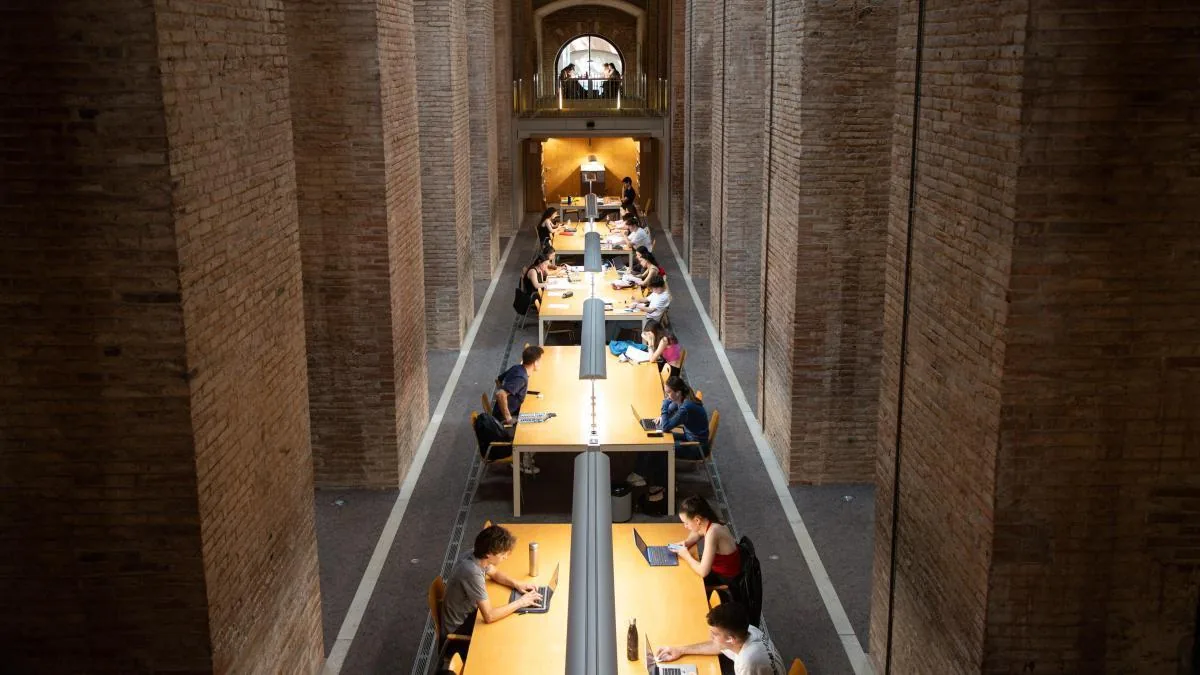
Is what this professor experiences in his classroom repeated in other universities? Raimundo Viejo, professor of Political Science at the University of Barcelona (UB), speaks to La Vanguardia after one of his classes yesterday. His answer says it all: “There are 34 enrolled in that subject, today only four came to class.” They are Economics students and absenteeism “is a trend, unfortunately, very repeated,” Viejo reveals.
“They start skipping classes from the second day,” adds this professor, who does not hide his helplessness over the lack of interest of those university students. He points out that absenteeism in class has skyrocketed since the coronavirus pandemic and laments that professors have their hands tied to redirect that situation: “we cannot force them to come,” he states.
“In my subject there are 34 enrolled; today four came to class,” reveals a political science professor
Jordi Riera, general director of Universitat Blanquerna, does not deny what is described in that letter, but qualifies that absenteeism at university “has repeated cyclically over time.”
Read more The 175 activists of the flotilla detained by Israel will disembark on a Greek beach
He recalls that in 1901, when Unamuno was rector of the University of Salamanca, he already warned the rectors of the other four universities in Spain, at a meeting held in Barcelona, that “if we do not do something different in the classrooms, there will be no reason for students to attend class.” Students could already read a book at home.
Unamuno already said in 1901 that “if we do not do something different in the classroom there will be no reason for students to attend”
Jordi Riera
General Director of Blanquerna
That premise, Riera adds, should never be forgotten and even less now, when current university students “live in a world that is already a classroom.” What the general director of Blanquerna talks about is “redefining presence in the classrooms.”
He considers that blaming only the students for the growing absenteeism “would be unfair.” He believes that the university must “reinterpret each moment” and the question to ask now is “what are we doing to motivate the student to go to the classroom?” Perhaps the classical meaning given to that space “is already outdated,” he adds.
Contixta Amat, vice-rector of Teaching Policy at the University of Barcelona (UB), shares with Riera that the student alone cannot be blamed for absenteeism. UB has just started a study to examine the phenomenon. And here external factors come into play, “such as the fact that there are more students, due to the rental problem, who live far from the university or the diversity of a student body that combines work with studies.”
There are more students, due to the rental problem, who live far from the university and who combine work with studies”
Contxita Amat
Vice-Rector Teaching Policy UB
Both agree on another element – “Access to information has changed and what those university students can learn in class – the teacher himself indicates how they can find it – they have at their fingertips and with a single click without leaving home,” points out Amat.
That is why Riera insists, referring to the resignation of attendance, that the challenge “is to create a new meaning for attending the classroom, where something impossible to find in the new information channels is offered.”
José Luis Muñoz, vice-rector of Training and Teaching Innovation at the Autonomous University of Barcelona (UAB), points out, for his part, that the absenteeism observed in university classrooms “cannot be explained solely in terms of individual disinterest or lack of moral commitment of the students.”
Absenteeism should not be understood as a reproach to students or teachers, but as a significant signal for educational improvement”
José Luis Muñoz
Vice-Rector Training UAB
He shares with his colleagues that “it is a complex and multi-causal phenomenon, linked, for example, to material living conditions, balancing studies and work, emotional distress, and the way the university experience is organized and given meaning.” He insists that “absenteeism should not be understood as a reproach to students or teachers, but as a significant signal to guide decisions for educational improvement and strengthen the formative value of the academic experience.”
Read more Sabadell closes the sale of TSB to Santander for 3.3 billion, of which 300 are capital gains