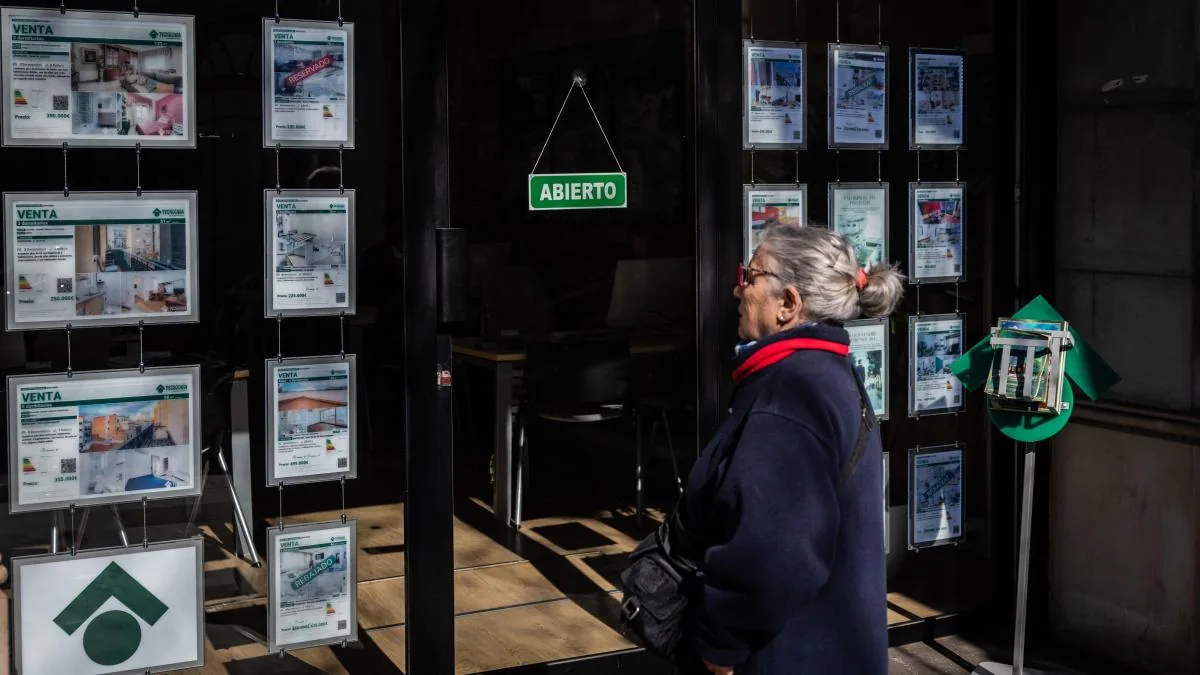
The Bank of Spain remains immersed in a process of reflection, “the deepest in Europe,” about whether it is advisable to tighten the conditions for accessing mortgage credit to avoid possible bubbles. Without yet making a decision, it has detected that this type of measure can “reduce the amount of homeownership and push more people towards renting,” said the bank’s Director General of Financial Supervision, Daniel Pérez Cid, during the presentation of the Spring Financial Stability Report.
Since the end of 2025, the Bank of Spain has been studying the limitation of mortgage granting requirements after receiving a recommendation on this from the International Monetary Fund (IMF) and noting that only three EU countries — Spain, Italy, and Germany — do not restrict this activity. The aim is to limit the loan-to-value ratio (LTV) or the ratio between the installment amount and household income (debt to income, DTI). It can also limit the number of years of the mortgage, as some countries do.
Pérez Cid indicated that the bank does not have a “sense of urgency” about this measure and is analyzing its benefits and costs. It could be “counterproductive” and generate great “heterogeneity” that “affects the life cycle of young people,” who would be forced to delay the moment they buy a home. For this reason, the bank “wants to have the most powerful arsenal possible before making a decision.”
The measures “reduce risk,” but “can lower the ownership rate and push towards renting”
These limits “reduce credit risk but affect the homeownership and rental housing market with long-term effects,” he said. “The ownership rate may decrease, and there may be a shift towards renting and a change in the relative prices between ownership and renting,” he added.
Currently, the average loan amount over the home price, the LTP, stands at 81.2%, compared to its historical peak of 107.7%, reached before the real estate bubble burst. For the Bank of Spain, Spanish households and the real estate market are in good health.
The report also shows that real housing prices continue to rise but concludes that they are at levels comparable to those of 2004 and still 15% below the bubble’s peak. There is also, unlike that time, a price heterogeneity, with prices rising more in more “strained” areas.
In its report, the Bank of Spain also begins to refine its risk scenarios to adapt them to the tension in the Middle East and the closure of the Strait of Hormuz. Its conclusions are that the economy starts from a good position, but also that a worsening of the conflict that drives the barrel to $145 for two years would cause economic stagnation and, if it reaches $220, a recession. This word is not common in the institution’s reports.
However, there is more concern about public accounts. “They have recovered from the shocks since 2020,” but “we identify that they remain at a high level in terms of GDP, above 100,” he assured.
“We miss concrete measures that explain the path to reducing the public deficit”
“We miss concrete measures that explain the path to deficit reduction,” he pointed out. “We continue to miss this lack of concreteness in the medium-term fiscal plan,” he added.
Regarding the war in Iran, the Bank of Spain has calculated the economy’s exposure to the conflict. Although direct financial exposure to conflict zones is “marginal,” the rise in crude prices could cause a “strong and rapid but also temporary increase in inflation.”
With Brent at $145, the forecast is that inflation will reach 6.8% in 2026 and 3.7% in 2027, while growth would be 1.3% this year and zero the next. The unemployment rate would reach 11.7%. This scenario “is more or less what happened in the Gulf War,” with a 9% supply reduction.
Recession and 9.5% inflation with oil at $220
In the scenario with oil at $220, supply would be 14% lower, and a situation comparable to the early 1970s crisis would occur. Inflation would rise to 9.5% this year and 3% next year, while growth in 2026 would be 0.6% and would turn into a contraction of 0.7% in 2027. “In this case, the recession is mild and quick, and growth returns in subsequent years,” he notes. Unemployment would reach 12.9%.
In any case, he describes these two scenarios as “very adverse” and offers another central scenario consisting of “moderate” effects that would lead to other “more adverse” ones associated with greater conflict intensity and persistence of the energy shock.
He also warns that “the extension and prolongation of these restrictions could lead to the fragmentation of the global energy supply” and the “high risk of a market correction” due to the war.
Bank solvency, he says, shows “notable aggregate resilience,” although its ability to generate profits “would be greatly reduced” if the situation worsens. At the same time, a tightening of financial conditions “would significantly impact the Spanish economy,” he states.
It would be “desirable” for banks to access Mythos AI
Regarding Anthropic’s AI, Pérez Cid described the possibility of banks accessing its Mythos model to detect cyber risks as “desirable.” “We have spoken with banks” to gauge the issue.
The Bank of Spain has also calculated in its report the weight of private credit on the Spanish economy. It ranges between 0.75% and 1.96% of GDP. It is a low level compared to other economies but also a matter of concern and monitoring.
Read more Israel lashes out at Lamine Yamal for waving the Palestinian flag in the street for the League