The amnesty law approved two years ago has benefited a total of 403 people, of whom 181 are protesters or pro-independence activists, 158 police officers, and 64 political officials, according to data from the lawyers’ platform Alerta Solidària. Two years later, a total of 93 political officials are still awaiting its application. These are cases that were pending resolution by the Court of Justice of the European Union (CJEU), which ruled in their favor this Thursday. Among them are Carles Puigdemont, Toni Comín, and Lluís Puig, declared in rebellion and with an arrest warrant issued by the Supreme Court; as well as Oriol Junqueras, Jordi Turull, Raül Romeva, and Dolors Bassa, who were pardoned from the prison sentence for the crime of sedition for which they were convicted, but not from the sentence for embezzlement, which involved disqualification from holding public office.
There is also a group of 35 former senior officials of the Generalitat who are still awaiting the formal removal of civil and accounting liability for the expenses of the 1-O and the external promotion of the procés. The Court of Auditors suspended the application of the amnesty to raise a preliminary ruling before the CJEU, which has kept their bail and assets provisionally frozen. This group includes, in addition to those mentioned above, former president Artur Mas, former minister Andreu Mas-Colell, and dozens of former secretaries-general, auditors, and delegates of the Generalitat abroad.
Among the politicians pending application are Puigdemont, Junqueras, and those prosecuted by the Court of Auditors
Additionally, there is a case in the High Court of Justice of Catalonia (TSJC) affecting two senior ERC officials, Josep Maria Jové and Lluís Salvadó, considered the architects of the state structures. They have not been tried and, despite requesting the application of the amnesty law, the court suspended the decision pending the CJEU ruling. Meanwhile, the 35 members of Puigdemont’s sub-government, who were in charge of the referendum preparations, were ultimately pardoned without going to trial. On the other hand, the Interior Minister Miquel Buch was granted amnesty despite having been sentenced to four and a half years in prison for embezzlement for hiring Puigdemont’s bodyguard.
For the rest of the groups, the amnesty law has had uneven application depending on the body responsible for resolving each case and has benefited similar numbers of prosecuted protesters and police officers investigated for the disproportionate nature of their actions. Since June 2024, criminal oblivion has been applied to a total of 181 pro-independence protesters and 158 police officers.
181 pro-independence protesters and 158 police officers pardoned
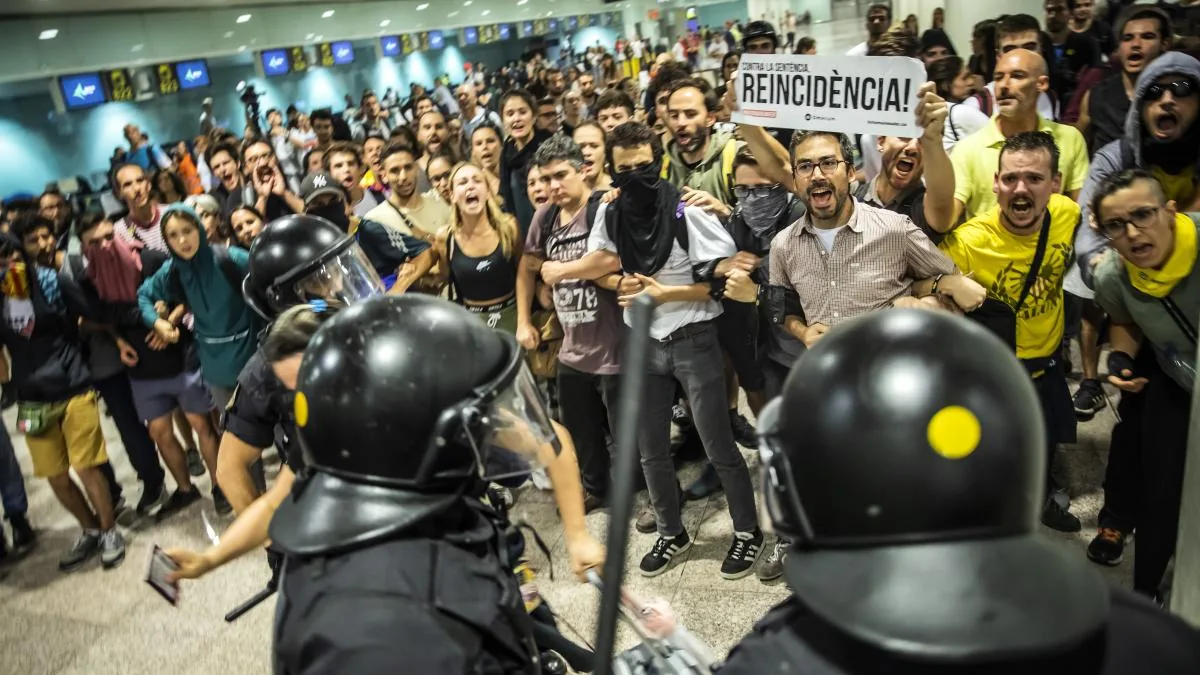
Within the first group are the 12 CDR accused of terrorism in the National Court. The court raised a preliminary question to the CJEU, considering that selectively pardoning terrorism offenses violated the European anti-terrorism directive. This Thursday, the European court ruled in favor of the investigated and deemed the application of the amnesty appropriate. Among the cases pending amnesty are numerous participants in protests and traffic blockades that followed the 1-O. One case is a road blockade that took place on November 8, 2017, between Abrera and Martorell, whose participants, despite requesting amnesty, have not yet received a response. In contrast, a court in Granollers pardoned, for example, 44 pro-independence activists who blocked traffic in October 2019 on the C-17 road, near l’Ametlla del Vallès, to protest against the procés sentence. The court agreed to dismiss the case before the trial was held.
Read more Tuchel takes all the criticism in England for the ‘blackout’ against Argentina
Also read
Alerta Solidària denounces that, while the application of the amnesty to the police has been practically automatic, the same has not happened with many prosecuted protesters and activists, who have been denied or had the measure suspended pending a response from the CJEU. A total of 158 police officers have benefited from the amnesty law. Most were national police and civil guards – 46 – who were investigated for their participation in charges against voters at several polling stations in Barcelona.
The accusations, representing the injured parties, opposed the application of the amnesty, considering that crimes against moral integrity, as well as torture or degrading treatment, excluded from the new law, could have been committed. However, the Barcelona Court concluded that “none of the facts exceeded the necessary threshold of severity to exclude the application of the amnesty.”
There is, however, one exception. Amnesty was denied to four officers investigated for having fired rubber bullets during the 1-O referendum against Roger Español, a protester who lost an eye due to the impact of one of those projectiles. In that case, the court argued that the crime of injury was excluded from the amnesty when it involved the loss of a principal organ.
Read more Services and consumption drive the Catalan economy against the weakness of the industry